The Blue-Ribbon Dwarf Conifer: Why Abies concolor ‘Compacta’ Belongs in Your Garden
The story of this remarkable dwarf conifer reaches back into the late nineteenth century. The German conifer specialist Ludwig Beissner first documented this slow-growing selection of the white fir in 1891, originally publishing it under the grand botanical moniker Abies concolor ‘Violacea Compacta’. The plant found a broader audience—and its literal passport to international popularity—when legendary plantsman Murray Hornibrook introduced it to the British nursery trade in 1923.
While strict botanical nomenclature technically favors Beissner’s original name, modern garden centers and international trade registries use ‘Compacta’ to prevent widespread confusion. You may still spot the historical name Abies concolor ‘Violacea Compacta’ tucked away in older gardening volumes or academic conifer databases, but ‘Compacta’ remains the gold standard for contemporary growers.
Architectural Form, Shifting Textures, and Year-Round Drama
Visual Textures and Shifting Hues
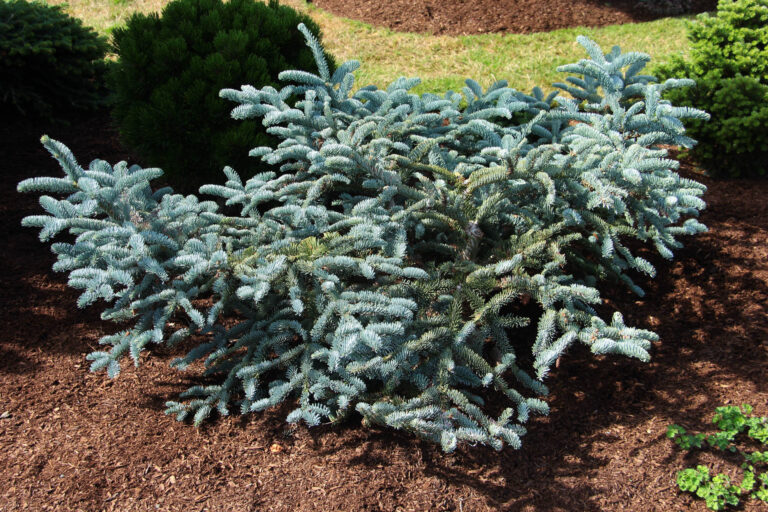
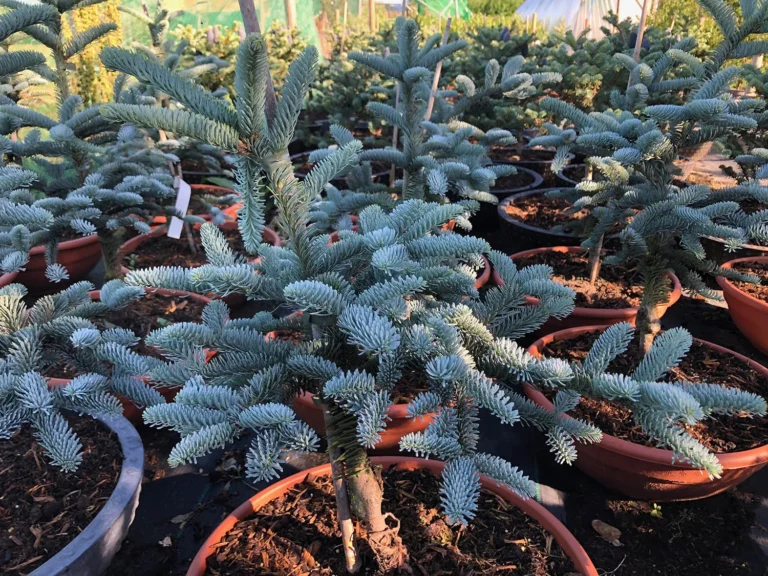
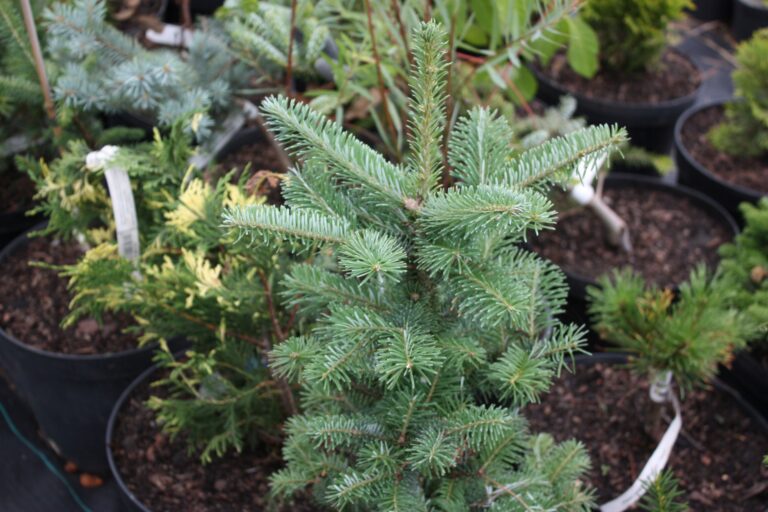
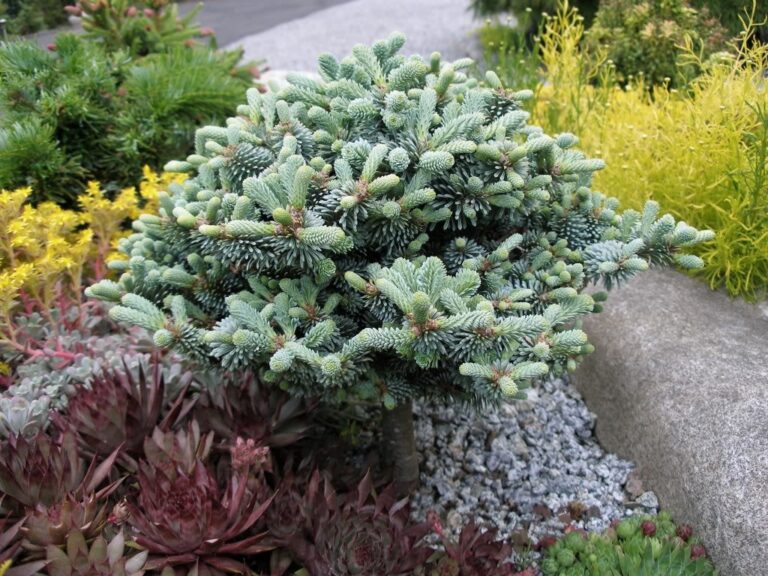
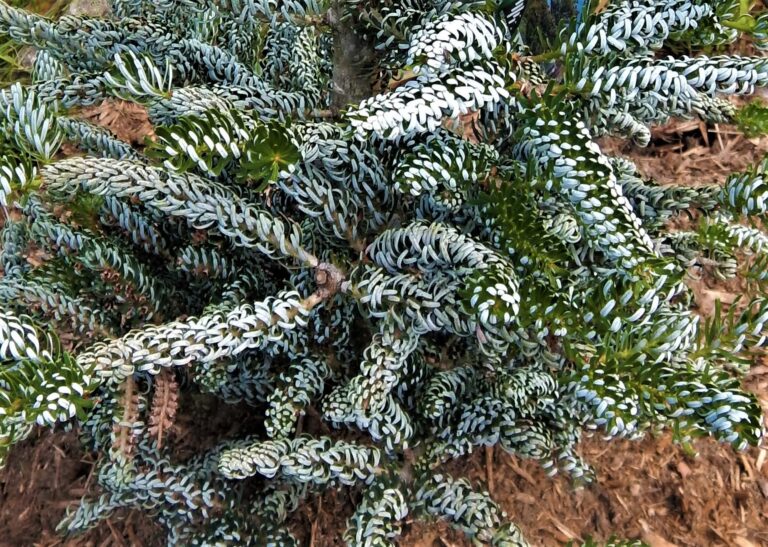
The primary allure of ‘Compacta’ lies in its exceptional, cool-toned foliage. The flat, slender needles curve gracefully like tiny sickles, stretching between 2 and 3 inches (5 to 7.5 cm) long. Their coloration is magnificent, shifting from a soft powder-blue to a deeper, metallic blue-grey or shimmering silvery-blue. Many conifer experts consider this selection to exhibit the finest blue tones across the entire Abies concolor spectrum.
Unlike stiff, prickly spruces or rigid pines, these needles feel remarkably soft to the touch. Gently crush a few needles between your fingers, and they release a delightful, crisp citrus-and-lemon scent. Because this frosty palette remains steadfast through blistering summer heat and dead-of-winter freezes, the plant provides crucial, reliable structure during the bleakest months of the year. This cool tone acts as a brilliant foil for dark evergreens, amber-hued ornamental grasses, or rich purple perennials.
Growth Habit and Scale
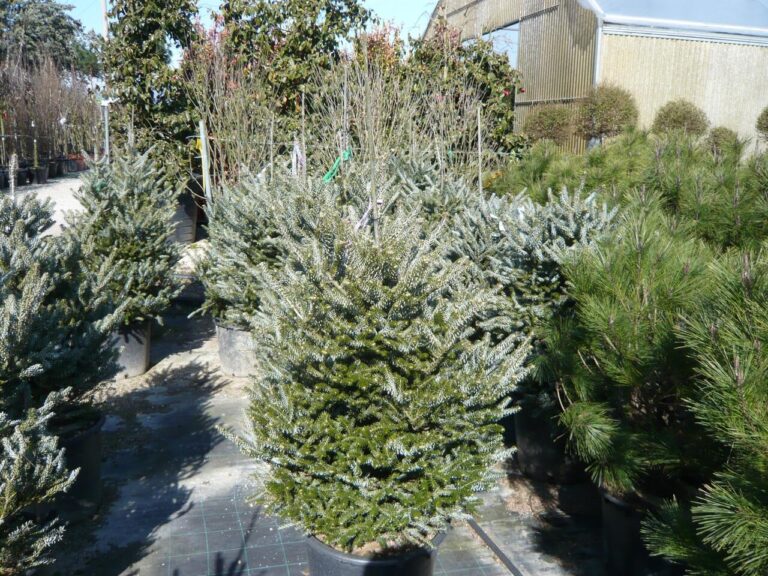
Left to its own devices, ‘Compacta’ develops into a dense, beautifully irregular mound with a distinctively layered, architectural branching pattern. It naturally grows into a sculptural, slightly asymmetrical specimen. However, gardeners seeking a tidier silhouette can easily shear the exterior lightly to coax the plant into a formal, rounded, or conical shape.
While local climates and soil types slightly influence its final dimensions, you can generally anticipate the following development:
Ultimate height settles around 1.5 to 2.5 meters (5 to 8 feet) over a span of ten to twenty years. The ultimate spread tracks similarly at 1.5 to 2.5 meters (5 to 8 feet), frequently stretching a bit wider than it is tall. This selection grows at a remarkably deliberate pace, putting on just 2 to 3.5 inches (5 to 9 cm) of new growth each year. In a typical garden setting, a ten-year-old specimen will measure roughly 3 feet (1 meter) tall by 2 feet (60 cm) wide.
In real-world landscapes, most plants comfortably settle into a permanent footprint of 3 to 6 feet (0.9 to 1.8 meters) in both directions. This makes it substantial enough to command attention as a focal point, yet disciplined enough to never overrun a small yard.
Cones and Mature Bark
True to its genus, ‘Compacta’ bears its cones perfectly upright upon its branches. These structures start life with a pale greenish tint before maturing into deep brown or purplish-brown cylinders measuring 3 to 6 inches (7.5 to 15 cm) long. Because these cones generally develop only on mature, well-established specimens after several decades, consider them a rare horticultural bonus rather than a daily feature.
The plant’s lower structure offers its own quiet beauty; young bark shows a smooth, clean ash-grey before slowly developing shallow, tactile furrows as the decades pass.
Designing with Compact White Fir
This dwarf conifer bridges the gap between rigid architectural structure and soft, fluid color. Its restrained scale makes it an incredibly versatile player in diverse landscape styles.
Signature Placement Options
- The Border Anchor: Position it as a standalone specimen in a prominent lawn or mixed border where its icy blue curves can be appreciated from every angle.
- The Rock Garden Jewel: Use it to provide reliable, year-round height and weight among delicate alpine selections and low-growing dwarf shrubs.
- The Patio Statement: Plant it as a long-term container specimen on terraces or near entryways, where its slow growth rate means you can go years between repotting.
- The Foundation Anchor: Tuck it near pathways, structural walls, or entry steps where you need year-round color without the risk of the plant swallowing the windows or blocking the path.
- The Tapestry Border: Integrate it into a mixed conifer bed to create a rich tapestry of contrasting textures and varied growth habits.
An added benefit for rural or suburban properties is that foraging deer rarely browse this fir, making it an invaluable asset for high-pressure wildlife zones.
Companion Planting and High-Contrast Color Palettes
To make the powder-blue foliage of ‘Compacta’ truly sing, consider pairing it with contrasting textures and complementary colors:
Juxtapose it against deep, rich green conifers—such as dwarf pines, dark yews, or emerald-toned junipers—to dramatically intensify its blue coloration.
Surround it with purple or blue-flowering perennials like woodland salvias, catmint (Nepeta), and stately ornamental alliums; the cool-toned needles serve as a unifying backdrop that anchors these vibrant blooms.
Blend it with warm-toned ornamental grasses or sedges featuring copper, bronze, or bright gold foliage to create a striking, sophisticated color contrast.
Intermingle it with silver-leaved companions like lamb’s ear (Stachys byzantina) or dusty artemisias to craft a serene, monochromatic “cool palette” garden.
Group it with bold, architectural perennials like Phormium to echo its structural presence in small-scale courtyard spaces.
The Ultimate Solution for Urban Courtyards and Containers
If you are dealing with a compact city garden, a gravel courtyard, an alpine rockery, or a paved patio, ‘Compacta’ is an exceptional choice. Its minimal annual growth increment ensures it won’t quickly crowd out neighboring plants or outgrow its container.
Furthermore, its irregular, layered branching pattern provides immediate visual complexity as a solitary specimen, meaning you don’t need a massive collection of plants to create a sophisticated look. In containers, it delivers invaluable structure through the dead of winter when the rest of the garden has gone dormant. For tightly confined sites, expect a realistic long-term size of roughly 1 to 2 meters (3 to 6 feet) in both height and spread, depending entirely on your local climate and potting setup.
Environmental Preferences and Site Selection
The wild Abies concolor hails from the rugged, high-altitude mountain ranges of the western United States and northern Mexico, environments defined by crisp, cool summers and snowy, cold winters. ‘Compacta’ inherits this robust constitution, performing beautifully in regions that mirror these alpine conditions, while struggling slightly in areas with oppressive, humid summer nights.
The plant is reliably hardy across USDA zones 4 through 8, with some growers reporting success in zone 4a. In the United Kingdom, it holds a top RHS hardiness rating of H7, proving it can tolerate the bitterest winter freezes.
It thrives best in full sun to partial shade, though in blisteringly hot southern zones, a spot with dappled afternoon shade helps protect the needles from scorching. Give it a sheltered position shielded from raw, drying winter winds to prevent needle burn.
When it comes to soil, ‘Compacta’ demands exceptional drainage; it prefers moist, moderately fertile, acid-to-neutral soils. It adapts well to sandy and loamy textures but will quickly fail in heavy, waterlogged clay or chronically soggy ground.
For detailed, step-by-step instructions on proper planting depth, soil amendments, precise irrigation schedules, seasonal feeding, and pruning techniques, please consult the standalone Master Growing Guide for Abies concolor rather than relying on generic conifer instructions.
Health, Longevity, and Maintenance Profile
Once established in the correct spot, ‘Compacta’ is remarkably self-sufficient and rarely requires intervention.
While it can occasionally host standard conifer aphids, severe infestations are quite rare on properly sited, unstressed plants. The cultivar is generally disease-free, though like most true firs, it can fall prey to honey fungus (Armillaria) if forced to sit in compacted, poorly drained, or heavily waterlogged soils.
Because it is highly deer-resistant, you can plant it confidently in open or wooded borders without the need for protective netting or chemical repellents. You never need to prune this plant routinely; any shaping is entirely optional and should be done with a light hand to preserve its naturally sculptural form.
A Proven Horticultural Classic
This cultivar’s exceptional garden value is backed by decades of expert consensus:
The Royal Horticultural Society honored it with the prestigious Award of Garden Merit (AGM), a distinction reserved exclusively for plants with outstanding track records of performance, resilience, and decorative excellence.
Conifer connoisseurs consistently rank it as an unmatched classic, noting that its intense, powder-blue needle color has never been surpassed by newer, modern Abies concolor introductions. Fully published and recorded in historic conifer registries, its pedigree stretches back well over a century, cementing its status as an elite standalone selection within the white fir family.
Quick Comparison: Dwarf Selection vs. The Forest Giant
| Feature | Abies concolor (The Species) | Abies concolor ‘Compacta’ |
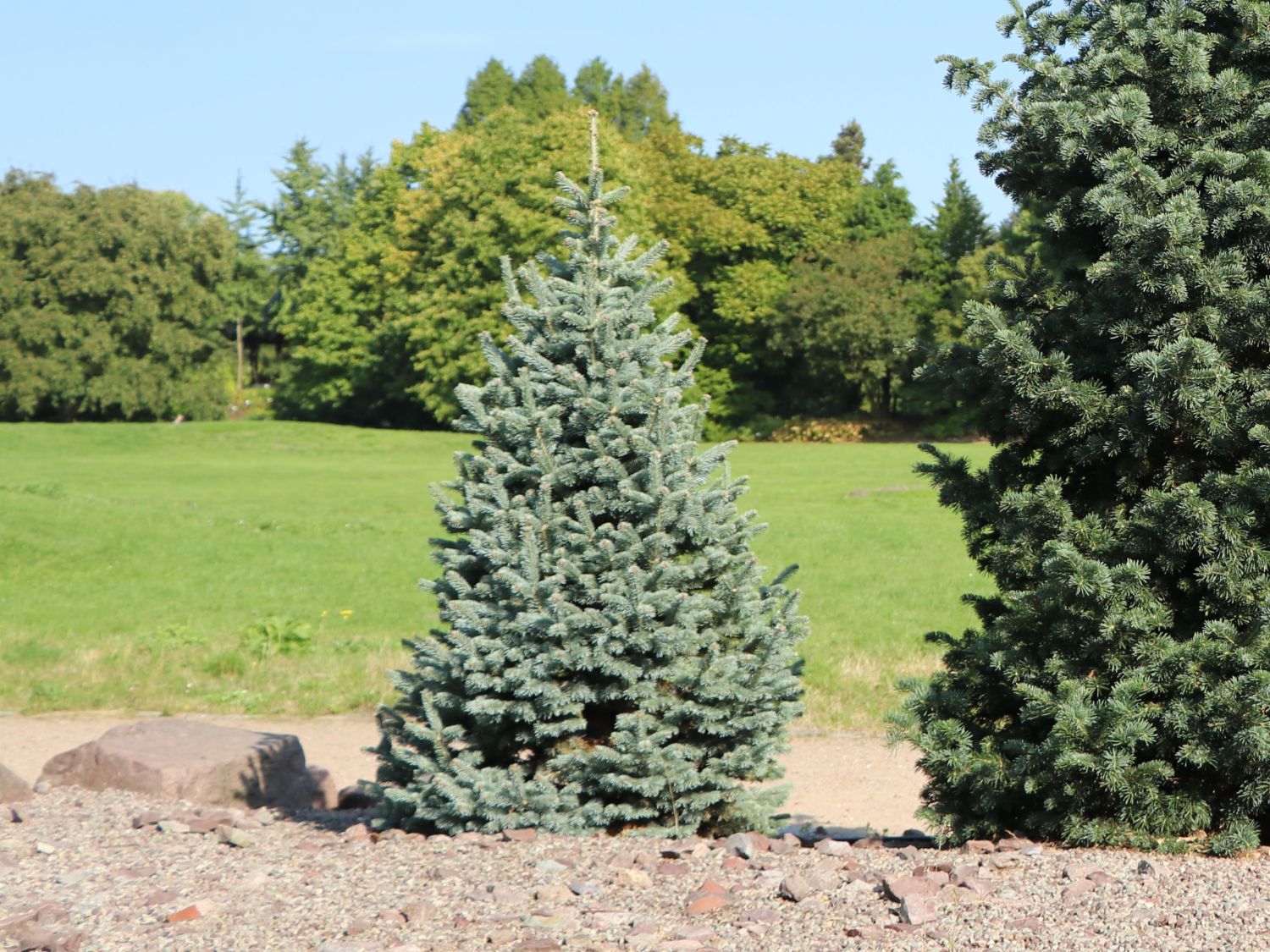
| Growth Habit | Tall, perfectly pyramidal forest tree | Dense, irregular mound; dwarf shrub |
| Mature Height | 30–70 feet (9–21 meters) in gardens | Approx. 5–8 feet (1.5–2.5 meters) over 10–20 years |
| Growth Rate | Slow to moderate for a massive timber tree | Very slow; just 2–3.5 inches (5–9 cm) per year |
| Foliage Color | Standard blue-green to glaucous green | Intense powder-blue to striking silver-blue |
| Garden Role | Large specimen tree, windbreak, woodland planting | Rock gardens, patio containers, small borders |
| Small-Space Utility | Poor; quickly overwhelms residential yards | Excellent; highly disciplined and slow-growing |
| RHS Award Status | No standard species award | Proud holder of the Award of Garden Merit (AGM) |
Mapping the Compact White Fir into Your Landscape
To get the absolute most out of ‘Compacta’ in your planting plans, treat it as a structural anchor in gravel beds or small borders, allowing its distinct form to define the surrounding space. Always position its icy blue-grey mass against a dark backdrop—such as a deep green yew hedge, a dark painted fence, or dark-leaved shrubs—to make the color pop.
Keep companion perennials low and mounding so they frame the fir rather than competing with its sculptural silhouette. If you are building a container arrangement, soften its base with trailing companions like creeping thyme or small, arching ornamental grasses to highlight its upright texture.
For foundational planting details—including exact planting depth, soil prep, watering regimes, and seasonal fertilizer applications—refer directly to the Master Growing Guide for Abies concolor, which outlines the core requirements for this species.