Horstmann’s Silberlocke: The Shimmering, Curl-Leaved Korean Fir Every Small Garden Needs
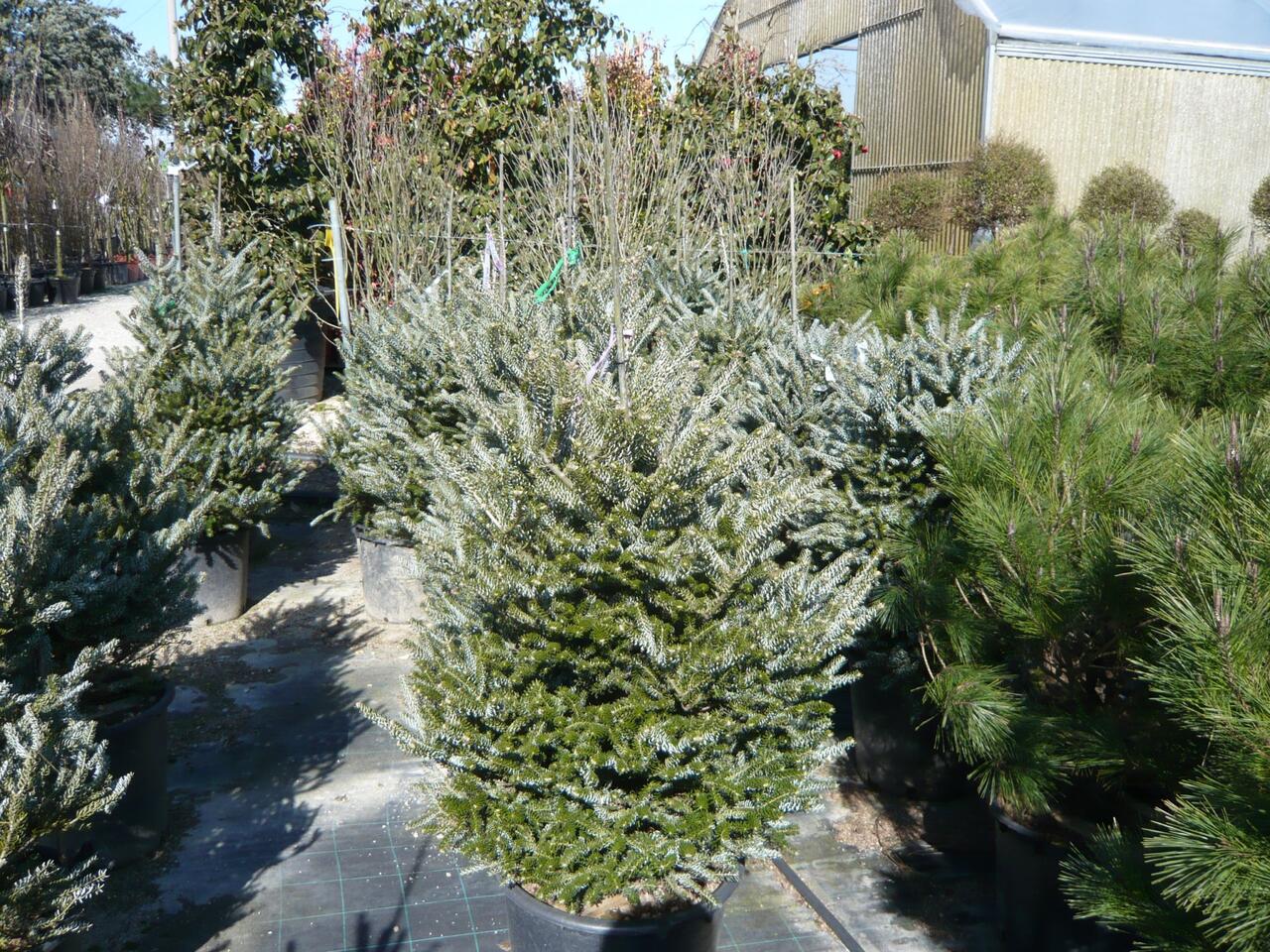
Few conifers command attention quite like Abies koreana ‘Silberlocke’. Also widely known across the nursery trade as ‘Horstmann’s Silberlocke’, this slow-growing, compact evergreen is a masterclass in texture. Its magic lies in its strongly recurved needles, which twist tightly upward to expose their brilliant, silvery-white undersides. The result is a striking, frosted optical illusion that glints even on youngest specimens.
To double down on its ornamental value, this exceptional Korean fir selection produces a heavy crop of upright, jewel-toned purple cones at a remarkably early age, injecting vivid colour against a silver-dusted canopy. With mature dimensions that remain modest—typically reaching just 2.5 to 4 metres tall with a 1 to 1.5-metre spread over 10 to 20 years under UK conditions—it acts as a pristine architectural focal point, rock garden anchor, or small-space structural wonder.
Cultivar Identity and Nomenclature
‘Silberlocke’ vs. ‘Horstmann’s Silberlocke’
Navigating plant labels can be notoriously confusing, but in this case, ‘Silberlocke’ and ‘Horstmann’s Silberlocke’ are one and the same. The Royal Horticultural Society (RHS) officially categorises Abies koreana ‘Horstmann’s Silberlocke’ as a synonym of A. koreana ‘Silberlocke’, alongside the highly descriptive common trade name ‘Silver Curls’.
The cultivar owes its existence to the sharp eye of German nurseryman Günter Horstmann, who selected and introduced it between the late 1970s and mid-1980s (horticultural records point to either 1979 or 1986). Over the decades, some commercial growers dropped the finder’s prefix for brevity, creating a split identity on retail benches. When designing or sourcing for a project, treat them as the exact same botanical entity: a premier selected form of Korean fir celebrated for its tightly curled, silver-revealing needles and precocious purple cone display.
Visual Traits and Design Value
Foliage: The “Silver Curls” Effect
The undeniable signature of ‘Silberlocke’ is the dramatic, upward-curling habit of its short, broad needles. This structural twist turns the bright, silvery-white stomatal bands—which normally hide on the undersides of the foliage—directly outward toward the viewer.
This creates a spectacular two-tone canopy. The dark green upper surfaces are largely obscured, allowing the luminous silver undersides to dominate the tree’s silhouette. The entire specimen takes on a brilliant, frosted quality that positively glows in bright sunlight and low winter light. Because this morphological trait is far more pronounced here than in other Korean fir selections, ‘Silberlocke’ stands as one of the most reliably and intensely “silver” cultivars available to gardeners today.
Cones: Early, Upright, and Violet-Purple
While most fir trees force you to wait decades for their reproductive displays, ‘Silberlocke’ is delightfully precocious. Even quite young, immature specimens produce an abundant crop of upright, barrel-shaped cones cloaked in rich shades of violet-blue and deep purple.
Perched vertically like holiday candles along the upper branches, these cones deliver a breathtaking contrast against the silver-dusted foliage from spring through early summer. They offer fantastic forage for local wildlife, or they can be harvested and dried for seasonal indoor decorations.
Habit and Scale
Structurally, ‘Silberlocke’ develops a dense, bushy, and broadly pyramidal form. Its perky, upward-reaching branches maintain a highly sculptural, architectural silhouette without any intervention.
In typical garden settings, expect a slow and manageable growth rate of roughly 10 to 15 centimetres (4 to 6 inches) per year. This translates to a landscape footprint of about 2.5 to 4 metres (8 to 13 feet) in height and 1 to 1.5 metres (3 to 5 feet) in width over a 10 to 20-year horizon. It is worth noting that some North American reference guides suggest an ultimate height of 6 to 9 metres (20 to 30 feet) when given ideal, consistently cool climates over many decades. However, its slow pace and compact youth make it a high-impact specimen that delivers maximum drama without swallowing up smaller suburban gardens.
Landscape Positioning and Design Combinations
Siting for Maximum Glow
Because the tree’s brilliant silver coloration relies entirely on how the needles catch the light, ‘Silberlocke’ demands thoughtful placement. It performs beautifully in full sun to partial shade, though a sheltered aspect is highly recommended to protect its tight form and prevent intense midday sun from scorching the exposed needle undersides.
Its restrained scale and dramatic geometry make it a perfect candidate for rock gardens, low-maintenance gravel beds, tight urban courtyards, and large patio containers. Position it along highly visible axes or near pathways where its intricate, curled needles can be appreciated up close.
Colour and Texture Pairings
The frosted, neutral tone of the foliage acts as a natural spotlight in the garden, effortlessly elevating both cool and warm design palettes. Consider these highly effective combinations:
- The Silver and White Theme: Underplant the fir with textural partners like Artemisia ‘Powis Castle’, Nepeta ‘Walker’s Low’, or the striking blue-gray blades of blue oat grass (Helictotrichon sempervirens) to fashion a luminous, drought-tolerant vignette.
- Soft Pinks and Creams: Offset the cool silver by pairing it with delicate pink shrub roses (such as ‘The Ancient Mariner’) or the massive, creamy flower heads of an oakleaf hydrangea like ‘Snow Queen’. The fir provides a steady, structural anchor for these romantic, shifting summer blooms.
- Cool Blue Accents: Weave in drifts of English lavender, blue fescue grass, or dwarf blue spruces to curate a deeply serene, cold-toned tapestry rich in contrasting textures.
- Woody Structural Companions: Contrast the fine, needle-like texture of ‘Silberlocke’ by pairing it with the deeply cut, cascading foliage of a weeping Japanese maple and the bold, shifting leaves of a dwarf oakleaf hydrangea.
This year-round dependability—silver needles through the dark of winter coupled with rich purple spring cones—renders it an invaluable tool for designers chasing multi-season interest.
Origins and Horticultural Recognition
This stellar cultivar hails from Germany, where it was meticulously selected and introduced by the legendary plantsman Günter Horstmann of Schneverdingen. Since entering the commercial trade between the late 1970s and 1980s, it has stood the test of time. The tree has been officially awarded the prestigious Royal Horticultural Society Award of Garden Merit (AGM), a distinction that underscores its outstanding reliability, exceptional ornamental qualities, and superb performance under real garden conditions.
Cultivation Notes
For fundamental planting mechanics—including ideal planting depth, soil prep, watering schedules, mulch application, and standard pest or disease protocols—please consult our site’s comprehensive Master Growing Guide for Conifers / Evergreens.
To summarize the essentials, ‘Silberlocke’ thrives best in consistently moist but sharply well-drained soils that lean slightly acidic to neutral. It handles a wide range of soil textures, performing admirably across clay, loam, and sand as long as standing water is avoided. It boasts an exceptional RHS H7 hardiness rating, meaning it can withstand severe winter freezes down into USDA Zones 4 through 7. This is a remarkably low-maintenance specimen that requires absolutely no pruning to keep its shape. Simply plant it in a sheltered spot to safeguard its pristine foliage and compact architecture, and let it shine.
Quick Reference Profile
- Botanical name: Abies koreana ‘Silberlocke’ (synonyms: ‘Horstmann’s Silberlocke’, ‘Silver Curls’) [1]
- Foliage: Aromatic, evergreen, dark green needles sharply recurved upward to showcase brilliant silvery-white undersides [1]
- Cones: Striking, upright, violet-purple barrel-shaped cones produced freely on young specimens during spring and summer [1]
- Habit: Compact, densely bushy, and broadly pyramidal with a highly architectural silhouette [1]
- Size (10–20 years): Typically 2.5–4 metres tall by 1–1.5 metres wide in UK conditions; can grow larger over decades in cool climates [1]
- Growth rate: Intentionally slow, averaging roughly 10–15 centimetres (4–6 inches) per year [1]
- Hardiness: Rated RHS H7 for extreme cold tolerance; roughly equates to USDA Zones 4–7 [1]
- Positioning: Prefers full sun exposure situated within a sheltered aspect [1]
- Soil preferences: Appreciates moist but well-drained, acidic to neutral substrates; highly adaptable to clay, loam, or sand [1]
- Maintenance needs: Virtually zero pruning required; structurally self-sustaining and generally disease-free, though growers should monitor for adelgids or aphids in susceptible regions [1]
- Design value: Offers a dramatic silver focal point; excels in gravel, rock, courtyard, and architectural beds; provides stellar four-season structure [1]