The Prostrate Blue Noble Fir: A Sculptural Maverick for the Modern Garden
Botanical Identity and History
- Botanical name: Abies procera (Glauca Group) ‘Glauca Prostrata’
- Common name: Prostrate blue noble fir; Glauca Prostrata noble fir
- Family: Pinaceae
- Foliage: Evergreen
- Habit: Low, spreading, prostrate to broadly mounding
- Hardiness: Approximately USDA Zone 5 and RHS H7, subject to local climate and exposure
- Exposure: Sun is generally preferred
- Award status: Listed by the Royal Horticultural Society as an AGM cultivar
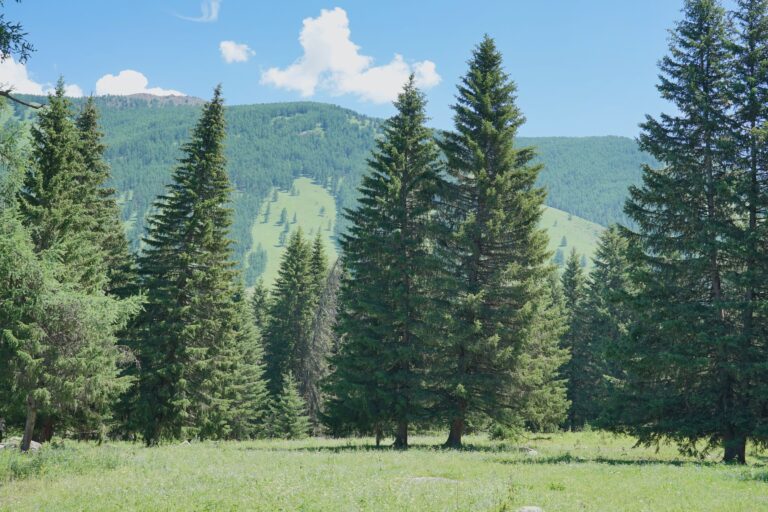
To appreciate this plant, you have to look to its roots. The straight species, Abies procera, is a giant of the Pacific Northwest, dominating the Cascade and Pacific Coast ranges with its symmetrical, upswept branches and lofty crown. ‘Glauca Prostrata’ completely breaks away from that towering heritage.
Horticultural records suggest this prostrate oddity originally propagated from a side branch mutation of the upright, blue-needled cultivar ‘Glauca’. Oregon State University notes this branch-sport origin, which beautifully explains both the plant’s horizontal wandering habit and its occasional, mid-life urge to throw up a vertical leader. The clone is deeply intertwined with late nineteenth-century British nursery culture, where keen plantsmen selected and stabilized these fascinating anomalies.
Understanding this genetic backstory is vital for anyone growing it. ‘Glauca Prostrata’ isn’t a dwarf tree pre-programmed to stay perfectly uniform; it is a spreading branch system given its own roots, meaning individual specimens possess a distinct personality and an occasional desire to revert to its ancestral, upright form.
Distinctive Appearance
Steel-Blue Evergreen Foliage
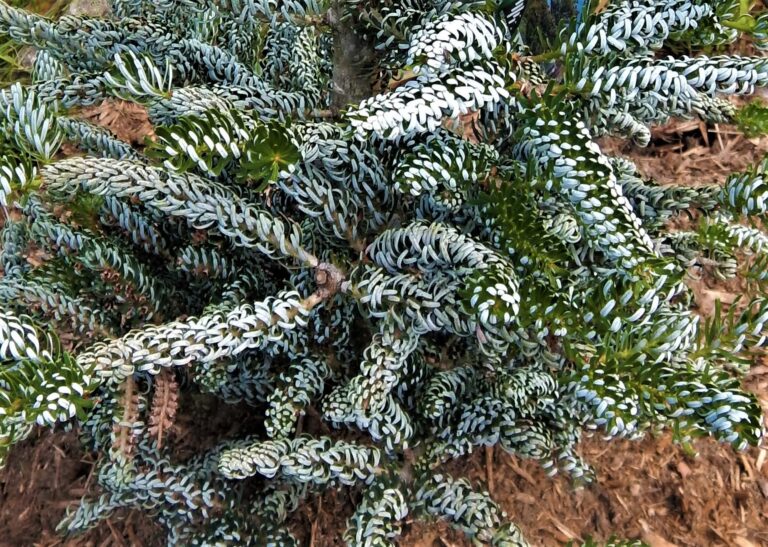
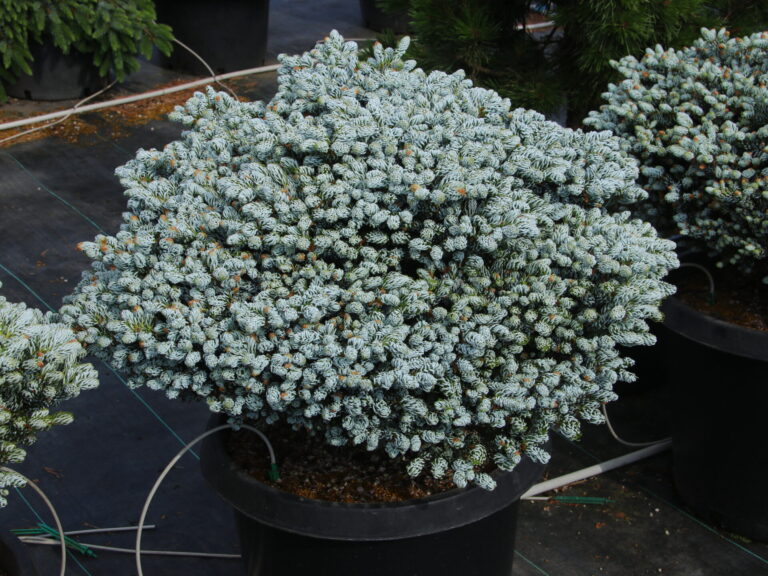
The defining glory of this cultivar is its cool, steel-blue to blue-grey foliage. Far from a fleeting spring flush, this luminous coloration holds its ground through every season, shifting slightly in intensity depending on the quality of light, weather patterns, and the emergence of fresh spring growth.
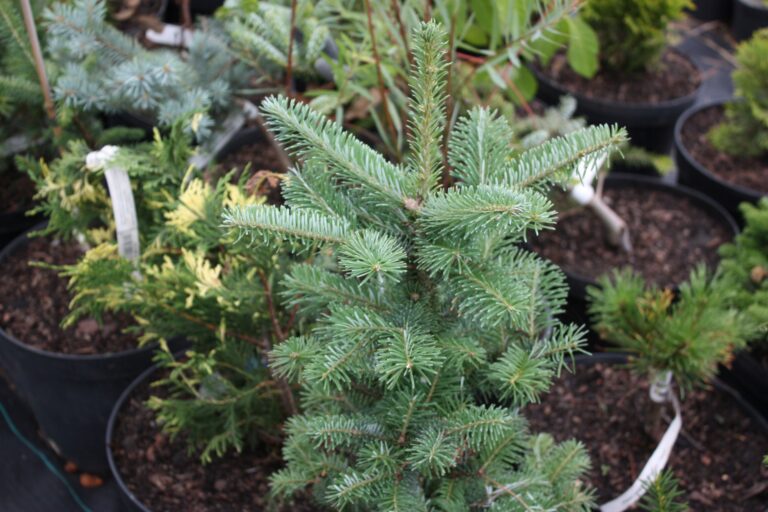
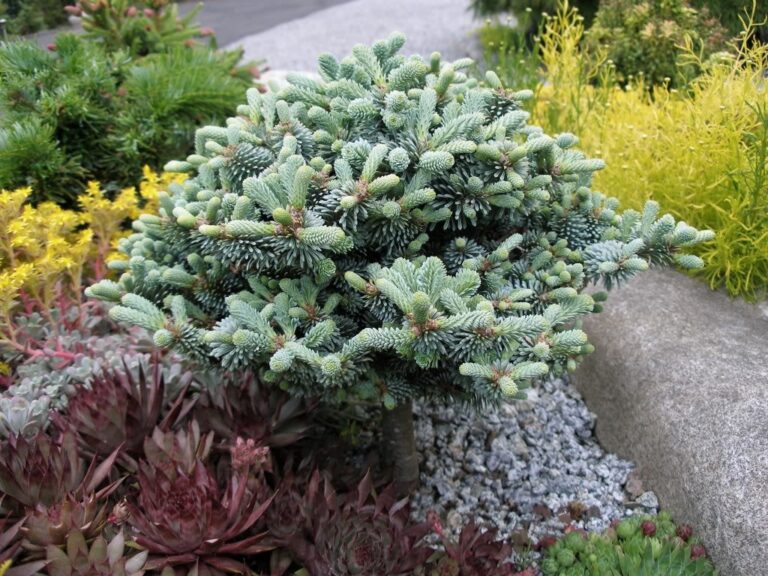
Look closely at the branches, and you will see short, narrow, distinctly upswept needles that crowd the stems in a dense arrangement reminiscent of a fine-toothed brush. From afar, it reads as a seamless, shimmering plate of silver-blue. Up close, the signature glaucous bands and curved attachments characteristic of true firs become clear.
Texture is where this Abies triumphs over blue spruces. While many silver conifers feel stiff and punishingly sharp to the touch, the noble fir offers a softer, touchable elegance, layering its branches in visually rich, velvet tiers. This icy hue pops dramatically when set against dark broadleaf evergreens, weathered barn wood, charcoal stone, or deep green backdrops.
A Flat-Topped, Spreading Outline
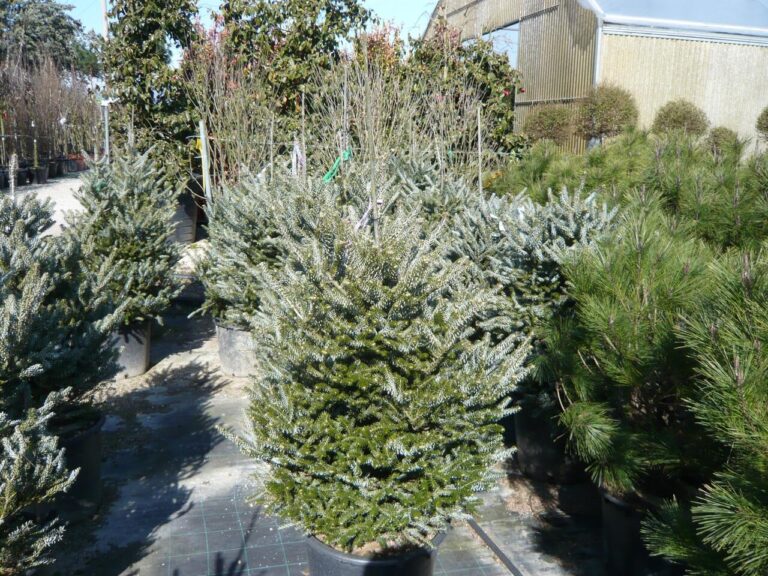
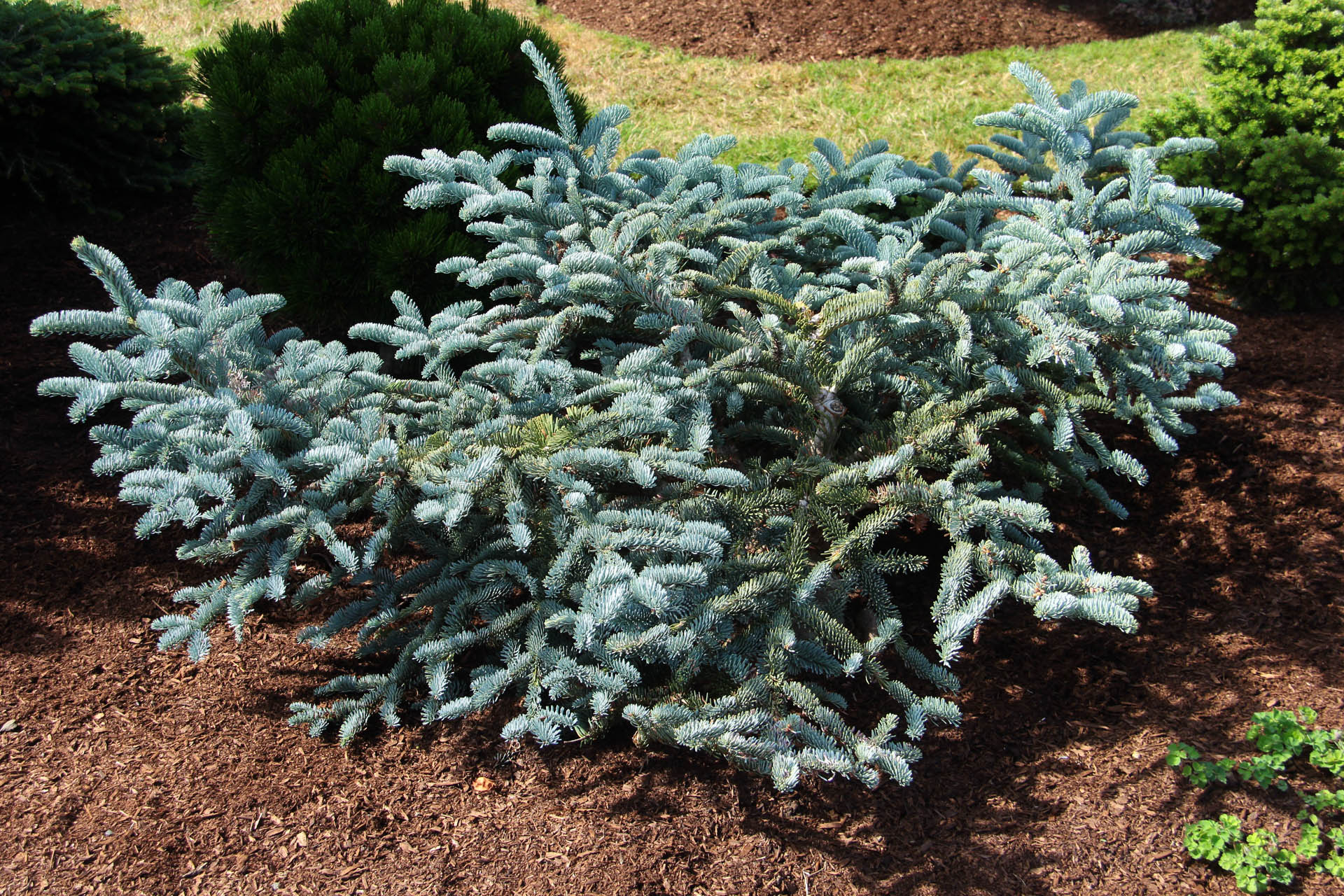
In its youth, ‘Glauca Prostrata’ often looks like an irregular, low cushion or a dense mound. With maturity, however, its true horizontal architecture takes over. The branches stretch outward from the core, creating a tiered, flat-topped silhouette that redefines the ground plane of a garden bed.
A realistic expectation for a mature specimen is a height of 0.5–1 m paired with a generous spread of 1.5–2.5 m. Some plants remain tighter, holding at 60 cm tall and 1.2–1.8 m wide, while ancient specimens in ideal conditions can wander even further. This variation underscores the plant’s unique nature, influenced heavily by individual grafting lineage, local climate, and how the gardener manages vertical shoots.
Keep these design dimensions in mind:
- Typical height: about 0.5–1 m
- Typical spread: about 1.5–2.5 m
- Growth rate: slow to slow-moderate
- Ten-year size: often approximately 0.5–0.8 m high and 1.2–1.8 m wide, though plants vary
Do not plant this expecting a rapid, carpet-forming ground cover to suppress weeds in a single season. Its brilliance lies in its deliberate, measured pace, gradually anchoring a space with its substantial evergreen weight.
Seasonal Details
While the blue-green canvas remains steady from January to December, spring brings a brighter, electric silver-blue flush of new growth before the needles mature.
On well-established specimens, you may also be treated to the striking reproductive displays of the noble fir lineage:
- Male pollen cones decorate the branch tips in shades of red, purple-red, or rich pink.
- Female seed cones sit proudly upright along the horizontal stems, refusing to dangle like spruce cones.
- These young cones often emerge in intense shades of blue-purple before ripening into a warm, structural brown.
Because the plant hugs the ground, these upright cones appear prominently above the foliage, acting as stark, architectural exclamation points against the icy blue mat.
Landscape Design Value
A Coniferous Ground-Cover Form
‘Glauca Prostrata’ fills a unique niche for designers who crave the refinement and color of a noble fir but lack the acreage for a forest giant. It serves beautifully as a structural ground-cover element, but it demands more respect than a common, fast-filling juniper.
To maximize its visual impact, give its wide footprint room to breathe. Cramming it into a dense border of aggressive shrubs suffocates its elegant branching habit. Instead, let it spill casually over a gravel path, a stone retaining wall, or the edge of a raised bed where its tiered form can be appreciated in profile.
Consider positioning it in these prime locations:
- Perched on the upper shoulder of a large rock garden.
- Atop a raised stone bed where branches can drape toward the viewer.
- Integrated into a conifer border to anchor upright and columnar selections.
- As a focal point in Japanese-inspired gardens alongside raked gravel, moss, and stone.
- Centered in a substantial, low trough as a permanent structural anchor.
- Positioned in the prominent middle ground of a specialized conifer collection.
- Sweeping across a sunny slope where its horizontal lines contrast with the gradient.
Contrast with Upright Conifers
This cultivar truly shines when paired with plants that offer a direct vertical counterpoint. Its strong horizontal lines make narrow companion plants look taller and crisper, while those upright neighbors keep the overall garden composition from feeling flat.
Try experimenting with these compelling combinations:
- A slender, golden-foliaged conifer rising directly behind the blue horizontal tiers.
- A deep green, column-shaped yew or upright juniper to create a sharp color contrast.
- A compact, pyramidal spruce or dwarf fir to create a clever generic echo while contrasting form.
- Dark burgundy or purple-leaved shrubs to establish a rich, warm-versus-cool color dynamic.
- Silver-leaved perennials and fine-textured grasses for a sophisticated, monochromatic look.
- Pale granite boulders or dark basalt gravel to intensify the glaucous tones of the needles.
The most unforgettable pairings rely on contrasting at least two of the plant’s core features: its chilling blue color, its horizontal sprawl, its brushed texture, or its year-round permanence.
Use in Containers
Planting ‘Glauca Prostrata’ in a premium container lifts its intricate architecture closer to eye level, allowing for an intimate appreciation of its blue needles and layered branching. Opt for a wide, stable vessel rather than a tall, narrow one; the goal is to visually anchor a broad, low-growing treasure.
Within a large planter, surround it with understated companions:
- Fine-textured, airy sedges or grasses.
- Low, tactile cushions of moss or creeping thyme.
- Smooth river stones and diminutive alpine plants.
- Delicate spring bulbs that pop through the gaps without overshadowing the conifer.
Because this is a long-lived, slow-growing woody plant, view container planting as a permanent, specialized showcase rather than a quick seasonal swap. Always factor in the plant’s ultimate width when selecting its home.
Growth Habit and Form Management
The wild card when growing ‘Glauca Prostrata’ is its lifelong potential to produce strong, vertical shoots. This behavior harks directly back to its side-branch origins and explains why no two mature specimens look exactly alike.
If your design relies on a flat, ground-hugging profile, prune out these assertive vertical leaders as soon as they appear. Snapping or clipping them out early keeps the framework clean and prevents a thick, dominant trunk from permanently altering the plant’s architecture. On the other hand, if you prefer a quirky, hand-sculpted look, you can leave a well-placed vertical leader to develop, creating a fascinating, multi-tiered silhouette.
This gives the gardener two distinct design pathways:
- The Strictly Prostrate Look: Diligently remove vertical growth to maintain a low, sprawling, table-like mat.
- The Informal Architectural Look: Selectively retain an ascending branch to foster a stepped, irregular, Bonsai-like specimen.
Beyond managing these rogue leaders, the plant requires no routine shearing. Avoid the urge to clip it into a tight, geometric blob; let the natural, layered horizontal framework speak for itself.
Cultivation Boundaries
Cultivation note: For baseline guidance on site selection, soil preparation, planting, watering, feeding, and general conifer care, refer to the Master Growing Guide for Abies and cultivated firs. This profile focuses on the cultivar’s identity, appearance, history, design value, and distinctive management considerations.
‘Glauca Prostrata’ demands a bright, open spot to develop its most intense silver-blue coloration and to keep its growth tight and dense. However, because noble firs are native to cool, alpine regions, gardeners in areas with scorching, humid summers should position this cultivar where it receives light relief from punishing afternoon heat.
Give its future width plenty of respect. A cute 30-centimeter specimen in a nursery pot will eventually claim a significant piece of garden real estate, and those gorgeous side branches should never be drowned out by neighboring perennials.
Like most high-quality firs, it requires excellent air drainage and roots that never sit in stagnant, waterlogged soil. While generally trouble-free when its cultural needs are met, it can be susceptible to honey fungus if planted in contaminated ground.
How it Differs from the Species
| Feature | Abies procera Species | ‘Glauca Prostrata’ |
| Overall habit | Large, upright, broadly conical tree | Low, spreading, prostrate to mounding |
| Eventual scale | Commonly a major landscape tree | Usually under 1 m high and 1.5–2.5 m wide |
| Foliage colour | Blue-green to glaucous green | More distinctly blue-grey or steel blue |
| Landscape role | Specimen tree, woodland or large-space conifer | Ground-cover accent, rock-garden specimen, container or border plant |
| Branch architecture | Layered, ascending tree branches | Mostly horizontal, dense, somewhat flat-topped branches |
| Design effect | Height, permanence and formal conifer structure | Width, colour, texture and low evergreen movement |
| Potential issue | Normal tree growth | Occasional upright leaders that may alter the prostrate outline |
The contrast between the two is astonishing. The parent species stands as one of the most gargantuan trees in western forests, while this selected cultivar spends its life tracing the contours of the earth. ‘Glauca Prostrata’ doesn’t just offer a blue alternative; it completely reinvents how the noble fir functions in a garden design.
Identification Checklist
When hunting for an authentic specimen at a specialist nursery, look for this specific combination of traits:
- A distinctly horizontal, sprawling structure rather than a self-forming central leader.
- Densely packed needles displaying a rich, powdery steel-blue or silver-grey cast.
- Slightly upswept foliage that gives the branch tips a brushed, clean appearance.
- A slow, deliberate growth rate that favors width over height.
- The telltale presence of occasional vertical shoots emerging from an otherwise prostrate frame.
- Small, reddish male pollen cones or upright, purple-tinted seed cones on older, settled plants.
Keep an eye out for synonyms in nursery catalogs; it occasionally travels under Abies procera ‘Prostrata’ or simply “Abies procera ‘Glauca’ prostrate form.” Check with the grower to ensure you are getting the true, non-vertical cloning lineage rather than a standard upright tree that was merely grafted poorly.
Final Assessment
Abies procera ‘Glauca Prostrata’ is a connoisseur’s conifer, treasured not for rapid, thoughtless ground coverage, but for its rare blend of noble fir texture, horizontal growth, and winter-defying steel-blue color. It finds its ultimate purpose as a deliberate design punctuation mark—a icy blue ribbon that draws the eye across gravel gardens, over stone walls, or along the lower tier of a mixed evergreen border.
Plant it where it has room to expand, bathed in the crisp light it loves. If it throws up an occasional vertical leader, view it as a creative choice rather than a chore: snip it away to preserve a flawless prostrate rug, or run with it to cultivate a custom, multi-level living sculpture. Ultimately, this cultivar beautifully reimagines the majestic noble fir, compressing its rugged alpine spirit into an elegant, low-growing masterpiece.