Silver Show Korean Fir: The Luminous, Tight-Curled Masterpiece for Compact Gardens
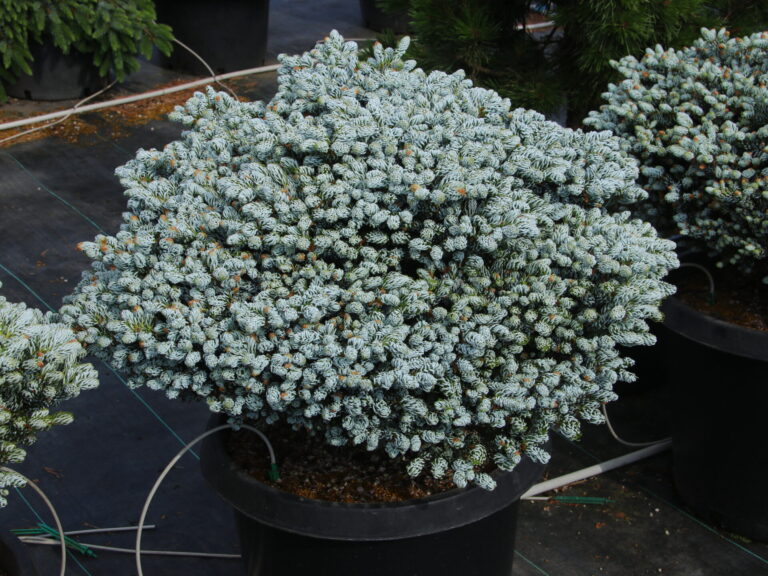
Abies koreana ‘Silver Show’ completely upends the traditional expectation of a dark, somber conifer. Selected specifically for its exceptionally vivid display of shimmering silver-white needle undersides, this slow-growing Korean fir delivers an electric, high-contrast presence in the landscape. While it shares a ancestral lineage with the widely celebrated ‘Horstmann’s Silberlocke’, ‘Silver Show’ behaves with far greater structural restraint. It features shorter, more tightly coiled needles that hug the stems closely, generating a brighter, noticeably more refined surface texture. To double its seasonal impact, the tree produces a striking crop of upright, purple to violet-blue cones that frequently emerge when the specimen is still remarkably young.
Cultivation note: For foundational advice regarding planting, ideal soil profiles, watering regimens, hardiness zones, and routine maintenance, please consult the Master Growing Guide for Abies and Korean firs. This specific profile focuses directly on the cultivar’s unique botanical identity, ornamental characteristics, historical background, and strategic landscape value.
Unveiling Cultivar Identity and German Heritage
This exceptional evergreen represents an established, highly coveted cultivar of the Korean fir (Abies koreana), a distinguished member of the pine family, Pinaceae. ‘Silver Show’ originated as a deliberate seedling selection at the Kurt Wittbold-Müsller nursery located in Verden, Germany. It was selected in 1969 directly from ‘Silberlocke’ parent material.
This precise genetic origin explains why the plant mirrors the charm of ‘Horstmann’s Silberlocke’ while simultaneously pushing the boundaries of foliage refinement. Both cultivars display an eccentric, recurved needle habit that flashes a pale underside to the viewer. However, ‘Silver Show’ distinguishes itself through a slower rate of annual growth and a significantly tighter, more dramatic needle curvature. Rather than developing into a carbon copy of its parent on a smaller frame, ‘Silver Show’ packs its foliage tighter, concentrating the high-contrast visual punch across every single branchlet.
The name serves as a perfect literal description. Instead of settling for a uniform, static dome of grey or blue, ‘Silver Show’ creates brilliant, undulating bands of silver-white as the needles twist dramatically around the moving shoots. From across the garden, the specimen reads as a vibrant, silvery blue-green beacon. Up close, the tightly curled foliage reveals a complex, multi-layered, almost frosted texture that commands attention.
Choreographing the Foliage Effect
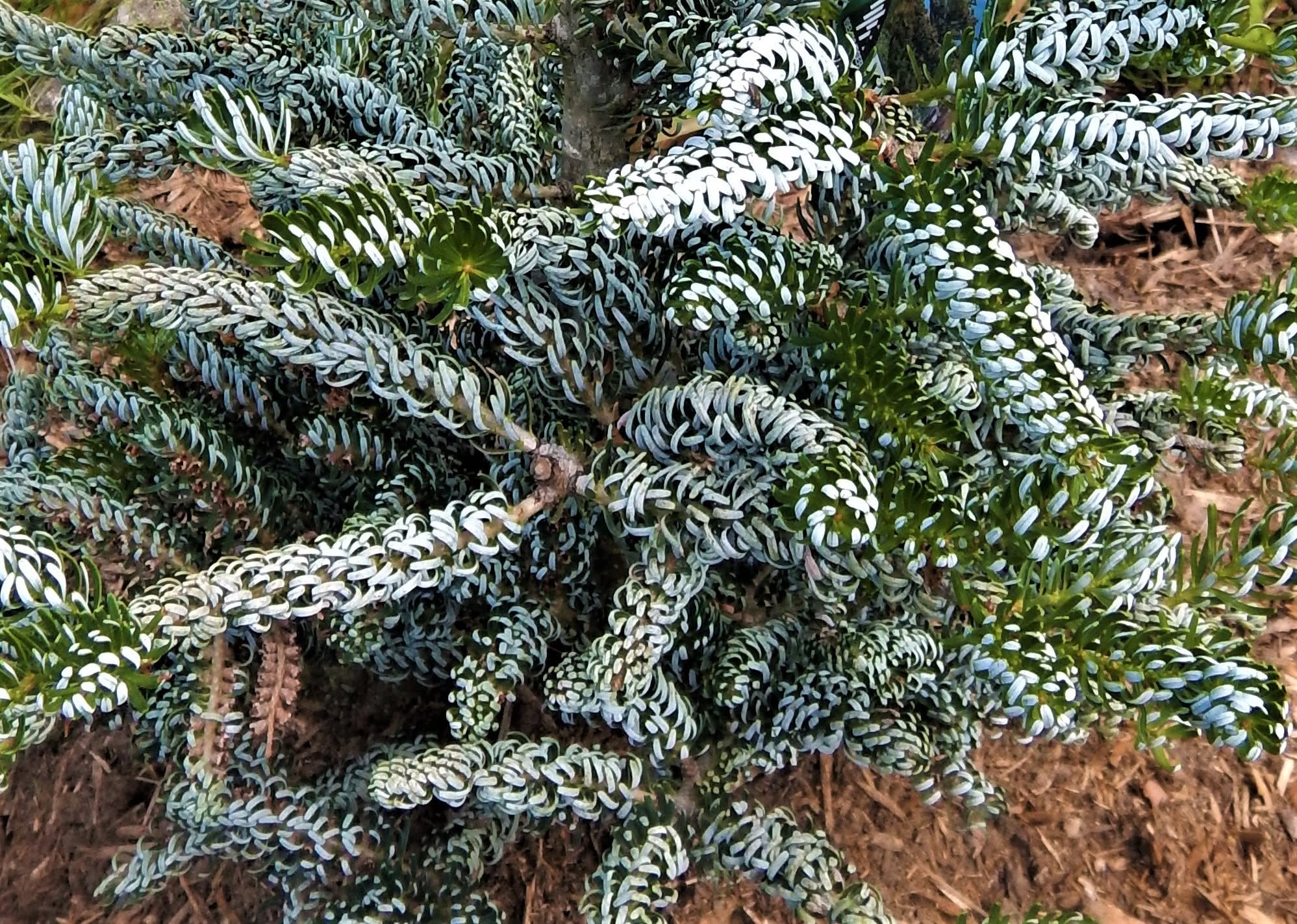
The absolute crown jewel of ‘Silver Show’ is its short, dramatically curved needle structure. Because of the intense reflexed angle of the foliage, an overwhelming percentage of the chalk-white needle undersides faces directly outward toward the light. This extreme curl creates tight, compact spirals that envelop the stems, making individual shoots look almost perfectly cylindrical.
This remarkable geometry yields several sophisticated landscape effects:
- Branch surfaces catch the light with far greater brilliance than standard, flat-needled species.
- The canopy boasts an intricately detailed, woven finish rather than a heavy, monolithic mass of greenery.
- The striking silver-white highlights remain fully visible even when you view the tree from sharp, oblique angles.
- Deep green upper needle surfaces peek through just enough to prevent the tree from looking washed-out or monochromatic.
- The interplay of fresh spring growth, structured charting branches, and mature interior foliage builds an exquisite, layered depth.
Consequently, the tree’s coloration is a dynamic performance dictated by lighting conditions and viewing angles. Under direct sun or angled afternoon light, the exposed undersides gleam an intense, clean white. On moody, overcast days or when peered at from directly above, the palette shifts into a sophisticated blend of forest green, slate blue, and soft, metallic silver. This mercurial quality gives ‘Silver Show’ a sense of movement and depth unmatched by uniformly grey conifers. Because it is a true evergreen, this mesmerizing structural character remains flawlessly intact through all four seasons, leaving the seasonal color shifts to the magnificent cones.
Architectural Form and Long-Term Dimensions
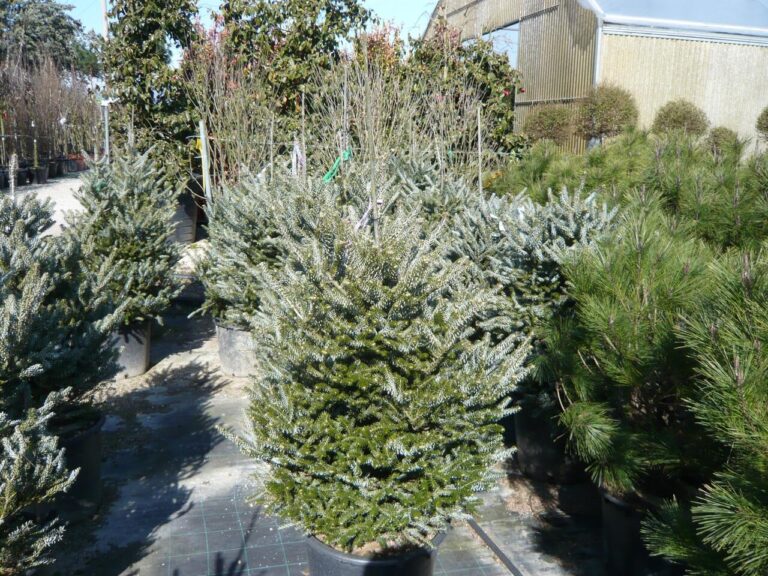
In its youth, ‘Silver Show’ assumes a compact, broadly pyramidal or rounded shape. As the plant establishes its root system, it steadily asserts its definitive, highly structured columnar-upright habit.
Mature size metrics inevitably fluctuate based on regional macroclimates, soil fertility, irrigation, and the specific rootstock used for grafting. A fully mature specimen typically settles between 2.5 to 4 metres in height, spreading about 1.5 to 2.5 metres wide. After a decade in the ground, expect a healthy tree to measure roughly 1.5 metres tall and 0.9 metres wide, putting on a modest 10 to 25 centimetres of new growth annually.
These variations underscore an important horticultural reality: conifers are living sculptures shaped by their environment, not manufactured plastic assets. For smart garden planning, look at ‘Silver Show’ as a dependable, slow-growing small tree or a large specimen conifer. Do not make the mistake of assuming it will stay trapped forever in a miniature rock-garden scale.
These intermediate proportions are absolute gold for residential landscapes. It provides the perfect solution for gardens where a wild, full-sized species Korean fir would completely overwhelm the plot, yet a standard, ultra-dwarf conifer would simply get lost in the shuffle. It offers just enough vertical gravity to anchor a design without consuming precious square footage.
Cones and High-Contrast Seasonal Accents
True to its lineage, ‘Silver Show’ proudly carries its cones perfectly upright, sitting them atop the upper branches like regal candles rather than dangling them hidden beneath the foliage. These structures play a massive role in the tree’s ornamental choreography, offering a striking counterpoint to the pale, reflective needles.
The color transformation is a true garden spectacle. Young cones emerge in vivid shades of violet-blue or rich purple, eventually deepening into a stately, resinous chocolate-brown as they mature into autumn.
This color timeline plays beautifully against the frosted backdrop:
- The initial violet-blue tones offer a cool, jewel-like contrast against the icy silver-white foliage.
- Deep purple mid-season cones transform the upper canopy into a dramatic, high-contrast focal zone.
- The final mature brown cones ground the tree, blending warmly with the woody bark while maintaining their vertical silhouette.
- Precocious cone production means even young, container-grown specimens display these mature features early on.
These are not minor, incidental reproductive parts. On a well-sited specimen, they break up the silver canopy with precise vertical punctuation, ensuring the plant never reads as a single, uninteresting blur of white.
Direct Comparison: ‘Silver Show’ vs. ‘Horstmann’s Silberlocke’
When deciding between these two sterling cultivars, the differences come down to fine qualitative nuances rather than sheer scale.
| Feature | ‘Silver Show’ | ‘Horstmann’s Silberlocke’ |
| Overall Visual Impression | Slower pacing, tighter architecture, brighter and highly concentrated color. | The classic benchmark; slightly more vigorous and open. |
| Needle Curvature Geometry | Extraordinarily tight, crisp, and intensely recurved. | Curled gracefully upward to display the pale stomatal bands. |
| Silver Display Intensity | Maximized; the severe curl forces more white surface area outward. | Strong silver effect, but with a more relaxed, less packed appearance. |
| Structural Growth Habit | Highly compact, tidy, upright small-tree silhouette. | Similarly upright, but scaling out a bit quicker over time. |
| Primary Landscape Role | Refined, high-definition specimen or architectural focal point. | Versatile feature conifer suited to broader massing or mixed groupings. |
| Distinguishing Aesthetic Value | Unmatched surface luminosity and a highly polished, fine-grained texture. | Instantly recognizable for its loose, classic “silver-lock” look. |
Choosing ‘Silver Show’ shouldn’t be a mere space-saving decision. Its true value lies in its high-definition finish: the severe, coiled nature of the needles delivers a markedly more luminous, polished glow than its predecessor.
Strategic Landscape Positioning
To maximize the impact of ‘Silver Show’, position it where its intricate, twisted foliage can be appreciated up close rather than swallowing it up in a chaotic mass of dense planting.
The cultivar shines brilliantly in these specific placements:
- As a captivating, low-maintenance front-garden focal point.
- Nestled within a curated conifer collection or a dedicated collector’s border.
- As an elegant vertical element in tight courtyards or urban small-scale gardens.
- Providing clean, structural lines in crisp, contemporary architectural landscapes.
- Anchoring a quiet, Japanese-inspired garden focused on texture and form.
- Standing against a sea of gravel or stone, where the silver needles mirror pale rock.
- Injecting essential, year-round vertical rhythm into an expansive mixed shrub border.
- Sited solo on a manicured lawn edge where its complete silhouette can be admired from all sides.
While it functions beautifully as a small tree, it delivers its strongest design punch when deployed as a solo specimen. Resisting the urge to plant it in massed screens or repetitive rows is key; duplicating the tree often dilutes the rare, exquisite detail of the curled foliage. A single, thoughtfully placed specimen makes a far grander statement than a predictable line of them.
Its upright orientation is incredibly useful when you desperately need height but cannot afford to compromise on horizontal space. Tuck it toward the back of a shallow bed to create a shimmering vertical anchor, or set it front and center against a dark, moody backdrop to let the silver highlights truly sing.
Crafting Sophisticated Design Combinations
Partnering with Dark Evergreens
The luminous, silver-white quality of the needles achieves maximum drama when set against a dark, saturated backdrop. Consider pairing it with the deep greens of classic yews (Taxus), glossy English hollies (Ilex), or dense, matte broadleaf evergreens. This stark contrast makes the ‘Silver Show’ pop with incredible intensity without needing to crowd the space with other silver foliage plants.
Echoing Burgundy and Purple Foliage
The tree’s signature violet-blue cones naturally invite partnerships with rich burgundy, plum, or deep wine-colored companion plants. Integrating matte, broad-leaved dark shrubs creates a beautiful texture contrast against the fir’s narrow, tightly spiraled needles while reinforcing the exquisite tones of the emerging cones.
Integrating Ornamental Grasses
Fine-textured ornamental grasses mirror and accentuate the delicate needle patterns of the fir, while strongly upright grass cultivars echo its vertical stance. While silver-toned cultivars establish a lovely monochromatic relationship, use caution: packing too many grey tones nearby can wash out the brilliant, icy white highlights that make this fir so special.
Contrasting with Hardscapes, Stone, and Gravel
Utilizing pale stone or light gravel mulch can beautifully echo the white undersides of the needles, which works wonderfully in minimalist or dry garden schemes. Conversely, backing the tree with charcoal pavers, dark slate, or deep weathered timber siding creates a theatrical contrast that makes the tree look almost self-illuminated.
Framing with Seasonal Perennials
When selecting lower-growing perennials, look for plants that frame the tree rather than compete with it. Palettes of clean white, deep blue, amethyst purple, and rich crimson blossoms beautifully complement the cones and needles. Meanwhile, large-leaved perennials provide a stellar, broad-textured skirt beneath the fir’s finely detailed canopy.
The Ultimate Visual Design Value
‘Silver Show’ brings an elusive combination of structural traits to the table that few other conifers can match:
- It delivers year-round evergreen permanence without looking static or dull.
- It introduces bright silver tones without resorting to a washed-out, completely grey look.
- It provides clear vertical architecture without turning into an aggressively skinny pencil form.
- It remains wonderfully compact without looking like a stunted, unnatural rockery novelty.
- It offers intricate, high-definition texture at arm’s length while maintaining a sharp silhouette from afar.
- It pivots effortlessly between formal, clipped architectural designs and wild, naturalistic stone-and-grass matrices.
The secret to success lies in giving the tree breathing room. Avoid choking it with an overabundance of neighboring silver plants, which flattens the stark, deep contrast that gives this brilliant cultivar its undeniable magic.
Propagation Realities and Market Availability
True ‘Silver Show’ specimens are strictly propagated via precision grafting. This detail is vital for buyers: standard seed propagation cannot replicate the extreme needle curvature, slow growth habits, or precise vertical forms of the true cultivar.
Because it is a slower, more boutique selection, it remains scarcer in the nursery trade than standard ‘Silberlocke’. Nomenclature can also be loose depending on the source. When hunting for this plant, ensure the nursery tag reads explicitly Abies koreana ‘Silver Show’, rather than generic descriptions like “silver Korean fir”. While a young, fresh graft will already show hints of the reflexed needle habit, the true, blinding intensity of the silver-white display takes a few seasons to fully manifest as the branch structure matures.
Authenticity Identification Checklist
To verify that a specimen is a true-to-type ‘Silver Show’, look for this precise combination of traits:
- Classic Korean fir needles showcasing an intensely reflexed, backward-curling habit.
- Notably short, tightly coiled needles that expose a striking, brilliant white stomatic underside.
- A distinctly compact, upright, and tidy structural silhouette.
- A growth rate that is visibly more measured and restrained than standard landscape specimens of ‘Silberlocke’.
- An overall outer canopy that reads as bright silver-white rather than muted blue-grey.
- Perfect crops of strictly upright, violet-blue or dark purple cones that gracefully transition to a deep wood-brown.
- A small, refined tree scale over time, completely lacking the flat, low-growing cushion look of true rock-garden dwarfs.
Never rely on just one of these markers, particularly when evaluating young, freshly potted grafts. True authenticity is confirmed by looking at the whole picture: the slow growth rate, the intense needle coil, the striking surface brightness, and the upright architectural form.