The Master Guide to Growing Abies: Elevate Your Landscape with True Firs
True firs—the distinguished members of the genus Abies—bring an unmatched air of architectural permanence to the landscape. These evergreen conifers are celebrated for their flawless symmetrical silhouettes, richly aromatic needles, and a dramatic palette that spans piercing blues, cool silvers, luminous golds, and weeping forms. Cultivating them successfully requires moving past a one-size-fits-all approach to conifers. This definitive guide unpacks the essentials of fir husbandry, helping you pair the right specimen with your specific garden conditions while avoiding common pitfalls like poor drainage, hidden drought stress, and the classic mistake of putting a slow-growing giant in a restricted space.
Defining the Genus: What Makes a Conifer a True Fir?
Nestled within the pine family (Pinaceae), the Abies genus counts dozens of species native to the cool, temperate, montane, and boreal regions of Eurasia, North America, and northern Indo-China. In these wild habitats, they thrive in deep, reliably moist, yet sharply drained soils where summers remain relatively mild.
To the untrained eye, many conifers look alike, but true firs possess unique botanical signatures that set them apart from the crowd:
- Upright Cones: Unlike spruces or pines whose cones dangle downward and drop intact, fir cones stand proudly erect like candles on the upper branches. At maturity, they disintegrate right on the tree, leaving behind only a bare central spike.
- Needle Attachment: Fir needles are attached singly to the twig via a base that resembles a tiny suction cup, leaving a smooth circular scar on the bark when removed.
- Stomatal Bands: Flip a needle over, and you will typically find twin tracks of pale, silvery-white chalky lines running along the underside.
The Design Dividends: Why Firs Deserve a Place in Your Garden
Firs introduce structural integrity to a garden when lesser plants have dissolved into winter dormancy. They offer:
- Year-round evergreen structure and impeccable pyramidal geometry.
- Handsome, clean bark patterns and exceptionally tidy, tiered branching.
- Intoxicatingly fragrant foliage, a trait exemplified by the balsam fir.
- A spectacular spectrum of foliage colours, from chalky blues to variegated golds.
- Breathtaking, early-season ornamental cones in shades of neon purple and electric blue.
- Vital sanctuary, nesting sites, and cold-weather food resources for local wildlife.
- An effortless specimen form that maintains its clean silhouette without routine pruning.
For homeowners managing suburban plots, the Korean fir (Abies koreana) has rightfully stolen the spotlight. It breaks the giant-conifer mold by showing off its spectacular purple cones at a remarkably young age, all while offering an array of exquisitely well-behaved, slow-growing garden cultivars.
The Botanical Tapestry: Core Species for the Collector
The world of Abies is rich with diverse species, each bringing a specific texture and environmental preference to the table. The primary players in home horticulture include:
- Abies alba (European or silver fir)
- Abies balsamea (Balsam fir)
- Abies concolor (White fir)
- Abies koreana (Korean fir)
- Abies magnifica (Red fir)
- Abies nordmanniana (Nordmann fir)
- Abies pinsapo (Spanish fir)
- Abies procera (Noble fir)
- Abies lasiocarpa (Subalpine fir)
- Abies grandis (Grand fir)
Taxonomists frequently debate the fine lines between localized subspecies and overlapping regional populations. For the practical gardener, however, the real focus should be on practical traits: ultimate mature dimensions, foliage tone, growth rate, and how well a given tree handles your local soil and summer heat.
It is also worth clearing up a common point of confusion: firs are not spruces. Spruces belong to the genus Picea. While they share a broadly similar evergreen look from a distance, they diverge completely when you examine their pendulous cones, rough peg-like needle attachments, and prickly texture.
Elite Abies Cultivars: Exceptional Varieties for Every Garden Scale
The following selections have been carefully vetted to eliminate confusing trade names and redundant varieties. Minor collector plants without widespread retail availability are grouped into collective profiles, allowing you to focus on the absolute best performing, high-impact firs on the market today.
Korean Fir Cultivars (Abies koreana)
Abies koreana ‘Horstmann’s Silberlocke’ (syn. ‘Silberlocke’)
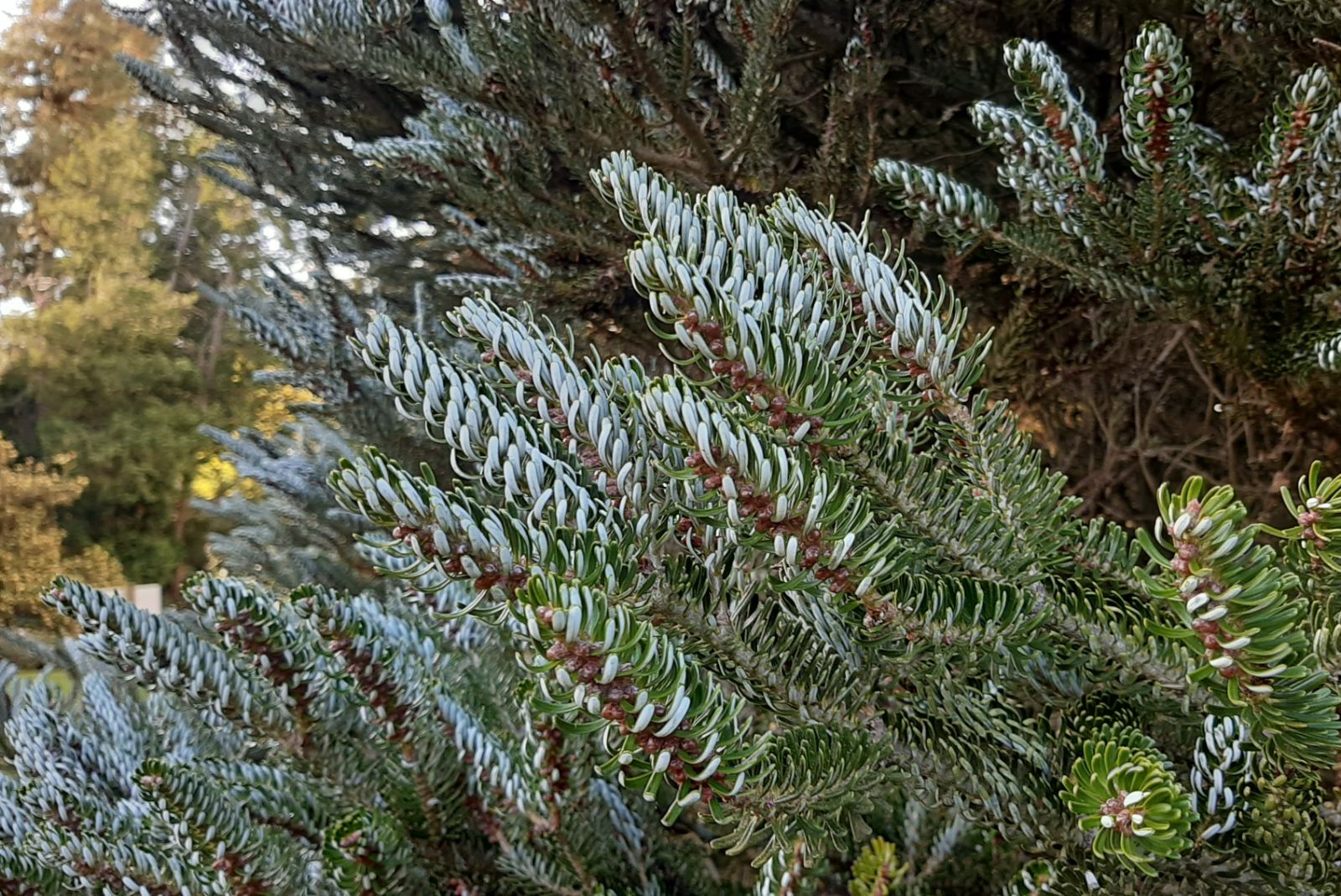
A masterclass in texture, this compact, structural selection features rich green needles that curl dramatically upward and inward, putting the bright, chalk-white undersides on full display. The visual effect is that of a tree permanently dusted with frost. Young specimens regularly produce upright, violet-purple cones that stand out beautifully against the silver backdrop. Expect an ultimate mature height of roughly 2.5 to 4 metres with a tidy spread of 1 to 1.5 metres, though exact dimensions shift based on your local climate and rootstock. For a complete guide to growing and landscaping with this specific cultivar, see our detailed profile on Abies koreana ‘Silberlocke’. It serves as a striking focal point in a mixed border or as an architectural accent near an entryway.
Abies koreana ‘Silver Show’
If you love the look of ‘Silberlocke’ but have even less room to spare, ‘Silver Show’ is the answer. This selection grows at a noticeably slower pace, forming a tighter, more dense column. Its needles are even more tightly rolled, creating a concentrated punch of silver-white brilliance. Position this sculptural gem against a dark backdrop of deep green shrubs or set it within a minimalist gravel bed where its intricate form can be appreciated up close.
Abies koreana ‘Kohout’s Ice Breaker’
This astonishing dwarf completely breaks the standard conical rules of the genus. It forms a low, flattened, intensely congested mound of tightly swirled, white-backed foliage. Though it began as a specialized collector’s prize, its unique texture has made it a mainstream favorite for rock gardens, stone troughs, alpine installations, and small containers.
Abies koreana ‘Blauer Eskimo’
Bringing a cool, steel-blue note to the dwarf Korean fir family, ‘Blauer Eskimo’ develops into a tight, globose bun of blue-grey foliage. Its frosty tone makes it an ideal candidate for cool-palette designs, modern gravel beds, and minimalist urban gardens.
Korean Fir Dwarf and Blue Collective Group
This category encompasses superb, closely related selections like ‘Blaue Zwo’ and ‘Cis’. Because these varieties share nearly identical landscape footprints, ultimate sizes, and care needs, they are best evaluated by subtle differences in blue intensity, local availability, and graft height. They naturally form slow-growing, low mounds or small trees with deep green, teal, or silver-blue needles, and many will produce classic upright purple cones. Use them to add structure to rock gardens, patio containers, or specialized conifer collections.
Noble Fir Cultivars (Abies procera)
Abies procera ‘Blaue Hexe’
A true dwarf iteration of an otherwise towering forest species, ‘Blaue Hexe’ forms a low, cushion-shaped, slightly flattened bun. Its needles are a striking, clear steel blue. Given its slow growth rate, it is perfectly suited for rockeries, trough gardens, and container groupings, especially when juxtaposed with pale gravel or fine-textured silver perennials.
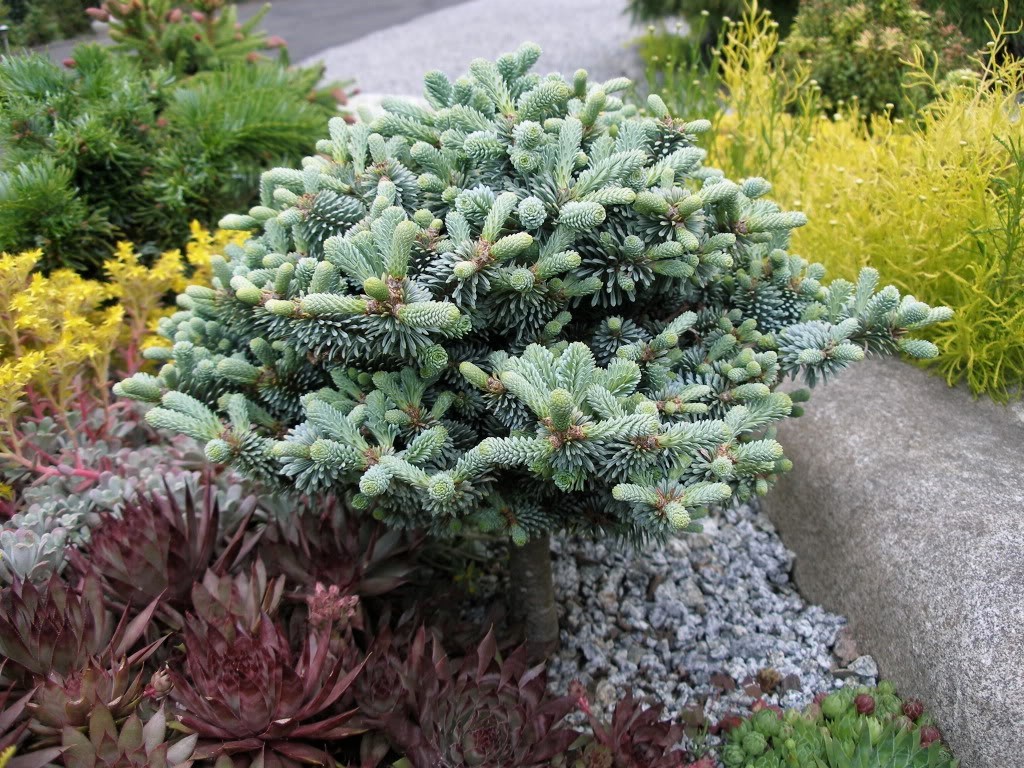
Abies procera ‘Glauca Prostrata’
This fascinating selection throws off the upright habits of its relatives to crawl horizontally across the ground. Developing into a wide, powder-blue carpet, it works beautifully as a high-end ground cover or for stabilizing sunny banks. Give its lateral branches plenty of room to stretch out, and keep nearby plants from shading out its lower skirt.
Abies procera ‘Aurea’
Grown for its luminous golden-yellow new growth, ‘Aurea’ acts as a vibrant beacon in the garden. While its juvenile growth is restrained, it eventually matures into a substantial tree. Its coloration is most intense when grown in full sun, though gardeners in brutally hot, low-humidity regions should provide light protection to prevent the intense light from scorching the needles.
Abies procera ‘Glauca’
An upright, classic noble fir selection boasting intensely blue needles that curve gracefully upward along the branches. It retains the bold, regular, architectural silhouette of the species but steps up the color drama. Plant this tree only where you have ample room; even a slow-starting young specimen will eventually claim significant vertical and horizontal space.
Dwarf and Blue Noble Fir Collective Group
This collective includes ‘Jeddeloh’ along with various unnamed blue dwarf seedlings and lookalike nursery selections. They are characterized by tight branching, low-growing or mounding habits, and striking blue needles. They are right at home in raised beds, rock gardens, and small spaces. Always verify the expected mature dimensions with your grower, as the word “dwarf” in conifer circles often denotes a slow annual growth rate rather than a permanently tiny plant.
White Fir Cultivars (Abies concolor)
Abies concolor ‘Compacta’
This selection offers all the long, sweeping, glaucous blue-grey needles of the beloved white fir but packages them into a much smaller, denser, slow-growing form. It allows suburban gardeners to enjoy the rugged character of Abies concolor without worrying about a forest giant outgrowing the yard. Give it a prominent spot on a spacious lawn or within a deep border, keeping its ultimate mature width in mind.
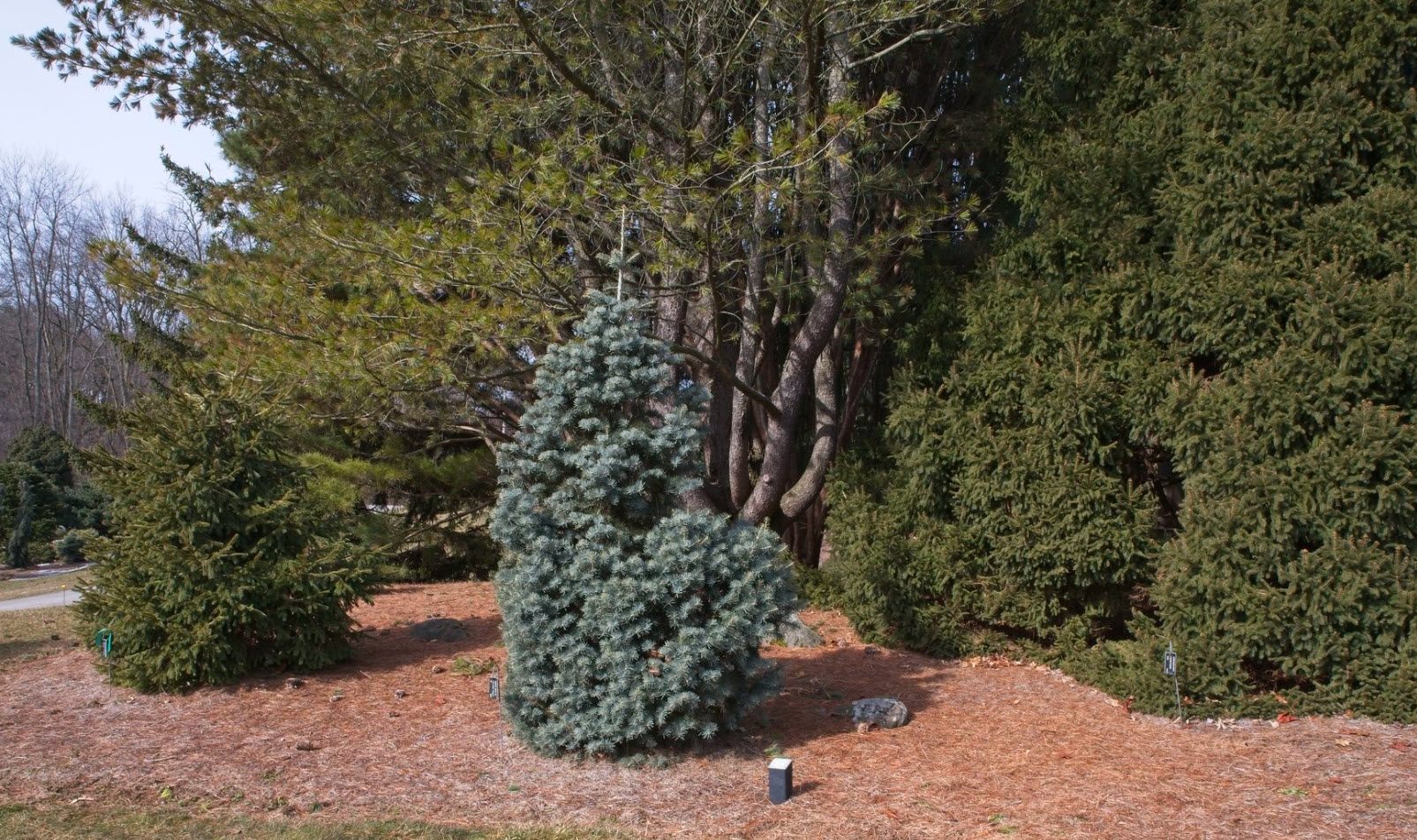
Abies concolor ‘Violacea’
One of the most breathtaking conifers in cultivation, ‘Violacea’ sports long, curved needles of an intense, electric blue-violet hue. Its upright, stately habit makes it a premier choice for focal points or as a high-contrast backdrop behind deep green or purple-leaved companions. It performs best when given deep, moist, well-draining soil and shelter from drying winds.
Abies concolor ‘Violacea Prostrata’
This form mirrors the exquisite blue-violet needle color of ‘Violacea’ but expresses it in a sprawling, low-slung habit. It looks spectacular cascading down sunny hillsides, draping over retaining walls, or spilling over the edges of heavy stone planters. Keep an eye out for any stray upward-climbing leaders, and prune them back promptly to preserve the prostrate form.
Abies concolor ‘Blue Cloak’
Living up to its name, ‘Blue Cloak’ forms a graceful, narrow tree draped in soft, powder-blue needles. It is an exceptional candidate for cool-toned, serene garden designs. Planting it in full sun keeps the blue color vivid, while deep soil and a sheltered site prevent wind and drought stress from marring the foliage.
Other Dwarf and Blue White Fir Selections
Minor blue and dwarf variants of Abies concolor are grouped here. They all share long, sickle-shaped blue needles, compact growth habits, and an absolute requirement for excellent drainage. When shopping within this group, look for clean nursery provenance and ask for specific mature dimensions rather than collecting every unnamed “blue dwarf” variant.
Balsam Fir Cultivars (Abies balsamea)
Abies balsamea ‘Nana’
A delightful, dense green cushion that looks like a miniature dome. It typically matures into a tight mound around 0.5 to 1 metre high and 1 to 1.5 metres wide, though exact sizes will vary based on your climate and whether it was grown from a cutting or grafted. Its highly aromatic needles release a rich woodland fragrance when brushed against. It is ideal for rockeries, troughs, front-of-the-border clusters, and winter-interest containers. It requires cool, consistently moist, well-drained soil and will quickly decline in hot, dry, baking sites.
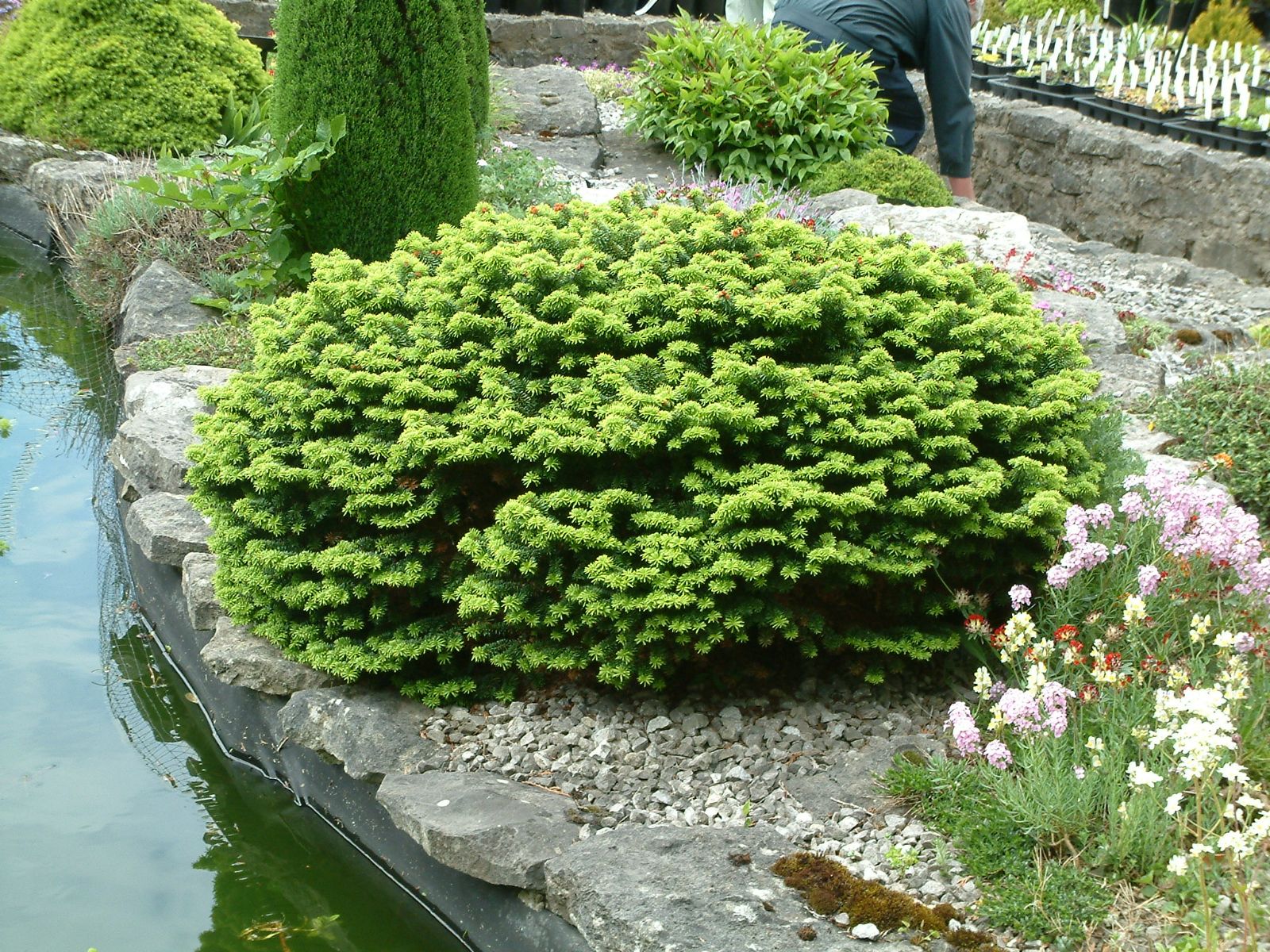
Dwarf Balsam Fir and ‘Hudsonia’ Collective Group
This group gathers the ‘Hudsonia’ variants and similar dwarf balsam firs that display a low, rounded, tightly branched habit and rich green, fragrant needles. Their exceptional cold-hardiness makes them incredibly valuable for northern gardens, but they remain sensitive to stifling summer heat, stagnant air, and waterlogged soil.
Nordmann Fir Cultivars (Abies nordmanniana)
Abies nordmanniana ‘Pendula’
A dramatic, weeping conifer featuring pendulous branches that drape downward around a central trunk. Because its ultimate silhouette depends heavily on how the main leader is trained and staked at the nursery, it is best to select your specific plant in person. It makes a stunning architectural statement next to a water feature, along a prominent pathway, or as an anchor specimen in a sweeping lawn.
Abies nordmanniana ‘Golden Spreader’
A bright antidote to dark green conifers, this low, spreading selection features needles heavily brushed with luminous gold. It serves a completely different design role than the species, working beautifully in rock gardens, low borders, and winter container arrangements. Full, bright light brings out the best golden intensity, but the roots must never be allowed to dry out completely.
Other Nordmann Fir Selections
Minor narrow, compact, or slight color variants are classified under this group. Their primary value is architectural—providing slightly tighter column shapes or unique needle textures. Always check the graft height, as a variety sold as a low mound can behave very differently if it was grafted onto a tall standard trunk.
Spanish Fir Cultivars (Abies pinsapo)
Abies pinsapo ‘Aurea’
This golden Spanish fir brings a unique texture to the garden with its short, stiff, blunt needles arranged spirally around the twigs like bottle-brushes. Its slow growth and golden hue create a spectacular focal point when paired with dark green or blue evergreens. Sharp drainage is absolutely non-negotiable, and it appreciates shelter from freezing, drying winds in wet winter climates.
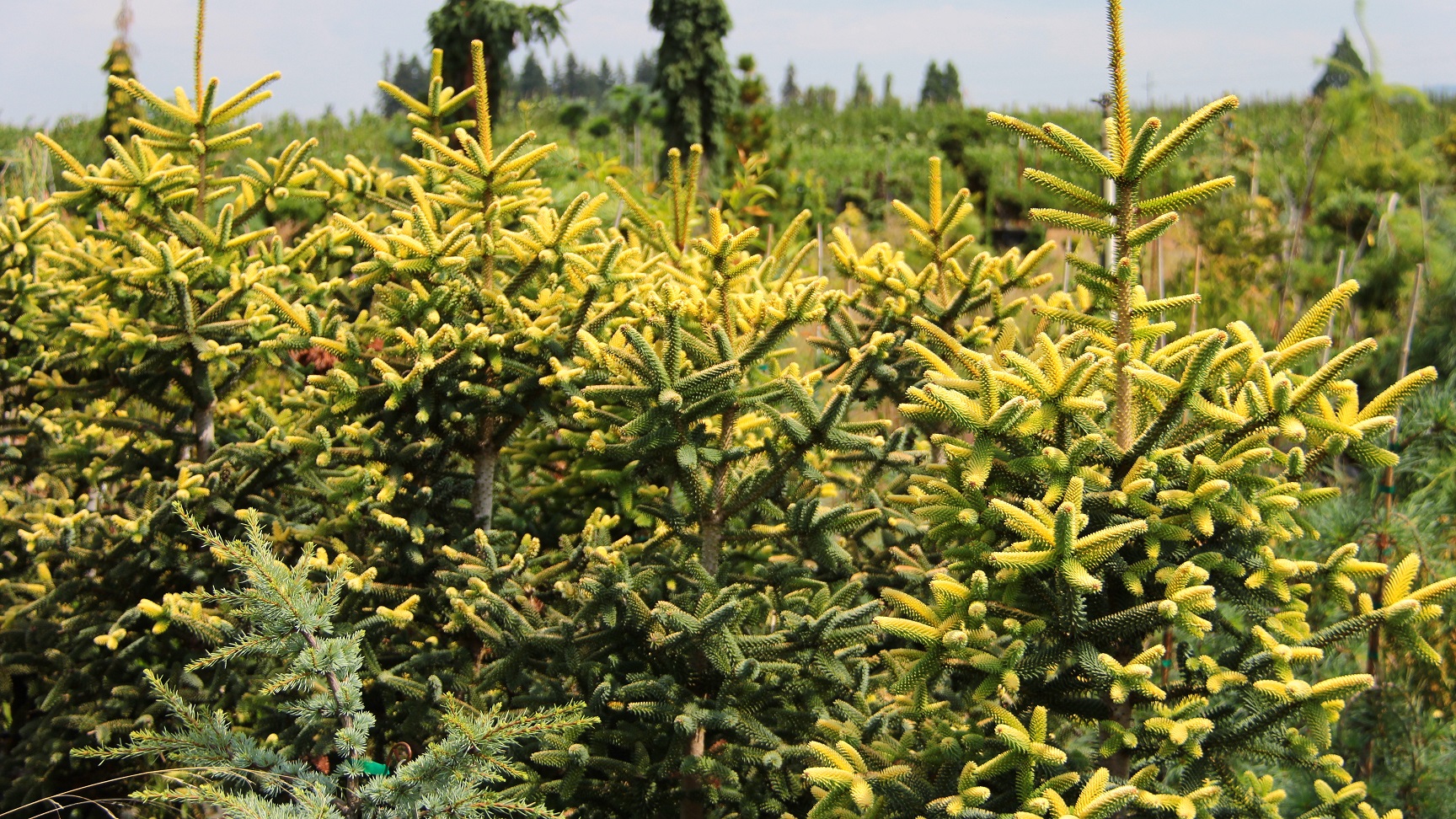
Abies pinsapo ‘Glauca’
A gorgeous steel-blue iteration of the Spanish fir. Its rigid, geometric needle arrangement gives it a distinctly prehistoric, sculptural quality. Because the parent species hails from the mountains of southern Spain, this tree appreciates bright light and excellent drainage but needs protection from severe, exposed winter winds.
Other Spanish Fir Colour and Growth Forms
Minor color variations and slow-growing variants are tracked within this single group. Most differ only slightly in their degree of blue-grey color or annual growth rate. Grouping them avoids a confusing web of near-identical profiles while still assisting collectors hunting for specific Spanish fir variations.
Red Fir Cultivars and Taxonomic Forms (Abies magnifica)
The straight species, Abies magnifica, is a towering, magnificent tree best reserved for large landscapes and cool, mountain-adjacent climates. Its botanical variant, Abies magnifica var. shastensis (the Shasta red fir), is distinguished primarily by minor cone and bract structures rather than any practical landscape difference, so it is kept within the main species profile.
Dwarf and blue iterations of the red fir, such as ‘Nana’, are grouped collectively. This ensures rare collector selections and minor taxonomic variants are accounted for without cluttering beginner resources with plants that lack a distinct commercial identity.
Cultivation Essentials: Creating the Perfect Environment
Climate and Hardiness Boundaries
True firs are cold-climate aristocrats, but individual species vary in their environmental tolerances:
- Balsam fir thrives in freezing northern zones but wilts in hot climates.
- Korean fir is exceptionally cold-hardy but languishes in areas with hot, humid summers or frequent droughts.
- White fir is the most adaptable of the group, showing better tolerance for heat and varied climates than most alpine firs, though it still demands deep soil and summer moisture.
- Red, noble, and subalpine firs are specialists that perform best in cool, northern, or high-altitude zones.
- Spanish fir handles milder conditions well, provided its roots stay explicitly well-drained.
While many garden firs thrive across USDA Hardiness Zones 3 through 7, winter survival is only half the battle; a tree that cruises through a freezing winter can still fail during a baking, humid summer. Always cross-reference a cultivar’s heat tolerance before planting.
Light Requirements
To maintain a tight, symmetrical, and dense crown, most firs require full sun—amounting to at least six hours of unfiltered, direct sunlight daily. Bright light is the catalyst for:
- Vibrant blue and silver needle coloration.
- Rich, scorching golds in yellow cultivars.
- Symmetrical, even branch development.
- Good air movement through the canopy, which keeps needle diseases at bay.
In areas with intense summer heat, light afternoon shade can be a lifesaver, especially for young, establishing trees. Conversely, deep shade will result in thin, leggy, sparse growth and dull foliage.
Soil Preferences
Firs are uniform in their hatred of heavy, compacted, stagnant earth. Aim for a soil profile that is:
- Constantly moist yet completely free-draining.
- Deep enough to accommodate a extensive, anchoring root system.
- Richly amended with well-decomposed organic matter.
- Neutral to slightly acidic in pH.
- Protected from intense, prolonged summer baking.
If your yard sits on heavy clay, you must aggressively amend the wider area with organic matter or install dedicated drainage infrastructure. Never plant a fir in a low, soggy hollow simply because the soil looks dark and rich.
The Drainage Test
Perfect drainage is the single most important factor for true fir survival. Saturated, waterlogged soils suffocate roots, triggering rapid root rot, needle yellowing, and sudden dieback.
Before you plant, dig a test hole in your chosen location, fill it to the brim with water, and watch how it recedes. If the water sits for hours without draining, you must either build up a raised planting mound, choose a different site, or install active drainage.
Planting Protocol: Step-by-Step Installation
Optimal Timing
The ideal windows for planting firs are:
- Late Autumn: Once the intense summer heat breaks and the tree enters dormancy, but before the ground freezes.
- Late Winter or Early Spring: Just as the soil thaws but before the buds break into active growth.
Container-grown specimens can technically go into the ground outside these windows, but they will require meticulous, daily watering if planted during the summer heat.
Site Selection Audit
Before bringing a tree home from the nursery, run through this checklist:
- What are its ultimate mature height and spread?
- Is it grafted, and what is the nature of the rootstock?
- Does it have room to breathe away from walls, paths, and overhead power lines?
- Will it eventually be shaded out by neighboring trees or buildings?
- Is it protected from harsh, sweeping winds?
Avoid the temptation to plant a large-growing species in a small foundation bed simply because it looks cute in a small nursery pot. Remember: “dwarf” often simply means it takes a long time to get big.
Spacing Requirements
Always space your plants based on their projected mature dimensions, not their size on the day of planting.
- Dwarf & Mounding Cultivars: Give them at least their full listed mature width plus a comfortable buffer.
- Medium Specimens: Situate them several metres away from foundations, patios, and competing trees.
- Large Species: Treat them as legacy forest trees, giving them wide-open spaces far from restrictions.
Crowding firs together ruins their natural symmetry, chokes off air circulation, and creates an ugly pruning nightmare down the road.
Soil Preparation and Installation Step-by-Step
- Thoroughly hydrate the tree’s root ball while it is still in its nursery container.
- Dig a planting hole that is exactly the same depth as the root ball, but at least twice as wide.
- Use a garden fork to score and loosen the compacted sides and bottom of the hole.
- Blend a modest amount of high-quality compost or leaf mould into the backfill soil.
- Set the tree in the hole, ensuring the root flare sits exactly level with—or a fraction of an inch above—the surrounding soil grade.
- Backfill the hole gently, firming the soil with your hands as you go to eliminate air pockets without burying the trunk.
- Apply a slow, deep soaking of water to settle the soil.
- Spread a 5–8 cm layer of organic mulch over the root zone, making sure to keep it several centimetres clear of the bark.
Avoid the amateur mistake of heavily amending only the planting hole with rich compost. This creates an isolated “pot” effect; roots will refuse to grow past the amended zone into the native soil, leading to an unstable, waterlogged root system.
Managing Containerized Firs
Slow-growing and dwarf fir cultivars can thrive in pots for years if properly managed.
- Choose a heavy, stable stone or terracotta pot equipped with large drainage holes.
- Utilize a premium, coarse, loam-based potting soil mixed with horticultural grit or bark chips.
- Select a container that is only one size larger than the current root ball; over-potting leads to cold, sour, waterlogged soil.
- Monitor watering closely—pot-bound conifers dry out rapidly in summer and are far more susceptible to root-freezing in winter and root-scorching in summer.
- Apply a weak, balanced liquid conifer fertilizer during the height of the spring growing season.
Seasonal Care and Long-Term Maintenance
Watering Wisdom
When it comes to watering true firs, think deep and infrequent rather than quick and superficial.
During the critical establishment phase (the first two full growing seasons), water the root zone slowly and deeply whenever the top few centimetres of soil feel dry. Pay extra attention during hot, windy spells, as drying winds can dehydrate needles just as fast as baked soil. Once their root systems are fully established, most in-ground firs can coast along on normal rainfall, though they will still require supplemental soaking during prolonged heatwaves. Container specimens must be checked for water year-round, even through dry winter stretches.
Nutrient Management
In fertile, well-mulched garden soils, established firs require very little supplemental feeding. If your tree is showing sluggish growth or pale color:
- Broadcast a balanced, slow-release granular conifer fertilizer over the root zone in late winter or early spring.
- Always follow the package directions; over-fertilizing causes weak, leggy growth.
- Never try to solve a drainage or watering issue by throwing fertilizer at the tree.
- Avoid high-nitrogen feeding in late summer, which stimulates soft, tender growth that will get zapped by winter frosts.
Mulching Routine
Maintain a clean, 5 to 8 cm blanket of organic mulch—such as shredded pine bark or aged leaf mould—over the tree’s entire root zone. Mulch acts as an environmental buffer: it locks in moisture, blocks competitive weeds, and keeps the soil cool during sweltering summer months. Always leave a clear ring of bare earth directly around the trunk; piling mulch against the bark traps moisture and invites fungal rot and rodent damage.
Pruning Best Practices
True firs possess an elegant, natural geometry and rarely require routine pruning. If you must pick up the pruners:
- Limit cuts to removing dead, broken, or diseased wood.
- Work during the active spring or early summer growing season.
- Always cut back to a live side branch or visible bud; never leave a bare stub.
- Crucial Rule: Do not cut back into old, bare, brown wood. Firs, like most conifers, cannot regenerate new growth from old wood. If you shear past the green needles, you will be left with a permanent brown hole.
- If a young tree tries to develop twin, competing vertical leaders, snip the weaker one away early to preserve a strong, single central trunk.
- On prostrate or weeping grafts, prune out any rogue, aggressively upright shoots that threaten to ruin the low habit.
If a tree has simply outgrown its space, do not attempt to top it or shear it back into bounds. Severe topping ruins the tree’s architecture and invites disease. In these cases, it is best to remove the tree and replace it with a properly scaled cultivar.
Propagation Principles
From Seed
Growing firs from seed is a rewarding project for raising straight species or producing hardy rootstocks for grafting. It is useless for named cultivars, however, as their unique colors and habits will not carry over to their seedlings.
- Harvest mature cones in autumn before they completely disintegrate.
- Extract the seeds, dry them briefly, and subject them to a period of cold, moist stratification (usually 1–3 months in a refrigerator) to mimic winter.
- Sow the seeds into a sandy, free-draining conifer seed mix.
- Keep the medium consistently moist and protect the seedlings from birds and rodents.
- Pot them up early and handle them gently; young firs loathe root disturbance.
By Grafting
Grafting is the industry standard for propagating named cultivars, ensuring that weeping, golden, blue, and dwarf characteristics are perfectly preserved. Specialist propagators typically use a side-veneer graft in late winter, joining a dormant scion (the cultivar shoot) to a compatible, vigorous fir rootstock. Because it requires precise knife skills and strict environmental controls, it is best left to experienced growers.
By Cuttings
Some cultivars can be raised from semi-ripe or hardwood cuttings taken in late autumn or winter, though success rates are famously unpredictable across different species. Use current-season shoots with a small “heel” of older wood, dip them in a strong rooting hormone, and place them in a highly aerated, sharp grit medium under high humidity. Be prepared to wait—fir cuttings can take months to throw out roots.
Layering and Division
True tree-form firs cannot be divided, as they arise from a single trunk and root system. However, low, sprawling, prostrate cultivars can occasionally be multiplied via ground layering. Pin a low-hanging branch firmly to the earth and nick the bark; over a year or two, it may form its own independent root system that can be severed from the parent plant.
Pests, Diseases, and Troubleshooting
When planted in their preferred environmental sweet spot, true firs are remarkably resilient. However, when stressed by heat, drought, or poor soil, they become targets for problems.
Common Cultivation Obstacles
- Honey Fungus (Armillaria): A destructive, soil-borne fungal disease that attacks the root system, causing pale foliage, structural decline, and eventual collapse.
- Needle Rusts: Fungal pathogens that manifest as yellow spots, powdery orange pustules, and distorted, curling needles.
- Needle Blights: Often striking during cool, wet spring seasons, causing older inner needles to turn a premature reddish-brown.
- Budworms & Caterpillars: Voracious chewing pests that web needles together, stripped fresh growth, and damage tender terminal shoots.
- Aphids & Scale Insects: Tiny, sap-sucking insects that cluster on stems, draining the tree’s energy and secreting sticky honeydew that hosts black sooty mould.
- Phytophthora Root Rot: The inevitable consequence of swampy, poorly drained soil, which rots the root tips and kills the tree from the ground up.
- Winter Burn: Occurs when freezing winter winds dry out the needles while the root zone is frozen solid, preventing the tree from drawing up water. This leaves the windward side of the tree looking parched and brown.
Integrated Management Strategy
- Always match the specific Abies species to your local climate and heat realities.
- Never plant a fir in saturated or waterlogged ground.
- Provide deep water during summer droughts and the initial establishment years.
- Space trees correctly to maximize air movement through the branches.
- Prune out and safely destroy any diseased or pest-riddled branches.
- Foster a healthy garden ecosystem to encourage predatory birds and beneficial insects.
- Never spray non-selective pesticides indiscriminately without identifying the specific pest.
- If your needles are showing ambiguous spots or mysterious dieback, send a sample to a local university extension office or diagnostic lab for an accurate analysis.
When troubleshooting a sick tree, remember that needle yellowing and browning can stem from a dozen different triggers—including herbicide drift, physical root damage, insect feeding, or fungal blights. Avoid jumping to conclusions based on color alone; instead, base your diagnosis on the exact timing of the symptoms, which needles are falling (old vs. new), and the condition of the surrounding soil.
Landscape Integration and Design Strategy
Design Applications
Firs are versatile structural players that can anchor a wide array of landscape designs:
- Stately, individual lawn specimens.
- Evergreen focal points at the end of a long garden vista.
- Architectural anchors at corners or flanking large entryways.
- Luminous color accents using intense blue, silver, or golden cultivars.
- Rich, informal evergreens screens and windbreaks.
- Naturalistic transitions along a woodland edge.
- Textural anchors in alpine rock gardens or stone troughs.
- Sprawling, high-end evergreen ground covers on sunny banks.
- Dramatic cascading elements using weeping or pendulous forms.
Wildlife Benefits
A mature fir is a thriving ecosystem. The dense, layered branching offers superb nesting sites and crucial shelter for songbirds during blinding winter storms. Furthermore, the seeds tucked inside those majestic upright cones provide high-fat nutrition for native birds and small mammals.
Companion Planting Pairings
The best companions for Abies are plants that share their love for cool, rich, free-draining soil without aggressively invading the fir’s root zone:
- Under Large Species: Shade-loving woodland perennials, native ferns, and wild ginger.
- Around Compact Cultivars: Colorful Heuchera varieties, fine-textured ornamental grasses, and clump-forming spring bulbs.
- In Acidic Beds: True heathers, dwarf rhododendrons, and low-growing blueberries.
- With Prostrate Forms: Hardy Sedum varieties, creeping thymes, and alpine rock plants.
- Color Contrasts: Pair silver or blue firs with dark, burgundy-leaved shrubs, or set golden firs against deep purple perennials.
- Naturalistic Styles: Blend firs with moss-covered stones and fine forest grasses to evoke a peaceful Japanese or woodland aesthetic.
Always maintain a clean, well-mulched circle directly beneath the canopy of an establishing fir; do not allow aggressive, thirsty ground covers to choke out the young tree’s roots.
Troubleshooting Quick-Reference
Why are my fir needles turning brown?
First, investigate the basics: check your planting depth, the soil drainage, and recent weather anomalies. Needle browning can trace back to drought, waterlogged roots, winter burn, physical root disruption, fungal blights, or nearby herbicide spraying. If the browning is restricted to the older, inner needles during autumn, do not panic—this is normal seasonal shedding. However, if the fresh, current-year tips are turning brown or dropping, you are likely dealing with a serious root problem or an active pest infestation.
Why is my tree growing lopsided or uneven?
Asymmetric growth usually points to an environmental imbalance: one-sided lighting (such as a tree planted too close to a blank wall), intense wind exposure, or a neighboring plant physically crowding it out. If the tree develops an uneven shape because the central leader was snapped, train up a new side shoot to take its place. Do not try to solve structural imbalances by hacking at the tree with hedge shears.
Why is the blue or golden color looking washed out?
A lack of bright, direct sunlight is almost always the culprit behind faded foliage. Without sufficient light, golden varieties turn a drab greenish-yellow, and blue varieties lose their bright, waxy coating. Keep in mind that color intensity also shifts naturally with the seasons, the age of the tree, and the genetics of the rootstock. If your containerized fir is fading, gradually move it into a brighter spot. Avoid drought stress, as a parched tree will lose its needle density and scorch.
Help! My “dwarf” fir is growing too fast!
In the nursery industry, terms like “dwarf” and “compact” are relative descriptors of annual growth rate, not a guarantee of a permanent size. A plant that adds only 5 centimetres of growth a year is technically a dwarf, but over forty years, it will still become a substantial presence. Always verify the long-term, mature dimensions before planting. If a tree has truly outgrown its space, remove it and plant a more suitable cultivar rather than repeatedly butchering its branches.
Why is my fir tree dying from the bottom up?
This pattern typically signals a severe issue below ground level, such as phytophthora root rot, a honey fungus infestation, severe soil compaction, deep drought, or winter damage caused by voles chewing the bark around the root collar. Inspect the base of the trunk for fungal structures, loose bark, or chew marks, and check the moisture level of the soil. If the decline is lightning-fast or spreads to neighboring conifers, call in a certified arborist or a plant pathology service immediately.
My prostrate fir has a branch shooting straight up. What do I do?
Occasionally, a horizontal or pendulous grafted variety will attempt to re-assert vertical dominance by throwing up a vigorous, upright shoot. Trace this rogue branch back to its exact point of origin on the main framework and cut it completely away early in the season. This preserves the clean, cascading form of your plant.
Frequently Asked Questions
How fast do fir trees grow?
Growth rates depend entirely on the specific species and cultivar. Tall timber species can grow quite quickly once established, adding 30 to 60 centimetres a year, whereas specialized dwarf selections might grow only a fraction of an inch annually. Local soil quality, moisture levels, sun exposure, and rootstock heavily influence the final speed.
Do firs require full sun?
Yes, the vast majority of Abies species reach their peak beauty when grown in full sun. This is especially true for intensely blue, silver, or golden varieties. While afternoon shade can prevent scorching in hot climates, heavy shade leads to a sparse canopy, weak branches, and dull foliage.
Can I cultivate Abies in pots long-term?
Absolutely. True dwarf and slow-growing cultivars make exceptional container subjects. The key is providing a heavy, stable container, using a highly porous, loam-based conifer potting mix, and ensuring regular watering and routine repotting as the root system fills the pot.
What is the best season to prune a fir?
Pruning should only be performed when absolutely necessary, preferably during the active spring or summer growing season. Focus strictly on clearing out dead, broken, or diseased wood, and never cut back into the old, bare brown wood, as firs cannot generate new buds from old stems.
Why are the young cones on my fir bright purple?
This is one of the most delightful traits of the genus! Many true fir species produce immature upright cones wrapped in brilliant shades of blue, violet, or purple before they ripen into a quiet woodland brown. The Korean fir (Abies koreana) is particularly famous for showing off these colorful cones while still a young shrub.
Do fir trees require an acidic soil profile?
While many true firs prefer a slightly acidic to neutral soil, they are reasonably accommodating. Having a perfectly low pH is far less critical than ensuring the soil is deep, fertile, consistently moist, and completely free of stagnant water.
Are fir trees appropriate for small urban gardens?
The straight species are far too massive for standard yards, but the world of dwarf and compact Abies cultivars offers spectacular options for tight spaces. Never buy based on the word “dwarf” alone; always check the verified mature height and width labels before planting.
Can I propagate a specific cultivar from a collected cone?
No. While you can successfully raise straight species trees from seed collected from mature cones, named cultivars will not come true from seed. Seedlings will vary wildly from the parent plant. To keep a specific cultivar true to form, it must be propagated via grafting or root cuttings.