Abies pinsapo ‘Aurea’: The Golden Spanish Fir with Sculptural Splendour
The Abies pinsapo ‘Aurea’—commonly known as the Golden Spanish Fir—is a mesmerizing, slow-growing conifer celebrated for its stiff, geometric silhouette and a brilliant seasonal color transition that pits radiant new growth against mature, blue-green needles. This choice selection functions beautifully as a permanent focal point in medium to large landscapes, alpine rock gardens, or gravel beds. Its structural refinement and luminous seasonal flushes demand close-up appreciation.
For foundational planting protocols, including soil preparation, deep-watering schedules, fertilizing, mulching, and routine pest or disease management, please consult the Master Growing Guide for Conifers / Abies. The insights below focus exclusively on the unique aesthetic qualities, landscape value, and precise placement strategies required to maximize the impact of ‘Aurea’.
Origin and Horticultural History
This venerable cultivar traces its roots back to 1867–1868, when it was selected and introduced by the Adrien Sénéclauze Nursery in Bourg-Argental, France. With more than a century and a half of garden history behind it, ‘Aurea’ remains recognized in major conifer literature as a timeless classic among golden sports.
While it perfectly mirrors the species’ signature stiff, radially arranged needles and densely packed branches, a natural reduction of chlorophyll in its young foliage gives it a significantly slower growth rate. The result is a compact, well-behaved specimen far better suited to residential gardens than the imposing straight species.
Foliage Colour and Seasonal Display
Spring and early summer flush
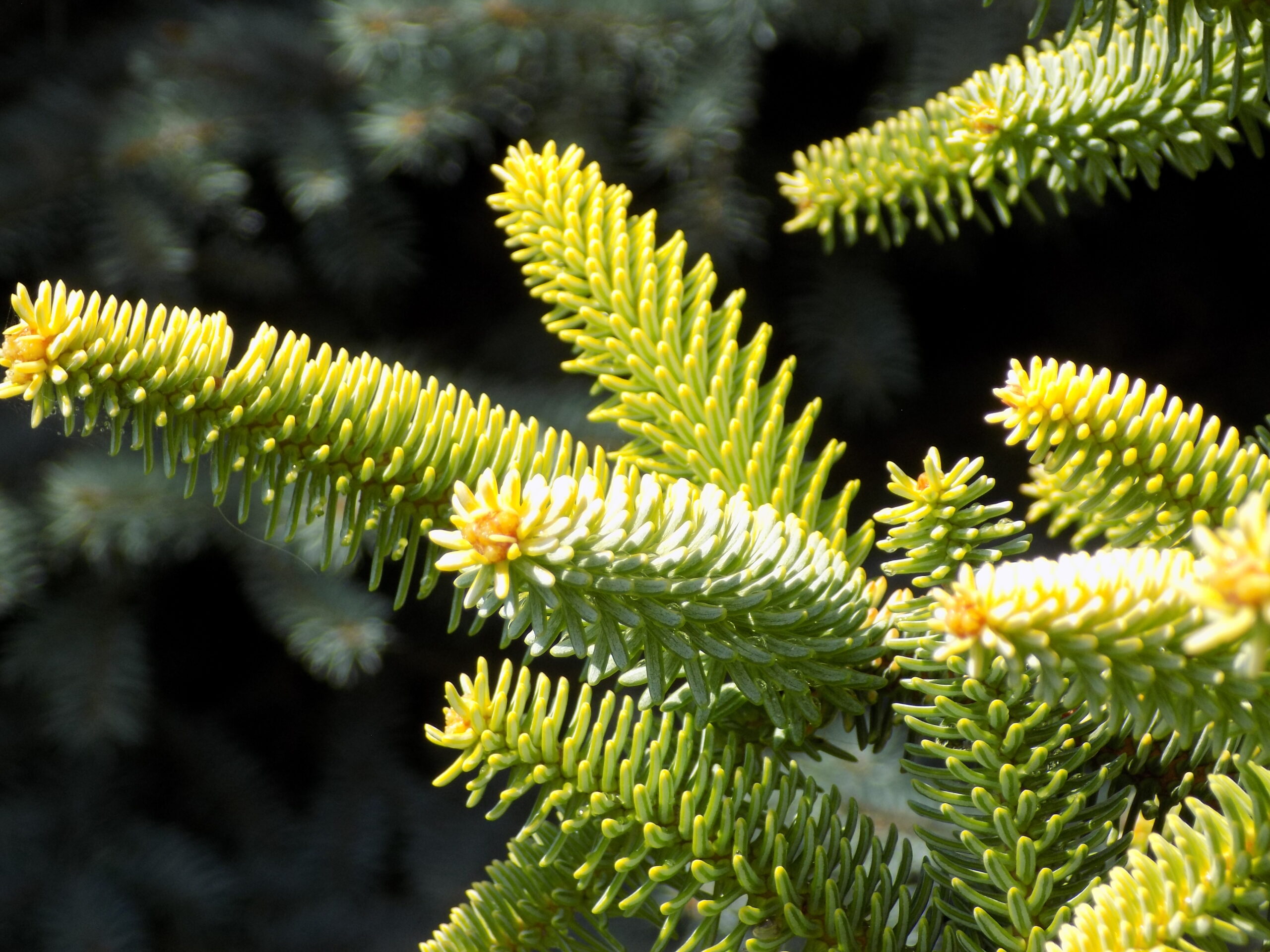
As spring awakens, the new shoots of ‘Aurea’ emerge in a vibrant display of golden-yellow to sulfur-yellow, concentrated heavily on the upper surfaces of the needles. This brilliant spring flush serves as the tree’s primary decorative feature, reaching its peak intensity when grown in exceptional light and supported by consistent soil moisture.
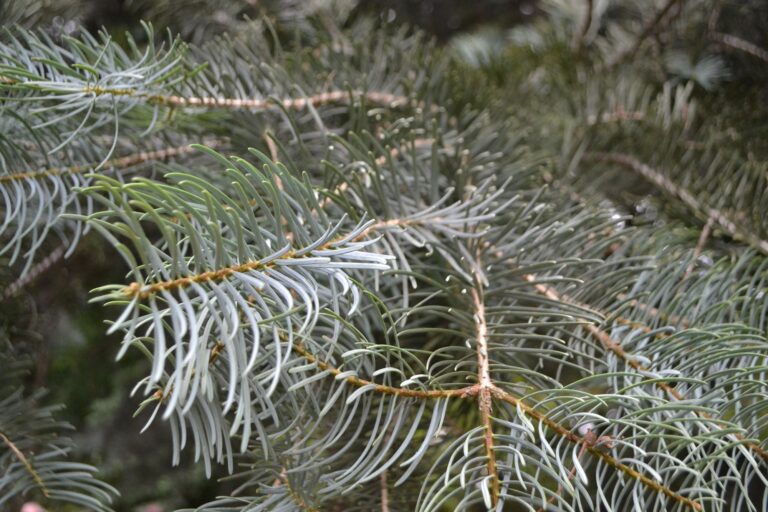
Because the short, rigid needles radiate straight out from the branchlets like a bottlebrush, the golden new growth registers visually as glowing, distinct tips against the darker interior foliage, delivering a beautiful layered and textured effect.
Maturation and winter tone
As the growing season deepens, these gilded needles slowly transition, taking 1–3 years to mature to green or blue-green, depending heavily on your local climate and site conditions. By late summer and autumn, the prevailing impression is that of a cool, blue-green to glaucous-green tree punctuated by golden new tips marking the latest growth extensions.
In cooler or maritime climates, the golden cast can persist remarkably well year-round, especially on the sunward side of the canopy. Conversely, in hot, sun-baked regions, the color tends to fade more rapidly, shifting toward standard green by winter. Some growers note that parts of the foliage assume a subtle white-gold or greenish-gold hue as winter sets in, particularly in areas characterized by intense winter sun and low temperatures.
Colour retention considerations
Predicting the endurance and intensity of the golden coloration comes down to three crucial environmental factors:
- Light exposure – Full sun triggers the most dazzling yellow flush, though it can accelerate color fading or trigger needle scorch in regions with punishing summer heat.
- Climate – Cooler maritime or moderate continental regions with mild summers help the golden tones linger longer, often keeping the majority of the canopy illuminated.
- Aspect and microclimate – In chilly zones, the yellow intensity is frequently biased toward the sunny side of the tree, resulting in an asymmetrical but highly compelling color play.
If your primary design goal is a long-lasting, brilliant gold display, target a location that receives excellent morning light but offers protection from brutal afternoon heat.
Size, Habit, and Growth Rate
Mature dimensions
Horticulturists consistently classify ‘Aurea’ as a slow-growing, compact form of Spanish fir. While mature dimensions vary based on regional conditions, typical expectations include:
- Height – Expect a mature height of 4–8 m (13–26 ft), a stature usually achieved over several decades.
- Spread – The footprint generally spans 1.5–3 m (5–10 ft), remaining narrower than its height to form a proud, conical silhouette.
North American regional guides frequently note mature heights of 15–25 ft (4.5–7.5 m) and widths of 6–8 ft (1.8–2.4 m), reinforcing its design utility as a medium-small specimen tree rather than a massive forest conifer.
Growth rate and time to maturity
Because of the reduced chlorophyll content in its foliage, this cultivar develops far more slowly than the straight species. Gardeners can anticipate a typical annual extension of just:
- 10–15 cm (4–6 in) of new growth per year.
At the 10-year mark, ‘Aurea’ typically stands at an approachable:
- 1.5 m (5 ft) tall and 1.2 m (4 ft) wide under average garden conditions.
- Certain UK references indicate a mere 1 m (3 ft) of height in 10 years for particularly compact variations, especially during their initial establishment years.
Reaching full maturity generally requires 20–50 years, making it an investment in long-term garden structure rather than an overnight screening solution.
Habit and form
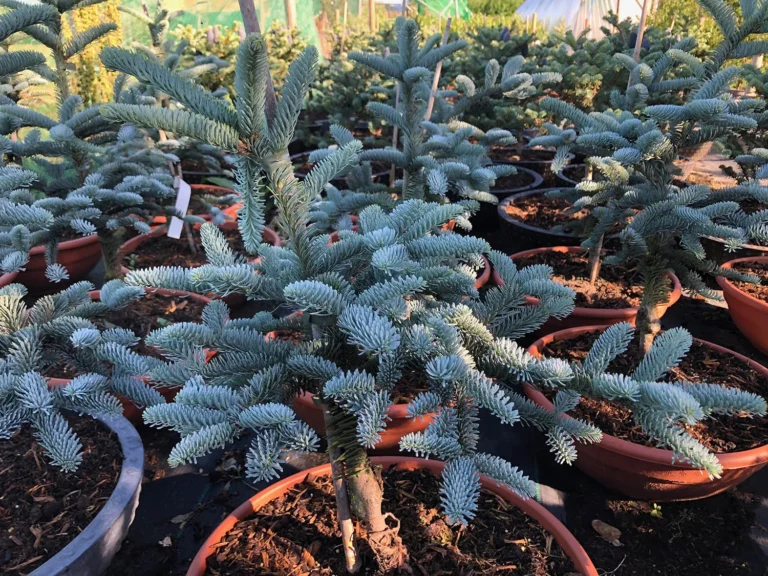
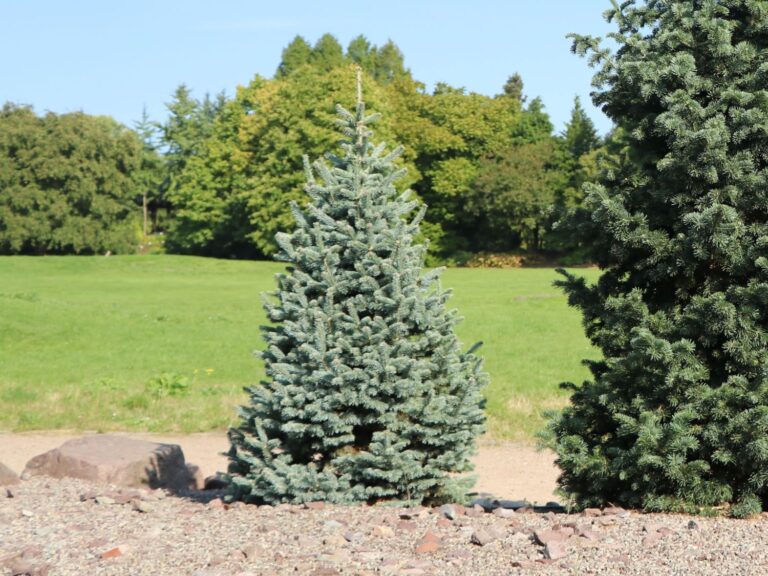
Juvenile specimens are notably conical and dense, carrying stiff branches and short needles that push out in every direction to create the distinctive “hedgehog” texture associated with Abies pinsapo. With age, the crown broadens into a broadly conical or slightly irregular form, particularly if the central leaders suffer damage from high winds, heavy snow, or periods of drought stress.
In mature landscapes, the tree can develop a beautifully irregular, almost anarchic silhouette, with structural stems and branches wandering in multiple directions to create a striking architectural statement. If you prefer a crisp, formal outline, occasional staking and light formative pruning can help maintain a perfectly upright, traditional fir shape.
Visual Design Value and Garden Character
Architectural specimen
Above all, ‘Aurea’ is prized as an architectural evergreen that brings distinct design assets to the landscape:
- It delivers a powerful vertical line anchored by beautifully layered branching.
- It provides a fine, rigid texture courtesy of its short, radially arranged needles.
- Its naturally restrained proportions fit perfectly into medium to large gardens, elegant courtyards, and expansive rock or gravel installations.
This slow development and compact nature make it a natural choice for a focal point on front lawns, near outdoor terraces, or positioned at key visual axes where the spring color display can be enjoyed intimately.
Colour contrast and planting combinations
The golden spring growth of ‘Aurea’ shines brightest when used to create dynamic color contrasts and rich textural layers:
- Juxtaposed with dark evergreens – Sited in front of or alongside deep green backdrops like Taxus, Picea abies, or dark Juniperus selections, the golden branch tips pop with dramatic intensity in the spring light.
- Paired with blue-toned conifers – Interplanting this fir with strongly glaucous choices, such as Picea pungens cultivars or Juniperus squamata ‘Blue Star’, introduces a warm, golden counterpoint to an otherwise cool, silvery palette.
- In gravel and Mediterranean-style designs – Its appreciation for sharp drainage and reasonable heat tolerance makes it an excellent companion for ornamental grasses, lavender, santolina, and sun-loving perennials, cutting through the muted tones of these schemes with its bright spring energy.
Because the golden pigment concentrates heavily on the top surfaces of the branches, siting ‘Aurea’ where onlookers can look down onto the upper canopy—such as along elevated walkways, below terraces, or outside second-story windows—greatly amplifies its visual charm.
Year-round structure
Like all true firs, ‘Aurea’ delivers invaluable evergreen structure across all four seasons:
- Spring and summer bring a lively burst of fresh color and intricate needle textures.
- Autumn and winter reveal its dense, rigorous branching and radial needle structure, maintaining a strong presence when deciduous neighbors have fallen dormant.
This year-round dependability makes it incredibly useful in four-season garden planning, particularly in regions where winter skies are gray and golden foliage helps lift the seasonal mood.
Placement for Golden Conifer Effect and Colour Retention
To coax the absolute best color performance and retention out of ‘Aurea’, keep these foundational siting principles in mind.
Light and aspect
The tree transitions happily from full sun to partial shade, though the ideal spot depends on your local climate.
In cool or maritime climates, choose a sunny, sheltered position with a south or west exposure to invite the most intense golden flush and keep the canopy bright for the maximum duration.
In hot, dry, or continental summer zones, providing a measure of afternoon shade or opting for an easterly aspect shields the needles from sunscorch and prevents premature color fading. The Royal Horticultural Society highlights that partial shade can actively prevent sun-bleaching, safeguarding the quality of the gold in regions with high light intensity.
Microclimate and exposure
Aim for a sheltered site whenever possible. Protecting the tree from desiccating winter winds or heavy, wet snow loads prevents broken leaders and preserves its sculptural symmetry. Additionally, steer clear of low-lying frost pockets where late spring frosts could nip the tender, emerging golden shoots; a slightly elevated, well-drained slope is far more reliable.
Spatial context and viewing angles
Give the tree plenty of breathing room to develop its natural form, allowing at least a 1.5–2.5 m (5–8 ft) clear radius so you won’t have to resort to disruptive, hard pruning. Position it where its upper branches remain fully visible—perhaps flanking a path that steps down below the canopy, near a patio seating area, or close to a prominent window.
In mixed conifer groupings, ensure ‘Aurea’ won’t be crowded out or cast into deep shade by faster-growing trees. It truly thrives as a mid-layer anchor or a standalone specimen rather than an understory plant.
Suitability for Different Garden Types
This adaptable yet distinct fir finds a natural home in several specific garden styles:
- Architectural and formal gardens – Where its strong verticality and predictable scale can serve as a repeating structural motif or a clean specimen planting.
- Rock gardens and large alpine collections – Where its slow, deliberate growth rate aligns beautifully with the long-term, low-maintenance ethos of alpine gardening.
- Gravel gardens and Mediterranean themes – Benefiting enormously from excellent drainage and handling warm, sunny exposures with ease once its root system is established.
- City gardens and courtyards – Providing a striking, high-impact evergreen presence that delivers structure without outgrowing intimate urban spaces.
It is less suited to tiny suburban plots where every square foot is at a premium, or locations requiring an instant visual screen or hedge, given its slow growth curve and significant eventual height.
Distinctive Traits Summary
- Foliage – Short, rigid needles radiating fully around the stems; fresh spring growth emerges a bright golden-yellow, transitioning to green or blue-green over a 1–3 year period.
- Size – Deliberate and slow-growing; typically reaching 4–8 m tall and 1.5–3 m wide over decades, though often scaling down in colder or exposed environments.
- Habit – Neatly conical throughout its youth, transforming into a broadly conical or beautifully irregular, sculptural form with age; responds well to early staking and light shaping.
- Design role – An architectural powerhouse featuring vivid spring color, deep textural contrast, and year-round structural presence; tailor-made for rock, gravel, and courtyard settings.
- Colour optimisation – Delivers its most intense golden display in bright light, requiring shelter from extreme afternoon heat in hot climates; partial shade assists in preserving color clarity.