Compact True Firs: A Collector’s Guide to Dwarf and Blue Abies Cultivars
True firs (Abies) routinely rank among the most majestic giants of the forest, but their towering wild statures often scare gardeners away. Fortunately, a brilliant world of dwarf, compact, and intensely blue cultivars offers all the dramatic flair of the genus without the property-line-threatening height. These miniature gems bring striking textures, rich colors, and structural elegance down to a manageable, human scale.
The Shasta Red Fir Riddle: Abies magnifica var. shastensis
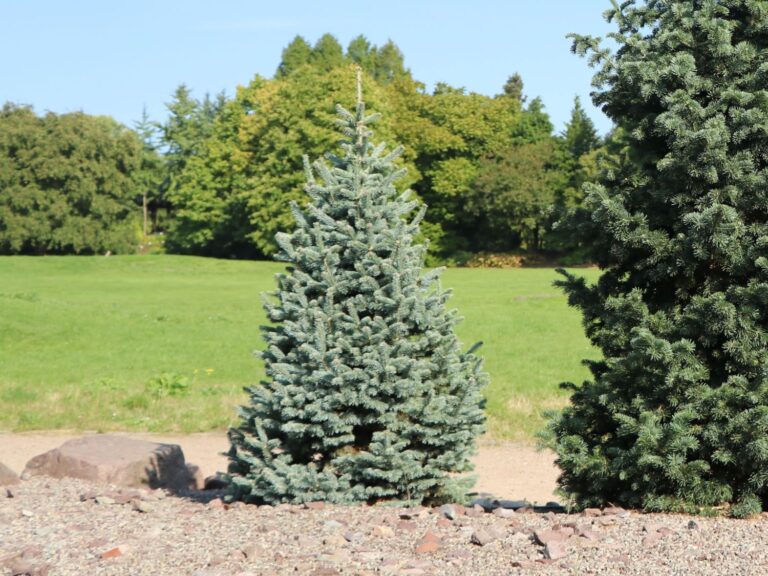
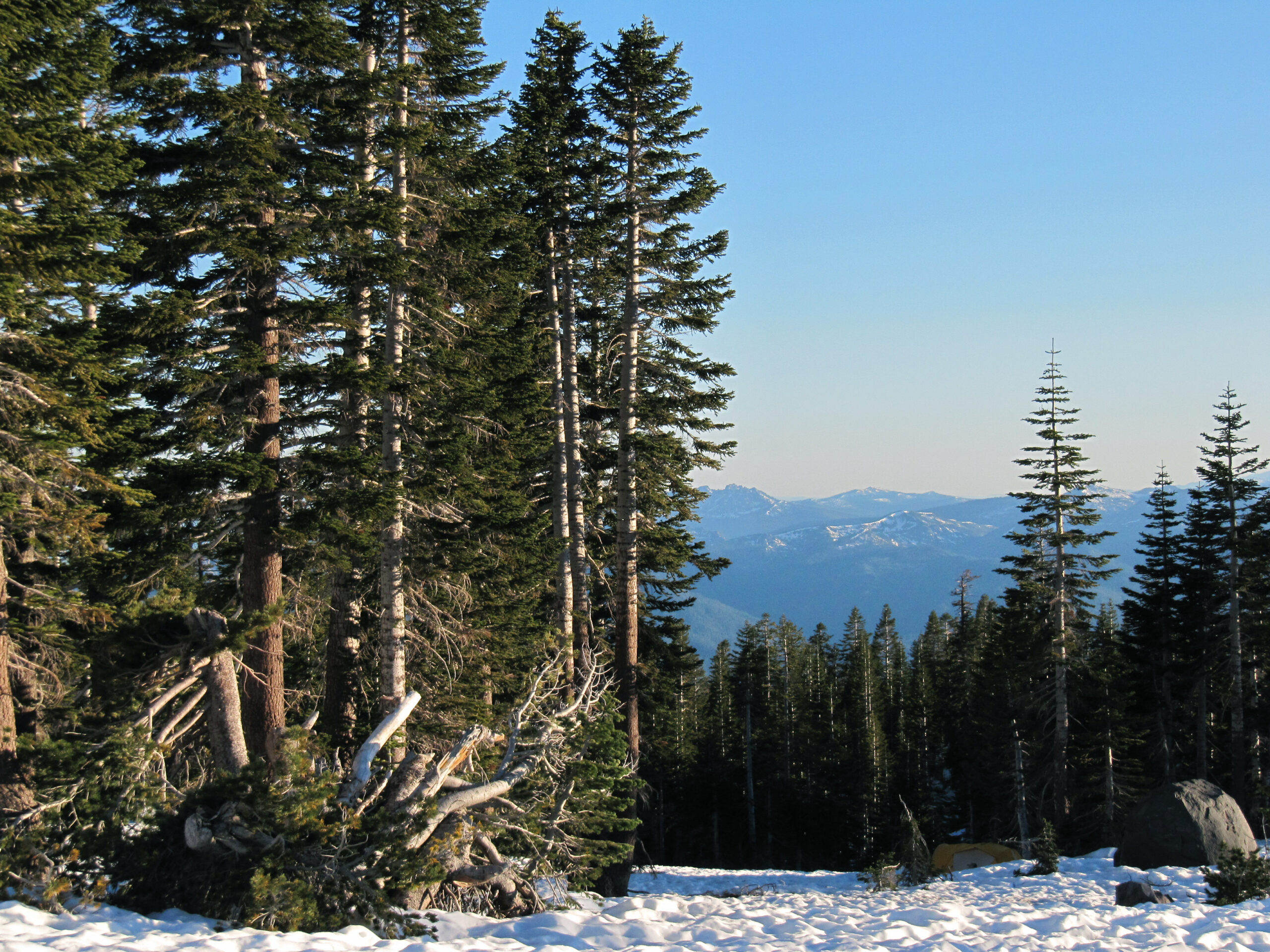
When it comes to the Shasta red fir, the line between a wild giant and a garden variety blurs. Botanists separate Abies magnifica var. shastensis from the typical California red fir based almost entirely on its reproductive anatomy rather than any obvious landscape difference. The cones of the Shasta variety are distinctly smaller—measuring 10–13 cm long compared to the massive 18–25 cm cones of the primary species—and feature highly visible, protruding bract scales that reflex outward. In the wild species, those scales remain completely hidden inside the cone structure.
Out in the garden, however, this tree is virtually identical to the standard California red fir: a statuesque, perfectly pyramidal evergreen defined by strict whorls of branches and neatly flattened needles. Because this distinction hinges on minute botanical features and the tree occupies a narrow native range in southwest Oregon and northern California, it belongs firmly within the main species profile rather than alongside true garden dwarfs.
Pint-Sized Noble Firs: Abies procera ‘Jeddeloh’ and Its Kin
‘Jeddeloh’
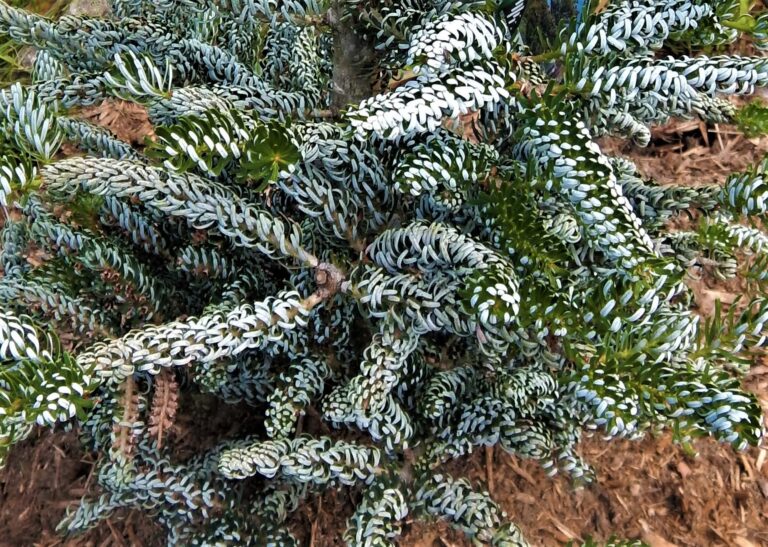
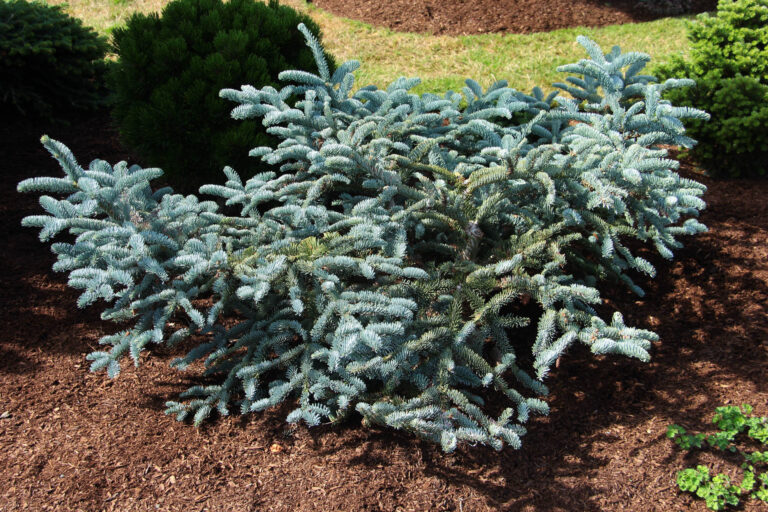
Born from a witch’s broom mutation, ‘Jeddeloh’ is an exquisitely slow-growing dwarf conifer that captures the majesty of the noble fir in miniature. It takes a full decade just to reach roughly 15 cm tall and 30 cm wide, forming a dense, impeccably behaved mound of bright, silvery-blue needles. This microscopic growth rate and dependable habit make ‘Jeddeloh’ a premier choice for stone troughs, alpine houses, or front-row placement in a dedicated conifer bed where you want noble-fir beauty without the vertical footprint.
Other Dwarf Noble Firs
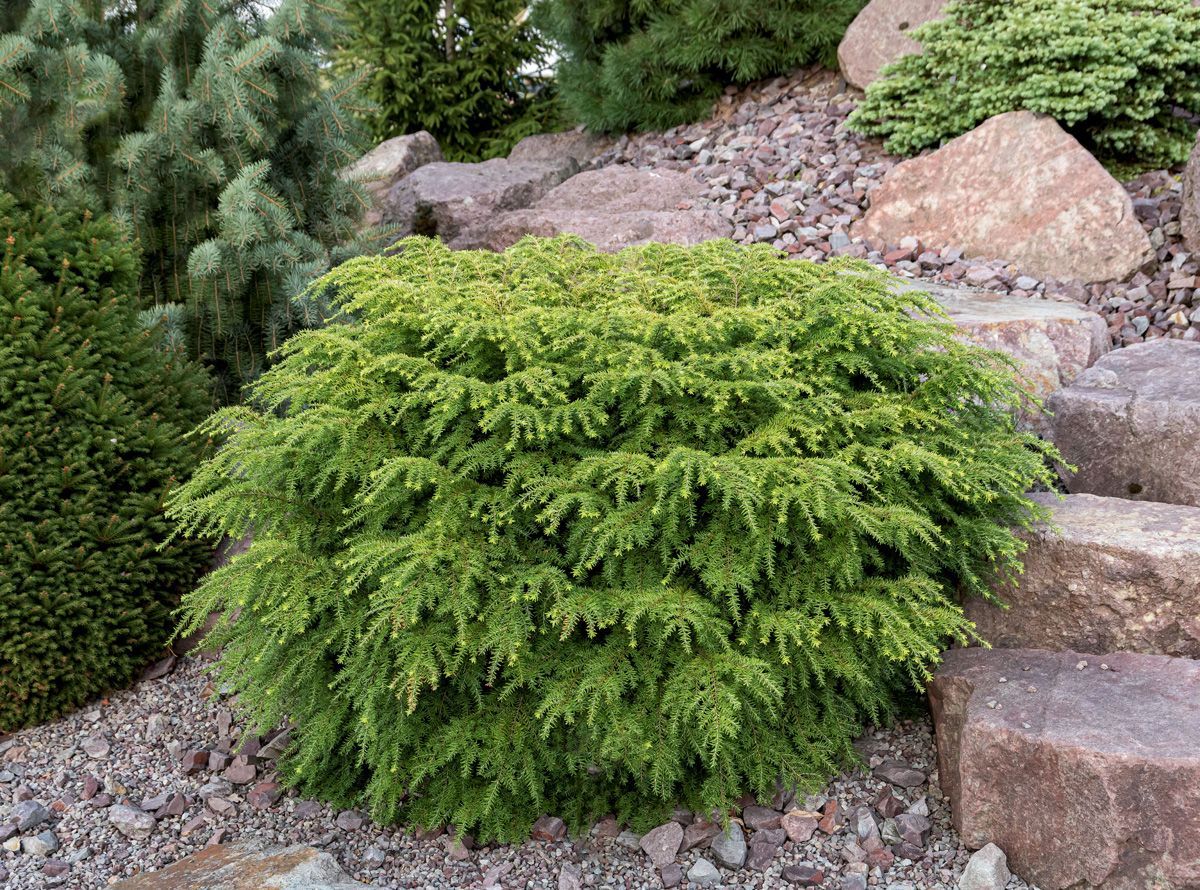
The noble fir (Abies procera) gene pool has yielded a handful of other captivating dwarfs, though gardeners must choose carefully. True miniatures like ‘Blaue Hexe’ maintain a reliably tight form, while pseudo-dwarfs like ‘Glauca Prostrata’—propagated from lateral side branches—frequently attempt to throw up a new vertical leader over time. All of these selections proudly display the species’ signature “hockey-stick” needle bases and shimmering blue-green tones. For practical design purposes, group them mentally as compact noble options, keeping in mind that ‘Jeddeloh’ remains the gold standard for absolute dwarf stability.
Jewel-Box Korean Firs: ‘Blaue Zwo’, ‘Cis’, and the ‘Blauer Eskimo’ Clan
The Korean fir (Abies koreana) is incredibly prone to producing compact, blue-gray variations, resulting in a crowded market of cultivars that share similar landscape functions. Rather than analyzing them in complete isolation, it is far more helpful to view them as a cohesive family of dwarf blue choices, each bringing a slight structural twist to the table.
‘Blaue Zwo’
Breaking the mold of the typical low-growing dwarf, ‘Blaue Zwo’ develops a dense, upright, almost columnar silhouette. It reaches roughly 1.5 m tall by 1.2 m wide over a ten-year period, delivering a brilliant pop of steel-blue foliage in spaces too narrow for standard evergreens.
‘Cis’
For those who crave geometric neatness, ‘Cis’ is an absolute triumph. This cultivar develops into a flattened, glossy sphere covered in deep green needles that radiate flatly around the stems. It averages just 1–3 inches of new growth a year, eventually maturing around 1.5 ft tall and 2 ft wide. The lustrous, polished texture makes it a striking anchor for a tailored rock garden.
‘Blauer Eskimo’ and Its Synonyms
‘Blauer Eskimo’ (frequently sold under the label ‘Blue Eskimo’) arose as a witch’s broom on the popular ‘Blauer Pfiff’. It is a true micro-miniature, expanding by a mere 2–3 cm a year to reach a tiny 15 cm height and 20 cm width in ten years. Its needles are a fascinating mix of chalky gray-green and frosted silver-blue. You will often find minor trade variants and nurseries listing this plant under slight name variations; these are best treated as part of the core ‘Blauer Eskimo’ family rather than distinct plants.
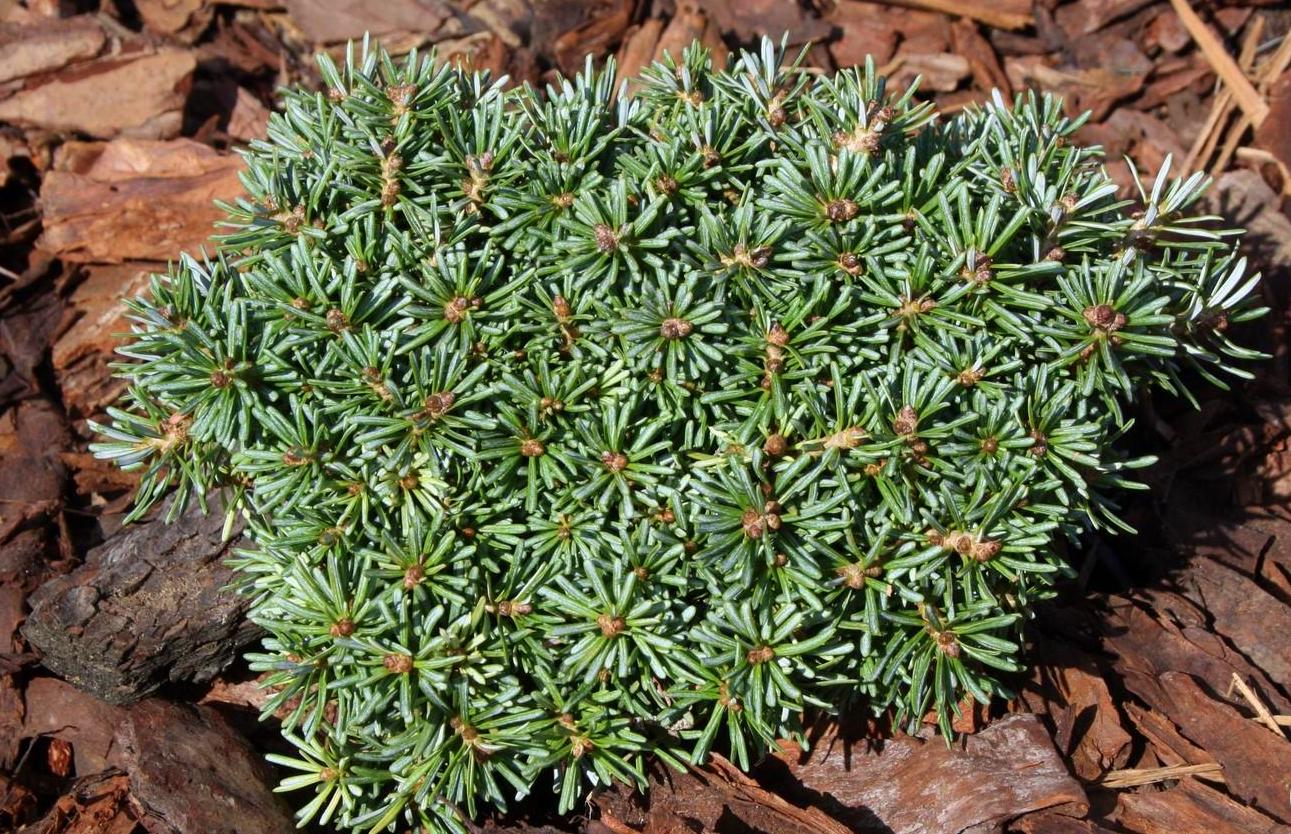
Together, these Korean selections give designers a magnificent toolset of compact blue-gray textures, running the architectural gamut from the upright stature of ‘Blaue Zwo’ to the tidy geometry of ‘Cis’ and ‘Blauer Eskimo’.
The North American Classics: Abies balsamea ‘Hudsonia’ and ‘Nana’
The Hudsoniana Group (‘Hudsonia’) and ‘Nana’ represent the heavy hitters of the dwarf balsam fir world, and the two are often confused in the trade. ‘Nana’ is incredibly widespread and mirrors A. balsamea f. hudsonia almost perfectly, with the primary botanical difference lying in how the needles arrange themselves radially around the twig. Both selections mature into rich, aromatic mounds standing 30–60 cm tall, clothed in dark green needles with clean, white-banded undersides.
Look closely, and you will see that ‘Hudsonia’ favors a slightly lower, flat-topped profile with distinctly blue-green overtones. ‘Nana’ tends to show off deep green needles accented by tan buds, which contrast beautifully against the neon-bright green flushes of spring growth. Because most of these dwarf balsam forms are completely sterile, they put all their energy into dense foliage, making them brilliant additions to scent-focused paths and small rock gardens. Other minor balsam sports without standout colors should simply be grouped under this broader dwarf balsam banner.
High-Altitude Drama: Abies lasiocarpa ‘Glauca Compacta’
If you want the icy, powdered look of a Colorado blue spruce but prefer a softer, touchable texture, ‘Glauca Compacta’ subalpine fir is an unmatched selection. This plant starts its life as a chunky globe before slowly elongating into a dense, intensely silver-blue pyramid. Depending on the specific nursery source, it eventually reaches 4–8 ft tall and 2–5 ft wide. The color holds its brilliant, metallic blue sheen all through the dead of winter. It serves beautifully as an elegant accent container plant, a rock garden centerpiece, or a structural color contrast in a mixed perennial border. Because its main appeal is the classic “dwarf plus blue” formula, it fits seamlessly into a broader collector’s layout rather than requiring isolated cultivation notes.
The Low-Slung Red Fir: Abies magnifica ‘Nana’
‘Nana’ brings the gorgeous, distinct coloration of the California red fir down to earth. This dwarf, columnar selection sports full-sized needles that display a noticeably bluer cast than the wild species. It puts on roughly 5–15 cm (2–6 inches) of growth per year, theoretically capable of reaching 10 ft by 3 ft in a decade, though real-world specimens often grow much slower—exemplified by an iconic 50-year-old plant at the Arnold Arboretum that topped out at just 1.5 m tall. It thrives best in cool, consistently moist, acidic soils, possesses very little tolerance for drought, and is reliably hardy down to USDA Zone 5. It shines best when showcased alongside other elite dwarf fir variations.
Shades of Powder Blue: Dwarf and Distinctive White Firs
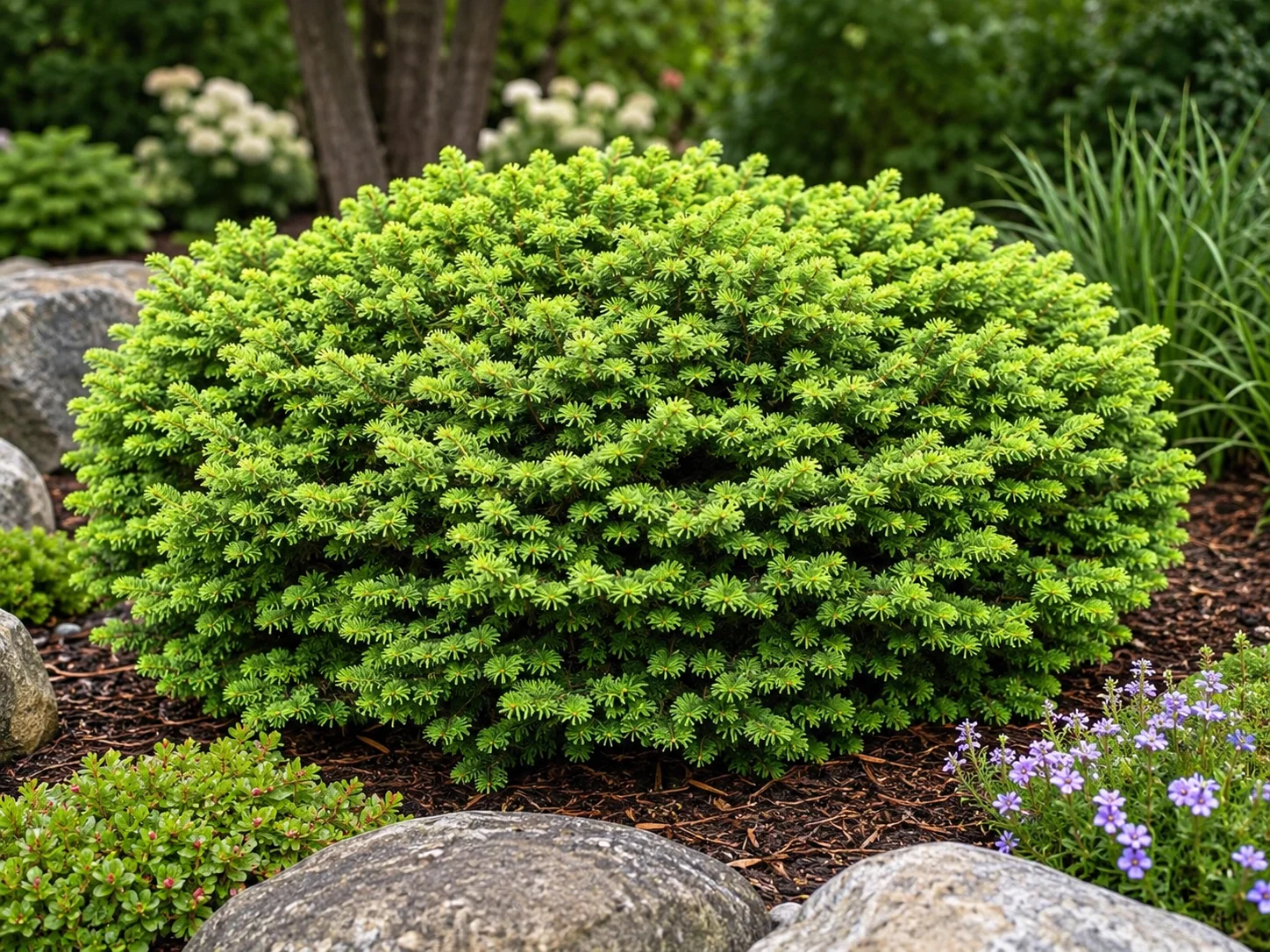
The white fir (Abies concolor) has given rise to an impressive lineup of blue and compact garden cultivars, many of which share similar cultivation needs and aesthetic themes. The standout selections include:
- ‘Candicans’: The undisputed heavyweight of blue white firs, featuring massive, sickle-shaped, powder-blue needles on a strong vertical frame.
- ‘Blue Cloak’: A graceful, slower-growing option that combines shimmering blue needles with a charmingly relaxed, weeping branch habit.
- ‘Compacta’: A sturdy, slow, upright dwarf that forms an asymmetrical mound roughly 6 ft tall in ten years, showing off large, robust blue needles.
- ‘Conica’: A sharply narrow, conical dwarf that grows significantly slower than the wild species, making it an excellent vertical pillar for tight spaces.
- ‘La Veta’: A spectacular, ground-hugging dwarf that creeps horizontally at first with long, layered, icy-blue needles, eventually forming a flattened globe 60 cm tall and 90 cm wide after a decade.
- ‘Archer’s Dwarf’: A highly symmetrical, uniform beauty packed with soft, silver-blue needles, reaching 3–6 ft tall in 10 years.
- ‘Violacea’: A classic, breathtaking form featuring intense, near-purple, silvery-blue needles, typically sold as a grafted specimen on sturdy species rootstock.
Minor or obscure Abies concolor seedlings that lack strong recognition in the arboretum circuit are best grouped under this main white fir cultivar umbrella, as they all share the same love for well-drained soil and crisp blue styling.
European Elegance: Compact and Colorful Nordmann Firs
The Caucasian or Nordmann fir (Abies nordmanniana) features a handful of unique compact, weeping, and color-variegated cultivars that make spectacular additions to a collector’s landscape. Key forms to seek out include:
- ‘Golden Spreader’: A showstopping dwarf that breaks the blue mold, forming a low, spreading cushion of chartreuse and gold, with brilliant yellow new growth in spring.
- ‘Silver Del’: A slender, slow-growing vertical accent that reaches 4–8 ft, featuring beautiful cream-colored variegation along the needles.
- ‘Barabits Compact’: A tough, low-slung, mat-forming green selection introduced out of Hungary in 1985.
- ‘Dobøichovice’: A highly dense, perfectly pyramidal dwarf found as a witch’s broom in Czechia in 1998.
- ‘Horizontalis’: A historic, flat-growing French cultivar that spreads wide while remaining entirely prostrate.
While selections with dramatic architectural changes—like prostrate carpets or bright gold foliage—demand individual attention, the more minor green compact sports should be grouped together under the general Nordmann cultivar banner.
Mediterranean architectural Gems: Cultivars of the Spanish Fir
The Spanish fir (Abies pinsapo) is famous for its stiff, sharp needles arranged in perfect spirals around the twigs, giving the branches a unique, pipe-cleaner appearance. Its garden variants offer incredible texture:
- ‘Aurea’ (Golden Spanish Fir): A slow, conical shrub that eventually matures into a small, structural tree. Its stiff needles emerge a luminous golden-yellow before softening to a glaucous blue-green. Growing 4–6 inches a year, it reaches roughly 5 ft tall and 4 ft wide in ten years, though the gold can fade to green by winter in cloudy climates.
- ‘Glauca’ (Blue Spanish Fir): A stunning, broadly conical tree covered in frosty, blunt, electric-blue needles. It can eventually reach anywhere from 15 to 60 ft tall and 7 to 30 ft wide, making a massive year-round color statement. This exceptional plant earned the prestigious RHS Award of Garden Merit in 1993.
- ‘Horstmann’: A robust, wide-spreading dwarf with icy, silver-blue needles.
- ‘Clarke’: A highly dependable, slow-growing dwarf collector’s piece.
- ‘San Fernando’ (also known as ‘San Pedro’): An extreme micro-dwarf displaying tight, gray-green growth.
- ‘Soltau’: An incredibly dense, tightly packed conical selection that reaches roughly 2 m after ten years of growth.
In wild stands, individual trees occasionally show off much brighter blue coloration due to dense bands of microscopic stomata on the needle surfaces; the cultivar name ‘Glauca’ dates back to a specific French seedling selected before 1867 to preserve this striking wild trait.
Collector’s Taxonomy Notes: Evaluating True Varieties
For the serious conifer collector, it helps to separate true landscape cultivars from purely botanical varieties. Subspecies and wild varieties distinguished solely by geographical provenance, minor variations in cone dimensions, or microscopic needle anatomy—such as Abies magnifica var. shastensis—are best kept on the primary species profiles. Because these plants maintain the standard growth rates and massive proportions of their wild parents, they do not fill the same landscape niches as true dwarf garden selections.
Design Combinations and Visual Values
- Rock Gardens and Troughs: Cultivars like ‘Jeddeloh’, ‘Blauer Eskimo’, ‘Cis’, ‘Hudsonia’/’Nana’, and ‘Glauca Compacta’ offer tight, deeply textured structural focal points that anchor alpine plantings without swamping their neighbors.
- Year-Round Color Contrast: Use the intense, frosted metallic tones of ‘Candicans’, ‘Blue Cloak’, ‘Glauca’, and the glowing ‘Aurea’ to break up monochromatic dark greens in the winter landscape.
- Vertical Accents for Tight Spaces: Look to ‘Blaue Zwo’, ‘Conica’, and ‘Archer’s Dwarf’ to provide crisp, narrow, upright forms that function beautifully as living exclamation points in restricted borders.
- Formal Structure: The clean, geometric shapes of ‘Cis’ and ‘Dobøichovice’ provide organic spheres and sharp pyramids that perfectly complement modern or formal garden layouts.