Meet Abutilon ‘Cannington Carol’: The Flowering Maple That Steals the Show with Radiant Foliage
With its striking cream-and-gold splashed leaves and pendulous scarlet bells, Abutilon ‘Cannington Carol’ is far more than a simple flowering shrub. This compact, evergreen flowering maple is a true foliage-first masterpiece, engineered to deliver high-impact color to the garden even when it isn’t in bloom. Developed in the 1970s at Somerset’s renowned Cannington College, this unique cultivar completely redefines how we use abutilons in small landscapes and container design.
Unraveling the Cultivar Identity
To appreciate ‘Cannington Carol’, you must first look at its botanical roots. This plant belongs to the cultivated flowering-maple group under the genus Abutilon, a vibrant branch of the mallow (Malvaceae) family. Its name is a registered horticultural cultivar designation, not a wild botanical species. Because modern abutilon cultivars are the products of intricate, multi-generational hybridizing, no publicly available records pinpoint the exact species parentage behind this selection.
This distinction is vital for accurate identification. Gardeners must not confuse this refined ornamental with Abutilon theophrasti—the fast-growing, weed-like annual known colloquially as velvetleaf—nor should it be mistaken for Abutilon megapotamicum, the sprawling, trailing species frequently sold as Brazilian abutilon. ‘Cannington Carol’ stands entirely apart as a well-behaved, bushy shrub selected intentionally for its spectacular, paint-splattered leaves and rich contrast.
The Historic Cannington College Origins
The story of ‘Cannington Carol’ is woven directly into the golden age of British nursery selection. During the 1970s, Cannington College in Somerset introduced a handful of standout variegated abutilons to the market. These introductions were revolutionary for their time because the breeders treated leaf variegation as the headline attraction, rather than treating it as an accidental curiosity.
The “Cannington” name is far more than a simple geographic stamp of British provenance; it serves as a pedigree. It tethers the plant to a celebrated lineage of foliage-centric selections. Among its peers, ‘Cannington Carol’ remains particularly prized for the sheer intensity of its yellow-and-cream mottling and its remarkably disciplined, compact growth habit.
Award-Winning Distinction
At maturity, ‘Cannington Carol’ forms a dense, neat evergreen mound measuring roughly 0.5 to 1 meter in both height and spread. It features distinctly lobed, maple-like leaves heavily flecked with gold, out of which drop rich, bowl-shaped scarlet flowers from early spring right through the first whispers of autumn.
This stellar performance has not gone unnoticed. The cultivar proudly holds the prestigious Royal Horticultural Society (RHS) Award of Garden Merit. This coveted stamp of approval guarantees that the plant has excelled in rigorous trials, proving it possesses superior ornamental value, excellent constitution, and reliable performance when grown in appropriate conditions.
A Masterclass in Foliage Character
Intricate Mottling Over Plain Borders
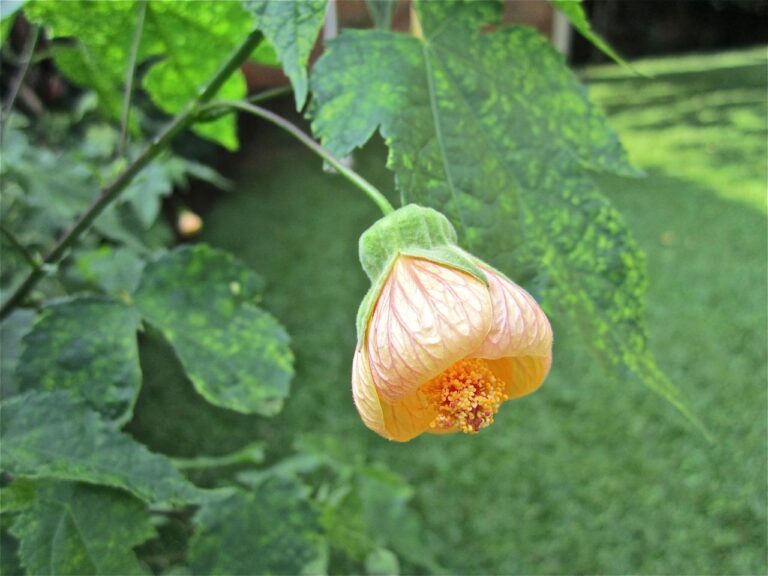
What truly defines ‘Cannington Carol’ is the chaotic beauty of its variegation. Instead of the clean, predictable cream borders or sharp central stripes seen on lesser cultivars, this plant features dark green leaves that are wildly, irregularly marbled with yellow and cream.
Step close to a single specimen, and you will discover a fascinating mix of leaf patterns:
- Deep forest green shattered by thousands of tiny yellow flecks.
- Mid-green blades broadly clouded over by warm, buttery yellow.
- Intricate marbled tapestries where cream and green contest the leaf blade evenly.
- Luminous, nearly pure cream leaves with only a few veins of green remaining.
This unpredictable distribution creates an incredibly lively, painterly surface. From across the garden, the shrub reads as a glowing cloud of pale chartreuse; up close, the fascinating complexity of the individual leaves becomes the main event. This natural irregularity keeps the plant from ever looking stiff, sterile, or mechanically produced.
The Fluid Evolution of Cream Phases
It is entirely normal for specific flushes of growth on ‘Cannington Carol’ to push so heavily into variegation that individual leaves turn almost completely cream. This striking trait is one of the most reliable ways to verify the cultivar’s identity. However, gardeners should not expect uniform paleness across every branch.
The shrub behaves as a constantly shifting visual mosaic throughout the growing season. Fresh spring growth frequently displays a completely different color balance than mature summer foliage. A single branch can simultaneously showcase a dramatic spectrum of pattern intensities, and specific shoots may suddenly flush much lighter than the rest of the canopy. This natural ebb and flow between green-dominant and cream-dominant phases is precisely what makes the plant so mesmerizing over time, though it also means a single snapshot rarely captures the full personality of a mature specimen.
Leaf Architecture and Texture
The deeply lobed architecture of the foliage mirrors the iconic silhouette of classic maples. This structural shape works beautifully with the plant’s coloration. The deep indentations of the lobes break up the pale cream patches into distinct, multi-dimensional panels, preventing the shrub from looking like a flat, washed-out mass of pale color.
This interplay between soft, sculpted lobes and erratic coloring becomes spectacular when staged strategically. By placing the plant against a saturated, dark background—such as a deep green evergreen hedge, a shadowed stone wall, or a charcoal-colored container—the luminous cream portions of the leaf blade instantly pop, providing immense visual brightness without relying on heavy blooms. To review universal soil drainage metrics and standard microclimate positioning for these unique shrubs, consult the comprehensive master guide to growing Abutilon varieties.
Fire and Ice: Flowers and Seasonal Synergy
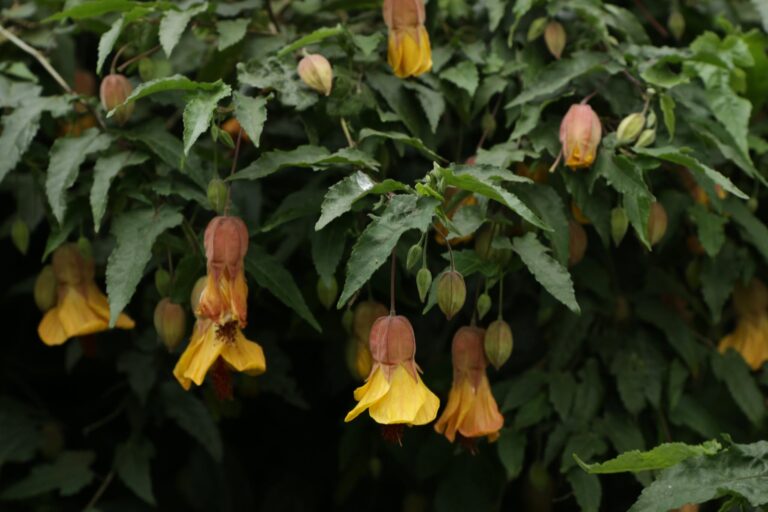
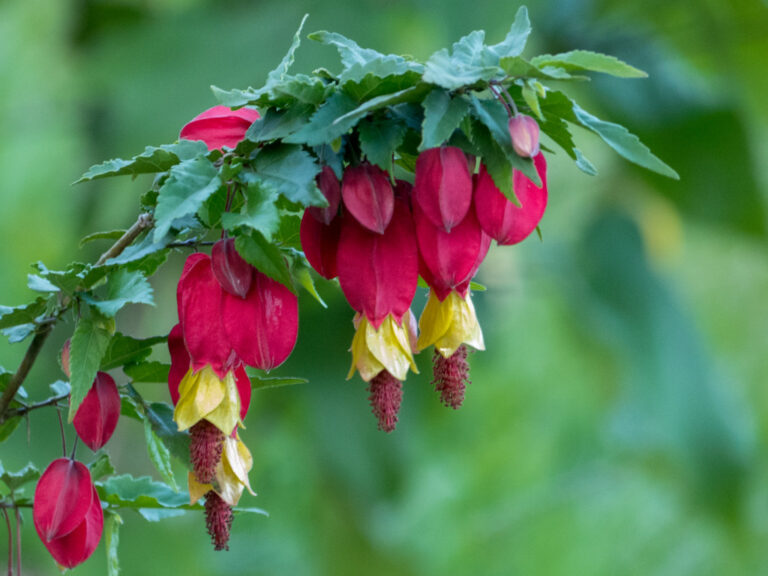
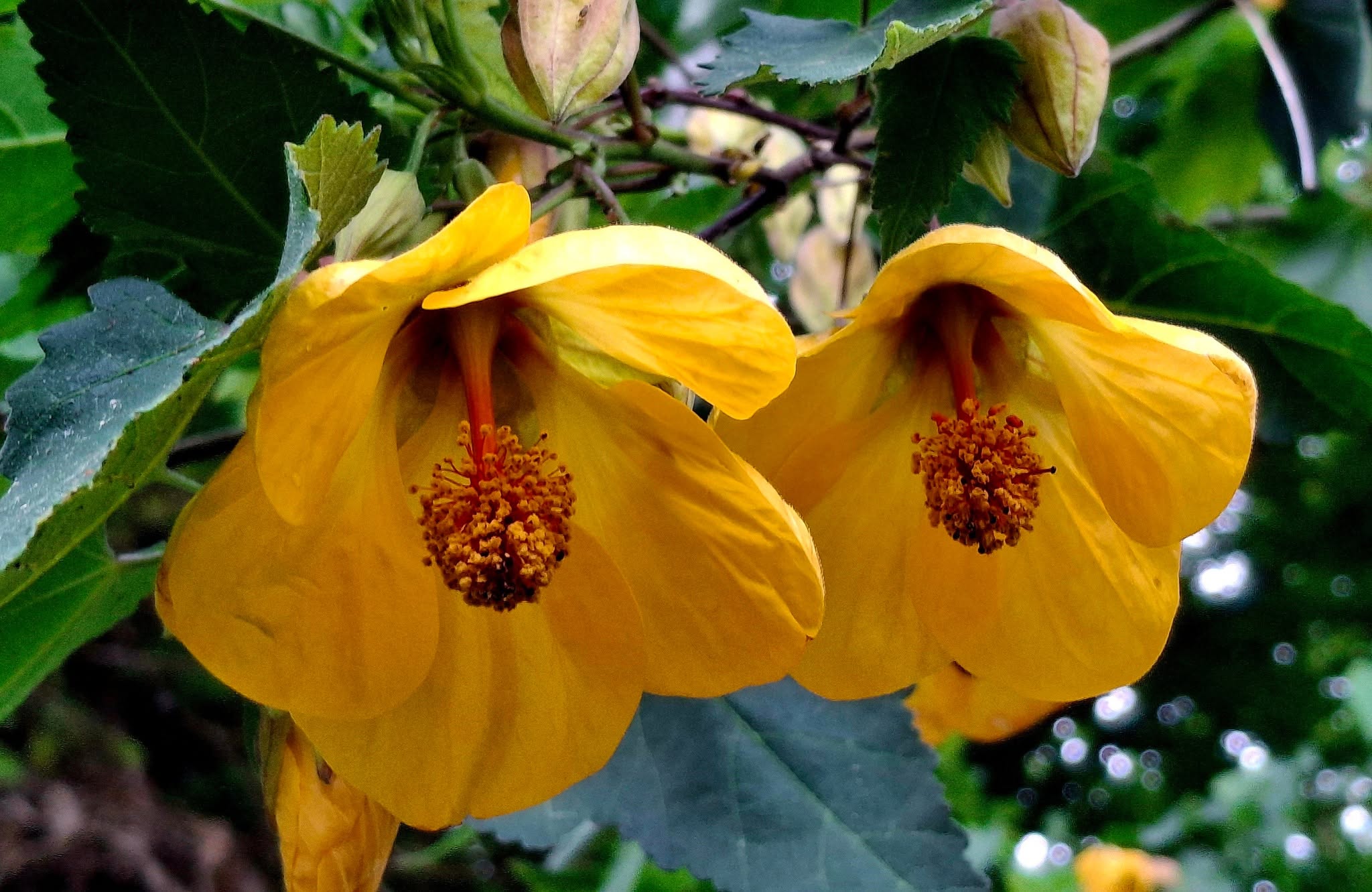
When ‘Cannington Carol’ does flower, the effect is theatrical. The pendulous, bell-like blossoms emerge in a rich, saturated scarlet that cuts sharply through the pale, frosted canopy. Given proper warmth and light, this flowering display runs continuously from spring until late autumn.
The blossoms add a gorgeous structural layer to the plant:
- The nodding, down-turned habit gives the entire shrub an elegant, gently swaying motion and an undeniably exotic, tropical flair.
- The intense scarlet saturation creates a flawless color contrast against the heavily cream-marbled leaves.
- Rather than getting lost in the variegation, the bright red bells punch through the foliage as distinct, clean focal points.
- The relentless succession of blooms ensures the plant constantly renews its energy well past the initial spring push.
Unlike common abutilons where a heavy flush of flowers completely obscures the branches, ‘Cannington Carol’ strikes a perfect balance. The fiery bells act as brilliant punctuation marks across a sophisticated, highly visible foliage canvas, keeping the plant remarkably ornamental even during brief rests between heavy blooms.
Proportions and Structural Scale
While many hybrid abutilons quickly turn into unruly, leggy giants, ‘Cannington Carol’ maintains a polite, compact stance. While it can occasionally reach 1 meter, it typically matures into a dense, beautifully proportioned shrub roughly 80 cm tall by 50 cm wide.
This restrained scale is an absolute gift for space-conscious gardeners. Instead of climbing, trailing, or clambering over neighbors, it anchors its designated spot with a tidy, architectural presence.
In a thoughtful garden layout, its proportions excel in several key roles:
- As an exquisite, mid-sized standalone specimen in premium patio pots.
- Staged in the foreground or middle tier of warm, south-facing, sheltered borders.
- As a brilliant, illuminating accent planted directly in front of dark, monolithic shrubs.
- Brought indoors as a seasonal centerpiece for bright conservatories or glasshouses.
- As a refined, fine-textured companion to coarse, bold-leafed tropical plants.
Because the foliage is so intricate, the plant demands to be noticed. Its restrained footprint allows you to place it exactly where visitors can admire the mottling up close—right alongside garden paths, near main entryways, on intimate terraces, or flanking outdoor seating areas.
Designing the Landscape and Container Layout
The Solo Foliage Focal Point
Because ‘Cannington Carol’ carries such a complex pattern, it delivers its maximum design impact when used as a singular accent. Cramming it into a bed filled with other variegated or polka-dotted plants creates visual noise and dilutes its charm. Instead, isolate a specimen so its irregular marbling can truly breathe. Position it where it can catch the eye from across the yard, yet sits close enough to reward a visitor who stops to examine the shifting colors of its leaves.
Creating Contrast Against Dark Backdrops
To make the cream and gold tones highly legible, pair this abutilon with deep, solid hues. Exceptional companion plants include those featuring:
- Unmarked, deep forest-green leaves.
- Strongly vertical, upright, or strap-shaped foliage to contrast the mounded habit.
- Broad, oversized leaves with a rich matte texture.
- Subtle touches of deep plum, midnight purple, or bronze.
The design goal here is a stark contrast in both color and leaf texture, rather than a battle between competing patterns. Deep-toned cannas, dark elephant ears (Colocasia), ornamental bananas, or solid green structural shrubs make magnificent backdrops—just ensure these aggressive neighbors do not crowd out or shade this relatively compact abutilon.
Harmonizing with Silver and Blue
For an entirely different aesthetic, frame ‘Cannington Carol’ with cool silver and blue-grey companions. This approach softens the bright cream markings, resulting in a serene, sophisticated composition that glows beautifully in low twilight or Mediterranean-style garden themes. Use these silver companions with a light touch, however; an excess of grey or white nearby can easily wash out the contrast, making the abutilon’s buttery tones look muddy rather than distinct.
Echoing the Scarlet Bells
The pendulous red flowers offer an open invitation to play with color echoes. Introducing scarlet bedding plants, rich burgundy foliage accents, or classic terracotta pots elsewhere in the space will effortlessly tie the design together. The golden rule here is restraint: repeat the rich red tone just once or twice in the surrounding area. Overloading the space with brilliant red will desensitize the eye, whereas a sparse, deliberate echo makes the abutilon’s hanging bells look beautifully intentional.
Masterful Container Pairings
Given its compact genetics, ‘Cannington Carol’ is an elite choice for pot culture. Container cultivation lifts the plant closer to eye level and allows you to move it to prime real estate—such as right beside a front door, on a sheltered veranda, or guarding a conservatory threshold.
Consider these specific container styles to set the mood:
- Deep Charcoal or True Black: Maximizes the brightness of the cream and green foliage.
- Classic Terracotta: Instantly warms up the rich yellow variegation and glowing red flowers.
- Pale Limestone or Cast Stone: Creates a quiet, understated, and elegant tonal look.
- A Sleek, Modern Cylinder: Eliminates visual distractions, keeping the eye focused entirely on the leaf patterns.
- Heavy, Architectural Urns: Provides the visual weight required to ground and balance the swinging, pendulous flowers.
Whatever your style, choose a container with clean lines. Ornate, heavily patterned pots will clash directly with the marbling of the leaves.
The Authentic Identification Guide
If you suspect you have found a true ‘Cannington Carol’, the plant should check almost every box in this comprehensive diagnostic profile:
| Diagnostic Feature | True Cultivar Standard |
|---|---|
| Growth Habit | Compact, multi-stemmed evergreen shrub. |
| Mature Proportions | Generally 0.5–1 m tall and wide; frequently settling around 80 × 50 cm. |
| Leaf Morphology | Sharply lobed; beautifully marbled and mottled, never featuring clean, solid borders. |
| Foliage Palette | An intricate mix of dark forest green, bright yellow, and rich cream. |
| Pattern Dynamics | Highly variable; occasional branches or leaves may emerge almost entirely cream. |
| Flower Profile | Nodding, pendulous, bowl-shaped blossoms in an unmistakable, saturated scarlet. |
| Blooming Window | Spans continuously from early spring all the way through autumn under ideal conditions. |
| Pedigree & History | Direct traceable origins to breeding work at Cannington College, Somerset, during the 1970s. |
| Industry Standing | Holder of the official RHS Award of Garden Merit. |
Never attempt to identify this plant based on yellow-flecked leaves alone. Countless older abutilon varieties sport basic yellow spotting. A foolproof identification requires the total package: a well-behaved compact habit, erratic and heavy yellow-and-cream marbling, pure cream leaf phases, and those unmistakable dangling scarlet bells.
Why It Deserves a Spot in Your Garden
Abutilon ‘Cannington Carol’ earns its legendary status because it packs an astonishing amount of visual interest into a remarkably small footprint. This isn’t just another red-flowered shrub that happens to have a bit of leaf color; it is a meticulously selected cultivar where the mesmerizing foliage serves as the primary asset.
Ultimately, its finest qualities speak for themselves:
- A proud, traceable horticultural pedigree from Cannington College.
- Breathtaking, marbled cream-and-gold foliage that breaks away from boring, static green borders.
- An ever-changing canopy that shifts beautifully between deep green and brilliant cream.
- A perfectly behaved, compact scale tailored for small courtyard gardens and patio containers.
- Fiery scarlet blossoms that create an immediate, high-contrast dialogue with the leaves.
- The peace of mind that comes with an official RHS Award of Garden Merit.
For gardeners who love the lush, dramatic look of tropical flowering maples but lack the space for a massive shrub, ‘Cannington Carol’ delivers the perfect solution. Give it a warm, sheltered spot where its marbled leaves can contrast against a clean, dark backdrop, let its scarlet bells swing freely, and enjoy one of the finest foliage plants ever introduced.