Growing Abutilon ‘Bella Red’: The Ultimate Dwarf Flowering Maple
Abutilon × hybridum ‘Bella Red’ is a genuinely dwarf flowering maple, a distinct genetic miniature rather than a standard, vigorous hybrid temporarily held in check by a pair of pruners. In a single growing season, this compact powerhouse tops out at a modest 1 to 1.5 feet (30–45 cm), shaping itself into a tidy, dense mound studded with oversized, lantern-like, reddish-orange blossoms. This restrained footprint makes it an invaluable asset for container displays, hanging baskets, tight patio corners, sun-drenched conservatories, and front-row bedding. It serves a completely different garden role than conventional flowering-maple hybrids, which routinely rocket to towering heights of 6 to 10 feet in the shrub border.
At a glance
| Feature | ‘Bella Red’ |
|---|---|
| Botanical name | Abutilon × hybridum ‘Bella Red’ |
| Common names | Flowering maple, Chinese lantern, Chinese bellflower |
| Family | Malvaceae |
| Habit | Compact, upright to gently spreading flowering shrub |
| Seasonal height | About 1–1.5 ft (30–45 cm) |
| Approximate spread | About 1–1.5 ft (30–45 cm) |
| Flowers | Large, pendent, bell- or cup-shaped |
| Flower colour | Reddish-orange to red, commonly with a contrasting yellow centre |
| Flower size | Up to about 3 in (7–8 cm) across |
| Foliage | Light green, maple-like, palmately lobed |
| Typical flowering | Late summer into autumn outdoors; potentially longer under protected conditions |
| Hardiness | Usually treated as frost-tender; best suited to USDA Zones 9–10 |
| Best uses | Patio pots, hanging baskets, window boxes, conservatories, sunny indoor displays, seasonal beds |
What makes ‘Bella Red’ distinctive?
A true dwarf form
Many plants sold under the umbrella of flowering maples are actually rampantly growing, woody powerhouses capable of evolving into massive shrubs in frost-free climates. The broader Abutilon × hybridum complex is famous for hitting heights of 8 to 10 feet given the right winterless conditions, and even when grown as temporary annual additions in chilly northern zones, they easily stretch 2 to 4 feet in a few short months. ‘Bella Red’ breaks the mold completely by topping out at a predictable 1 to 1.5 feet over a season.
This inherent structural restraint is the cultivar’s crowning horticultural achievement. It unlocks the ability to showcase the plant at eye level on a tabletop, slip it into a shallow balcony trough, or intermingle it with typical bedding plants without the fear that it will aggressively swallow its neighbors.
Keep in mind that if you overwinter this plant in a protected greenhouse, garden in a completely frost-free zone, or skip size-controlling maintenance, it can eventually exceed these dimensions. Even then, its natural architecture remains vastly more manageable and scaled-down than any traditional standard hybrid.
Maple-like foliage without being a maple
The soft green, palmately lobed leaves instantly explain why gardeners dubbed this group the “flowering maples.” However, the relationship is skin-deep. Botanically, Abutilon belongs to the mallow family (Malvaceae), making it a cousin to hibiscus and hollyhocks, completely unrelated to true maples in the genus Acer.
On ‘Bella Red’, this lush canopy behaves as a crisp, solid green backdrop designed to throw the intense flower colors into sharp relief. It operates quite differently from varieties prized for cream, white, or gold variegation; this is an unapologetically flower-driven selection where the visual payload comes from the contrast of neon blooms against bright jade leaves.
The structural pattern of the foliage adds great textual value. The crisply pointed lobes deliver a delicate, sharply cut silhouette that brings far more sophistication to a design than standard, round-leaved annual choices.
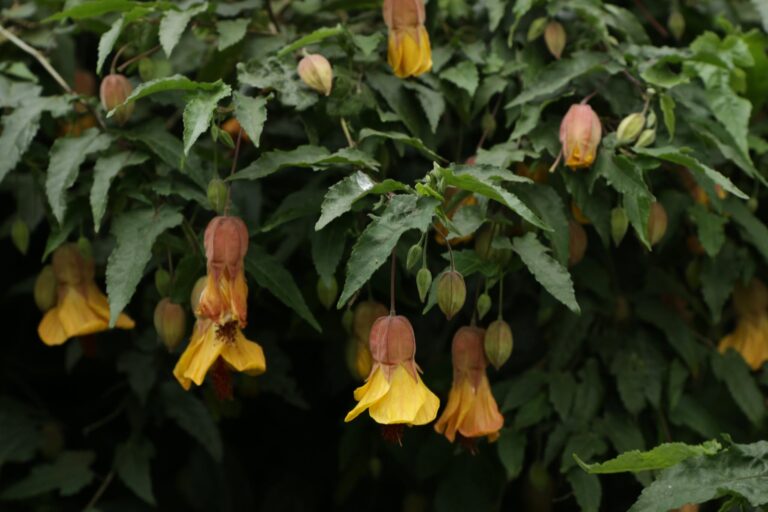
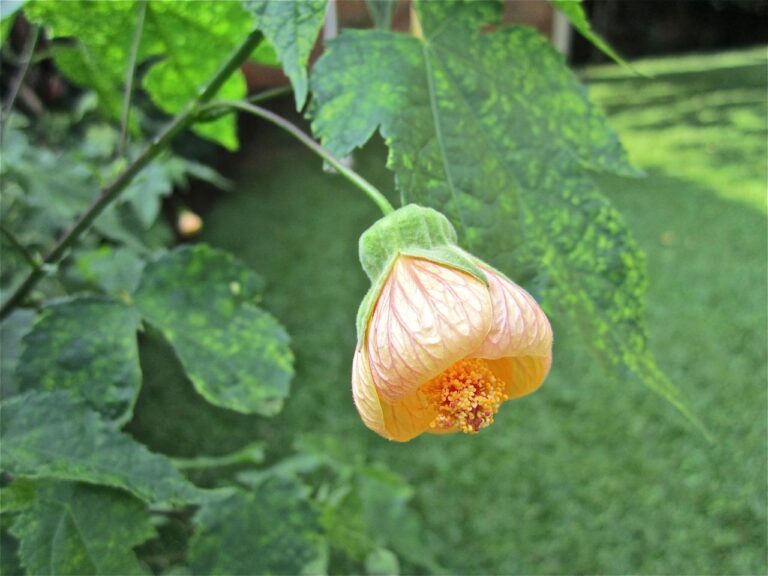
Large, pendulous reddish-orange flowers
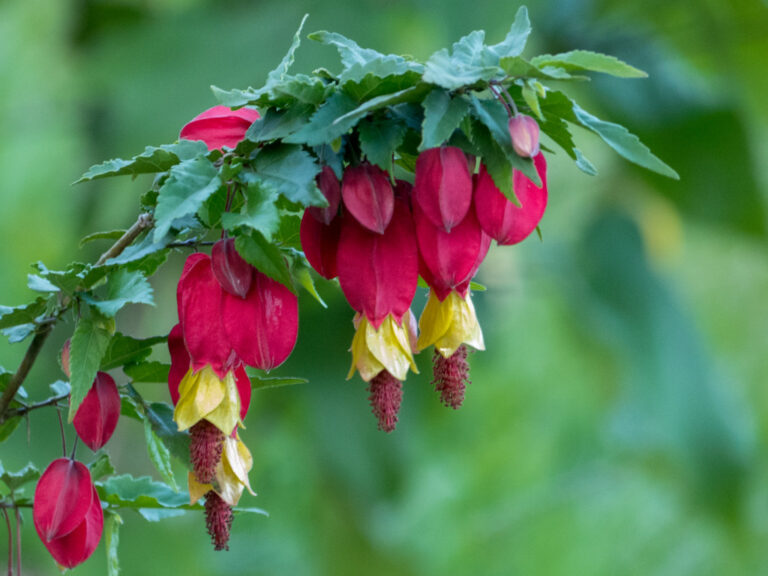
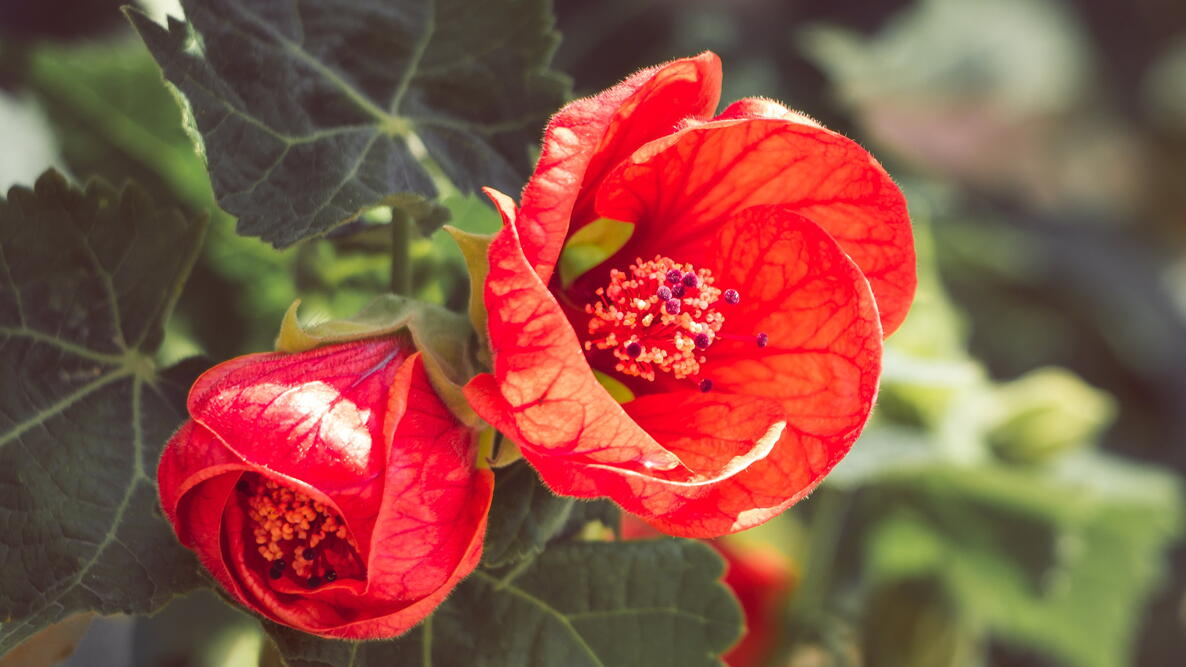
The blossoms are the undeniable stars of the show. Reaching up to an impressive 3 inches (7–8 cm) across, these massive, nodding bells drench the plant in shades of reddish-orange from the tail end of summer straight through autumn.
Depending on who you ask, you will see these blooms described as true red with a gold throat, punchy tomato-orange, or deep red-orange. These descriptions all capture a dynamic truth: the petals actively shift in appearance, reading as true red, brilliant orange-red, or glowing reddish-orange based on shifting sunlight, daily temperatures, flower maturity, and how a camera captures the light.
Every single bloom swings gracefully downward from a hair-thin, flexible stalk. This nodding stance creates an enchanting “lantern” look that shines brightest when the container is elevated or suspended in a hanging basket. If you look straight down on a ground-level pot, the flowers hide beneath the leaves; lift the pot up, and the full beauty of the bell-shaped petals and prominent central staminal column is revealed.
Structurally, these flowers show off classic mallow anatomy. Five wide, overlapping petals interlock to create a cup or flared trumpet, protecting a bold, central reproductive column. Modern breeding within this group has focused on maximizing flower size up to 3 inches and ensuring a relentless production of buds throughout the growing season.
Visual character and design value
A bright, warm-colour accent
‘Bella Red’ anchors the high-energy, fiery side of the Abutilon color spectrum. Its blazing reddish-orange bells carry far more electricity than pale pastel yellows or soft pinks, yet they avoid the heavy, light-absorbing somberness of dark crimson varieties. It delivers an intense pop of concentrated warmth without demanding a massive footprint in your garden layout.
The golden-yellow throat of each blossom serves as a brilliant bridge for creating harmonious plant combinations. It allows you to visually tie the plant to companion choices like:
- Golden-leaved foliage accents
- Yellow calibrachoa or trailing bidens
- Chartreuse sweet potato vine (Ipomoea batatas)
- Bright lemon-colored marigolds
- Cream-striped or yellowish-green ornamental grasses
- Soft peach, apricot, and coral annuals
If you want a high-contrast composition, partner these fiery bells with cool blue or deep violet neighbors like trailing lobelia, vanilla-scented heliotrope, white-eyed bacopa, or dwarf salvias. The purple and blue tones make the reddish-orange petals pop with incredible intensity, while the shared green foliage keeps the overall mix looking sophisticated rather than jarring.
A vertical accent in a shallow planting scheme
Do not mistake ‘Bella Red’ for a flat, ground-hugging bedding annual. Even with its dwarf stature, it sends its blossoms upward and outward on arching, structural stems, giving small-scale plantings a welcome dose of vertical movement.
This upright yet compact architecture shines in arrangements such as:
- The structural centerpiece of a mixed patio planter
- The crucial middle tier of a layered three-plant container combination
- A raised stone trough where the heavy bells can spill over the edges
- A hanging basket suspended at eye level or higher
- A window box where the stems can lean out toward the sun
- A pocket-sized courtyard display that needs architectural lines without overwhelming mass
When building a mixed planter, position this abutilon as the star attraction. Avoid packing it tightly against aggressive, suffocating neighbors; the dwarf stems need a bit of breathing room so the individual, dangling lanterns can be clearly seen.
A seasonal substitute for a larger shrub
Gardeners frequently deploy standard flowering maples as permanent conservatory features, trained wall shrubs, or massive focal points in large estate pots. ‘Bella Red’ translates that exact design aesthetic—the iconic lobed leaves and whimsical lantern flowers—into a micro-scale package.
This makes it perfect for tight spots where a 10-foot monster would be impossible:
- A compact, rented balcony
- A narrow urban terrace or fire escape
- A small, welcoming front doorstep
- A walled, sheltered courtyard pocket
- A casual tabletop container display
- A temporary seasonal arrangement that must be easy to swap out when winter arrives
Skip this cultivar if your goal is an expansive privacy screen or a tall architectural statement plant. Its true superpower is delivering maximum color impact within a tiny garden footprint.
Container and seasonal uses
Patio containers
Because its seasonal height and width stay perfectly neck-and-neck, ‘Bella Red’ is a natural fit for container culture. A single specimen easily anchors a medium-sized pot on its own, while a wider bowl offers plenty of room to tuck in cascading or low-growing companion plants.
Try this foolproof three-part design recipe:
- Use ‘Bella Red’ as your structural, upright focal point.
- Surround the base with low, mounding filler plants.
- Add a trailing plant or two to soften the container’s hard rim.
Just make sure your companion plants are not so overly aggressive that they swamp the lower branches of the abutilon. You want to keep the lower framework open enough so the heavy bells can hang cleanly in free space.
Hanging baskets
Elevating this cultivar lets you experience its unique anatomy at its best. Suspended in a basket, the pendulous lanterns are silhouetted against the open sky rather than getting lost against the plant’s own green leaves, making the intricate bell shapes instantly pop.
Its dwarf genetics also mean you will not have to deal with the long, awkward, wildly erratic branches common to standard varieties in baskets. Instead, you get a well-behaved, tightly packed orb of color.
Window boxes
When planting a window box, space ‘Bella Red’ so its heavy flower stalks face outward toward the street. It serves beautifully as a repeating vertical punctuation mark rising out of lower groundcovers, but keep the spacing relaxed enough to prevent the lobed leaves from forming a dense, messy wall of green.
For a high-drama, fiery window box, combine it with dark bronze foliage plants and glowing orange or yellow accent flowers. If you prefer an elegant look, frame the reddish-orange lanterns with pure white blossoms and frosted silver foliage, letting the abutilon supply the sole shot of rich color.
Seasonal bedding
In warm, winterless areas—or when used as a quick splash of color for temporary summer interest—‘Bella Red’ transitions beautifully into garden beds and borders. Do not use it like a standard low annual for mass ground coverage; it works far better as a structural accent:
- Space three plants evenly through a small border to establish a visual rhythm.
- Group a handful closely together to create a dense, high-impact block of solid color.
- Flank a garden gate or patio entrance with a pair of specimens.
- Use it to smoothly bridge the height gap between flat bedding plants and taller background shrubs.
Its short stature is exceptionally useful at the front edge of a protected border, providing a tropical look without casting heavy shade over low-growing neighbors.
Flowering period and presentation
Outdoors, ‘Bella Red’ puts on its most spectacular show from late summer well into the cooling days of autumn. However, the broader flowering maple family is inherently industrious; when moved into protected conditions like a heated greenhouse or sunroom, modern hybrids can push out new blossoms almost year-round.
This late-season peak makes the cultivar incredibly valuable. It hits its stride just as traditional early-summer annuals start running out of steam, instantly rejuvenating tired patio layouts and flagging trailing arrangements.
To enjoy the show, remember to keep the container elevated. Setting this plant flat on the ground forces you to look straight down on the canopy, completely missing the beauty of the dangling, down-turned lanterns.
How it differs from standard hybrids
| Characteristic | ‘Bella Red’ | Standard flowering-maple hybrids |
|---|---|---|
| Seasonal scale | Compact, about 1–1.5 ft | Vigorous, often 2–4 ft in a single cool-climate summer |
| Mature potential (frost-free) | Remains remarkably compact even if overwintered | Commonly shoots up to 6–10 ft, sometimes larger |
| Main garden role | Containers, hanging baskets, window boxes, small accents | Massive patio pots, sunny walls, conservatories, shrub borders |
| Flower effect | Massive reddish-orange lanterns on a miniature frame | Vast array of colors on a massive, sprawling structural framework |
| Space requirement | Ideal for tiny balconies and small tabletops | Demands substantial breathing room for a large shrub |
| Design impact | High-density, concentrated, front-row color | Large-scale, structural, architectural presence |
| Best viewpoint | Best enjoyed at eye level or looked at from below | Easily appreciated from across the yard as well as close up |
This massive difference in scale is a critical distinction. Labeling ‘Bella Red’ simply as a generic “flowering maple” without highlighting its miniature genetics leaves gardeners expecting a massive garden shrub. It is far better to approach it as a well-behaved, pint-sized seasonal blooming plant that offers the charm of an abutilon shrub in miniature.
Cultivar identity and reliability
The Royal Horticultural Society (RHS) classifies this plant as an abutilon belonging to the distinct Bella Series, while the Missouri Botanical Garden catalogs it under the full name Abutilon × hybridum ‘Bella Red’. The entire Bella line is celebrated for its early blooming habit, oversized flowers, and naturally compact forms. The series typically tops out around 15 inches (38 cm) and includes a warm palette stretching from soft apricot and gold to bright pink and deep crimson.
Keep in mind that exact dimensions and color intensity can morph depending on local humidity, container volume, sunlight exposure, ambient temperatures, and whether you treat the plant as a single-season annual or overwinter it. Some nursery catalogs quote slightly larger dimensions for specimens growing in warm, tropical zones, but those numbers should not overshadow the official dwarf seasonal records documented by the Missouri Botanical Garden and commercial production trials.
For plant tags, catalog entries, or retail signs, the clearest description is:
A compact, dwarf flowering maple reaching roughly 1 to 1.5 feet in a single season, loaded with large, reddish-orange, lantern-shaped flowers set against light green, maple-like leaves.
Limitations to consider
‘Bella Red’ is fundamentally frost-tender, not a tough, cold-hardy shrub capable of handling freezing winters outdoors. Throughout the UK, particularly in exposed or northern English gardens, it must be treated as a temporary summer patio accent or kept in a protected conservatory unless you can provide a frost-free space to carry it through the winter months.
Additionally, its wood can be somewhat brittle and delicate—a common trait shared across the entire Abutilon genus. This structural vulnerability is another excellent reason to grow it as a sheltered container plant rather than expecting it to stand up to heavy winds as a permanent, structural garden shrub.
If you bring it indoors, stay vigilant against classic greenhouse pests like whitefly, scale insects, spider mites, and mealybugs. The genus can also occasionally run into issues with root rot, rust, fungal leaf spots, and the systemic abutilon mosaic virus. These potential issues are universal to the genus and are covered thoroughly in our Master Growing Guide to Abutilon rather than clogging up this specific variety profile.
Final assessment
Abutilon × hybridum ‘Bella Red’ excels because it packs incredibly large flowers onto a wonderfully small frame. It delivers everything you want from a traditional flowering maple—the classic lobed leaves, the nodding lantern flowers, and a long blooming season—without forcing you to find room for a massive 10-foot shrub.
It finds its highest purpose in elevated patio planters, hanging baskets, window boxes, sunroom collections, or used as a repeating splash of summer border color. For the best results, partner its fiery reddish-orange bells with cool blue-purple flowers, neon chartreuse leaves, or soft, neutral companion plants. If you want a genetically dwarf abutilon rather than a large hybrid temporarily starved for space, ‘Bella Red’ stands out as an exceptional choice.