Why Abutilon ‘Kentish Belle’ Belongs on Your Sun-Drenched Walls
Few shrubs bridge the gap between historical romance and sheer garden utility quite like Abutilon ‘Kentish Belle’. Long recognized by the Royal Horticultural Society with the prestigious Award of Garden Merit (AGM), this vintage cultivar is celebrated for its robust vigor, lax, arching silhouette, and a virtually non-stop parade of bi-colored blossoms. For gardeners in mild regions looking to clothe a bare fence or transform a sunny wall into a vertical tapestry, this reliable performer remains an unmatched choice.
The Story Behind the Stem: History and Heritage
Unlike the sea of modern hybrids with murky origins, ‘Kentish Belle’ comes with a proper pedigree. Bred in the 1950s by Mr A. V. Pike—the esteemed Head Gardener at Kent’s historic Hever Castle—the plant was named to honor both its geographical roots and the bell-like elegance of its pendulous flowers.
Much of its garden prowess comes directly from its parentage. Inheriting key traits from Abutilon megapotamicum, it boasts slender, whip-like branches and compact, lantern-shaped flowers. Crucially, this lineage passes down a level of frost resilience that leaves other, more finicky flowering maples shivering in the breeze. It is a midcentury success story that continues to earn its keep in contemporary landscapes.
Anatomy of a Showstopper: Visual Characteristics
Growth Habit and Structural Form
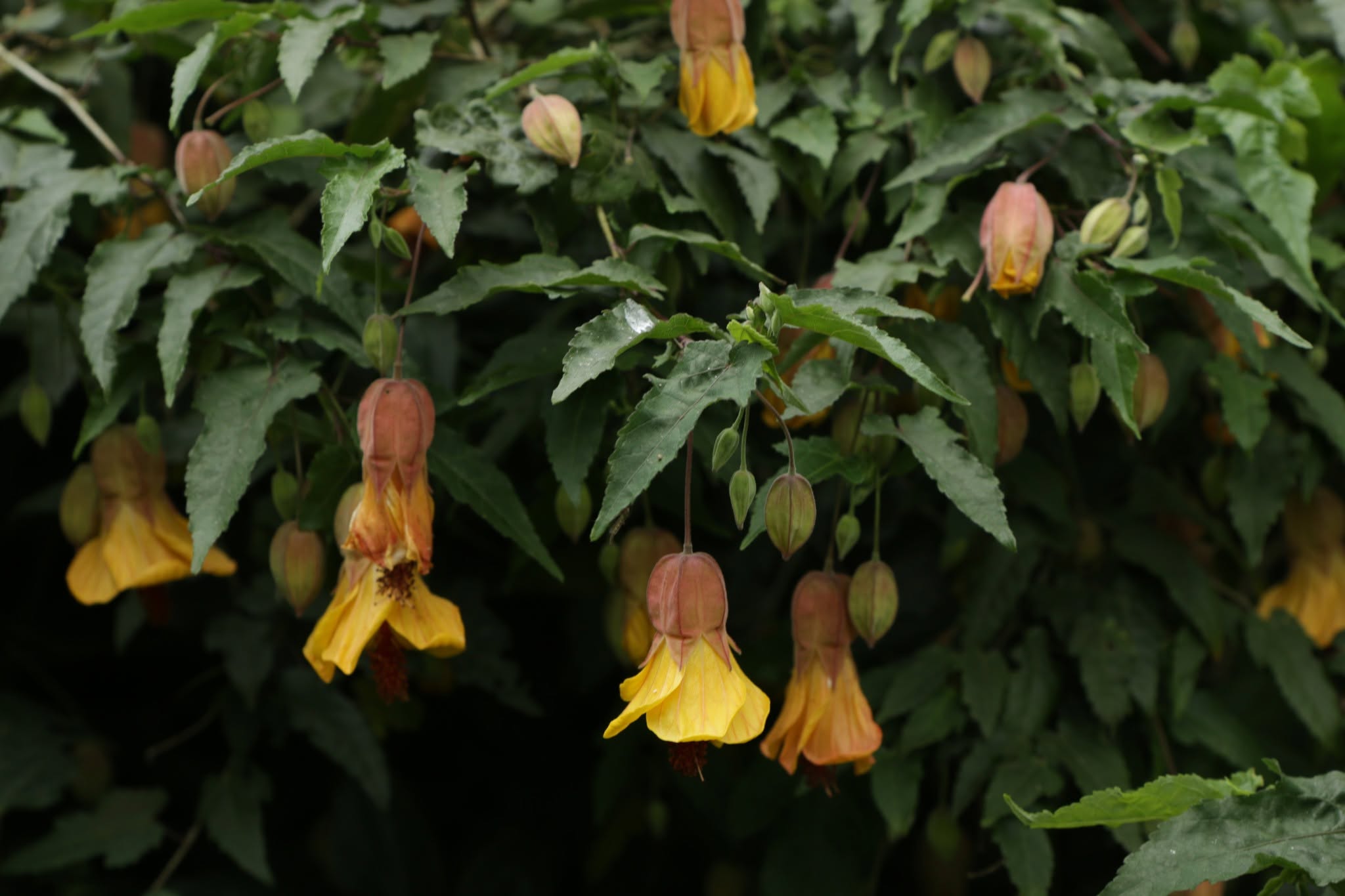
‘Kentish Belle’ brings a loose, romantic, and effortlessly arching geometry to the garden. Its slender, wiry stems sport a rich, dark purple-brown hue, pushing outward like a well-behaved rambler.
The foliage offers a handsome backdrop. It features semi-evergreen, dark green leaves that stretch up to 4 cm long. Deeply three-lobed and ranging from triangular-ovate to narrowly ovate, these maple-like leaves are precisely what earned the genus its common moniker of “flowering maple”. Expect the plant to reach a comfortable 1.5 to 2.5 meters in both height and spread over a 5- to 10-year period. When trained vertically against a warm backdrop, it easily pushes toward the top end of that scale.
The Floral Display
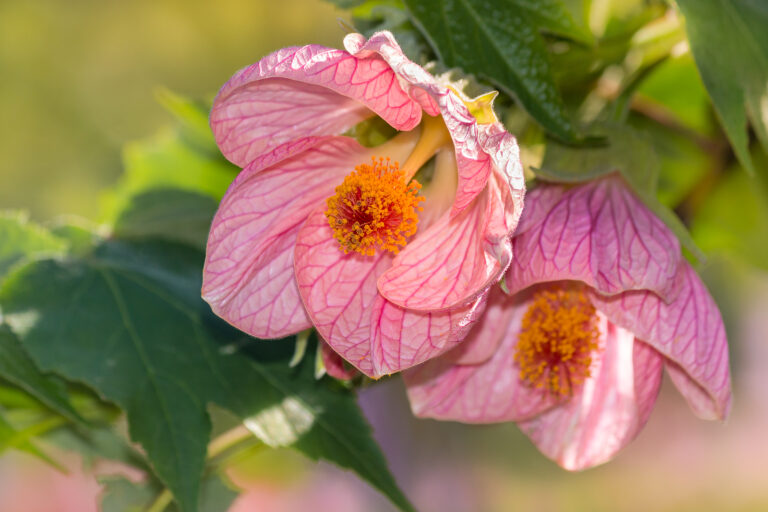
The real magic happens along the current season’s fresh, young shoots, where clusters of nodding, bell-shaped lanterns dangle with exquisite grace. Each individual bloom measures 4 to 5 cm long and puts on an unforgettable two-tone performance. Soft apricot to orange-yellow petals, etched with delicate, dark veins, emerge from a striking, wine-red calyx.
This marathon display kicks off in early summer and refuses to quit until late autumn—typically spanning July through November in UK gardens. In particularly sheltered microclimates, it routinely braves the chill right into early winter. As an added bonus, these open, downward-facing bells serve as a vital nectar station, drawing in bees and an array of native pollinators for months on end.
Strategic Placement in the Garden Landscape
Guarding the Wall and Bordering the Fence
To see ‘Kentish Belle’ at its absolute best, give it a vertical surface to conquer. It shines brightest when treated as a wall or fence shrub in sun-drenched, protected spots. Its flexible, rambling stems take beautifully to trellis work or horizontal wires, allowing you to curate a cascading curtain of nodding blossoms.
Siting the plant against a south- or west-facing brick wall does more than just show off its form; the trapped masonry heat coaxes out a far more profuse flush of flowers that lingers until the first true hard freeze. Even during the quietest moments of winter, the dark, structural framework of its branches looks incredibly sharp when contrasted against pale stone or light-colored fences.
Container Potential and Border Dynamics
You do not need a massive wall to enjoy this cultivar. Placed in large, premium containers on a sunny patio, ‘Kentish Belle’ makes a spectacular freestanding specimen, needing only a light stake or a modest tuteur to support its arching weight. Just ensure it is shielded from biting, cold winds.
Within mixed borders, position it in the middle or toward the back row where its height can be fully accommodated. This placement allows its weeping branches to drape elegantly over shorter, surrounding perennials without crowding them out. Because it holds onto a fair amount of foliage through mild winters, it keeps your borders from looking completely barren when the rest of the garden goes dormant.
Masterful Color and Texture Companion Plantings
Designing around ‘Kentish Belle’ is all about playing up its unique, fiery color palette and architectural movement.
Igniting Warm Tones
Lean into the plant’s natural warmth by pairing it with bronze and orange late-season perennials. Think of bold sweeps of Helenium, Rudbeckia, or the fiery spears of Crocosmia to echo the apricot petals. Planting it near warm terracotta vessels or weathered red brick instantly amplifies the deep tones of the winy calyx and purple stems.
Creating Cool Contrast
For a visual pop, contrast those warm lanterns against cool blues and deep purples. The electric spikes of Salvia nemorosa, the airy haze of Perovskia (Russian Sage), or the rich blue of Caryopteris create an instantly sophisticated complementary color scheme. Alternatively, use silver-leafed workhorses like Lavandula or Stachys byzantina (Lamb’s Ear) at its base; the pale foliage makes the dark stems and vibrant bells practically jump forward.
Structural Backgrounds
Let backdrop materials do the heavy lifting. Training this abutilon against cream-rendered walls, pale timber, or light limestone allows every dark twig and crimson bud to stand out in sharp relief. To keep the focus squarely on its maple-like foliage, surround it with fine-textured, solid-green evergreen companions like dwarf Hebe or small-leaved Osmanthus.
For the ultimate design impact, plant it where people can look up into the blooms. Positioning it along elevated walkways, next to garden benches, or atop low retaining walls ensures the intricate interior of the lantern flowers won’t be missed.
Winter Resilience and Climate Realities
While the genus has a reputation for being tender, ‘Kentish Belle’ is widely recognized as one of the toughest of the lot. It carries an RHS H3 hardiness rating, comfortably managing temperatures down to around -5°C. In fact, when tucked against a heat-retaining wall in well-drained soil, it frequently shrugs off dips down to -7°C.
It is tailor-made for mild, coastal, or southern gardens where sharp frosts are fleeting. For a deep dive into the nitty-gritty of soil preparation, planting mechanics, regular feeding regimes, and winter protection strategies, explore our comprehensive Master Abutilon Growing Guide.
What Makes This Cultivar Uniquely Valuable?
When you boil it down, Abutilon ‘Kentish Belle’ delivers a combination of traits few other shrubs can match:
- A rich, documented lineage tracing straight back to the master gardeners of Hever Castle.
- An adaptable, arching, and rambling silhouette that makes it uniquely suited for wall training.
- A sensational color combination of apricot petals nestled in rich, wine-red calyces, hung along dark, moody stems.
- An extraordinary flowering window that effortlessly bridges the gap between mid-summer and late autumn.
- The peace of mind that comes with planting one of the hardiest, most dependable outdoor abutilons available today.