The Ultimate Victorian Heirloom: Why Abutilon ‘Canary Bird’ Still Rules the Garden
Few plants capture the imagination quite like the flowering maples, and among this luminous group, Abutilon ‘Canary Bird’ stands as an absolute masterpiece. This isn’t just another yellow-flowered shrub; it is a living heirloom. Distinguished by its pure lemon-yellow, trumpet-shaped blossoms, a beautifully rounded habit, and a coveted Royal Horticultural Society (RHS) Award of Garden Merit (AGM), this cultivar remains the gold standard against which all other yellow abutilons are judged.
While modern hybrids come and go, ‘Canary Bird’ boasts a distinct visual identity and a storied history that have kept it at the forefront of premium garden design for generations.
Cultivar Profile: Identity & History
Origin and Naming
To understand the enduring appeal of ‘Canary Bird’, we have to look back to the United Kingdom around 1890. Bounded by the late Victorian era’s obsession with ornamental shrub breeding, this garden-origin hybrid emerged as an instant classic. Breeders of the time held a deep affection for avian-themed cultivar names, and the brilliant, cheerful yellow of these blossoms made ‘Canary Bird’ a natural choice.
Unlike contemporary abutilon hybrids that often emerge from a dizzying, unstable web of multi-species crosses, ‘Canary Bird’ is a triumph of genetic consistency. It has been clonally propagated and sold under its true name by specialist nurseries for well over a century, offering gardeners a direct connection to horticultural history.
Award of Garden Merit (AGM)
In 1993, the RHS bestowed its prestigious Award of Garden Merit upon ‘Canary Bird’, cementing its status as a plant of exceptional quality. An AGM isn’t handed out lightly; it serves as a rigorous stamp of approval under demanding UK trial conditions. To earn this badge, ‘Canary Bird’ had to prove itself across several critical metrics:
- Flawless Performance: It delivers dependable, uniform flowering and maintains a clean, attractive form season after season.
- Natural Resilience: It shows excellent resistance to common pests and diseases when stacked against its peers.
- Distinct Character: Its flower clarity and growth habit offer clear, unmistakable differentiation from lesser cultivars.
This accolade has kept ‘Canary Bird’ anchored in high-end nursery catalogues and elite design schemes for more than three decades.
Taxonomic Note
If you are hunting through modern botanical databases, you might occasionally spot this plant listed under the genus Callianthe (as Callianthe ‘Canary Bird’). This shift reflects the ongoing taxonomic reshuffling within the Malvaceae family. However, the horticultural world moves a bit more practically. In nurseries, garden centres, and landscape specifications, it remains overwhelmingly marketed as Abutilon ‘Canary Bird’. That is the name you will need when sourcing it for your projects.
Visual Characteristics
Flower Form and Colour
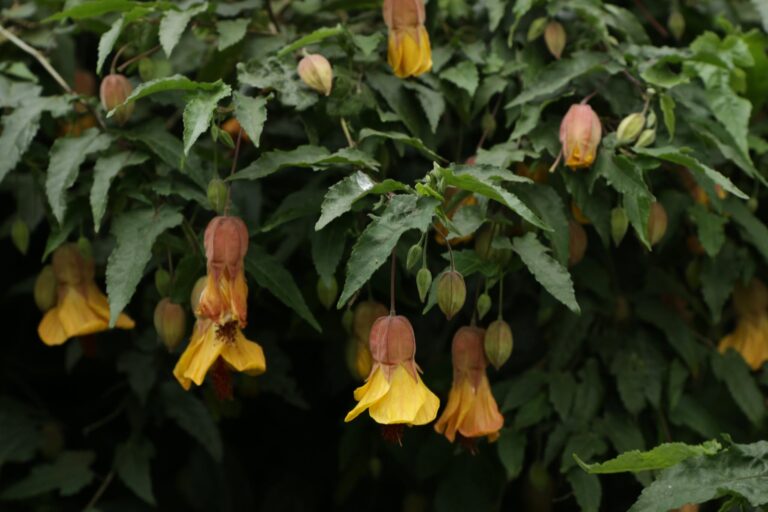
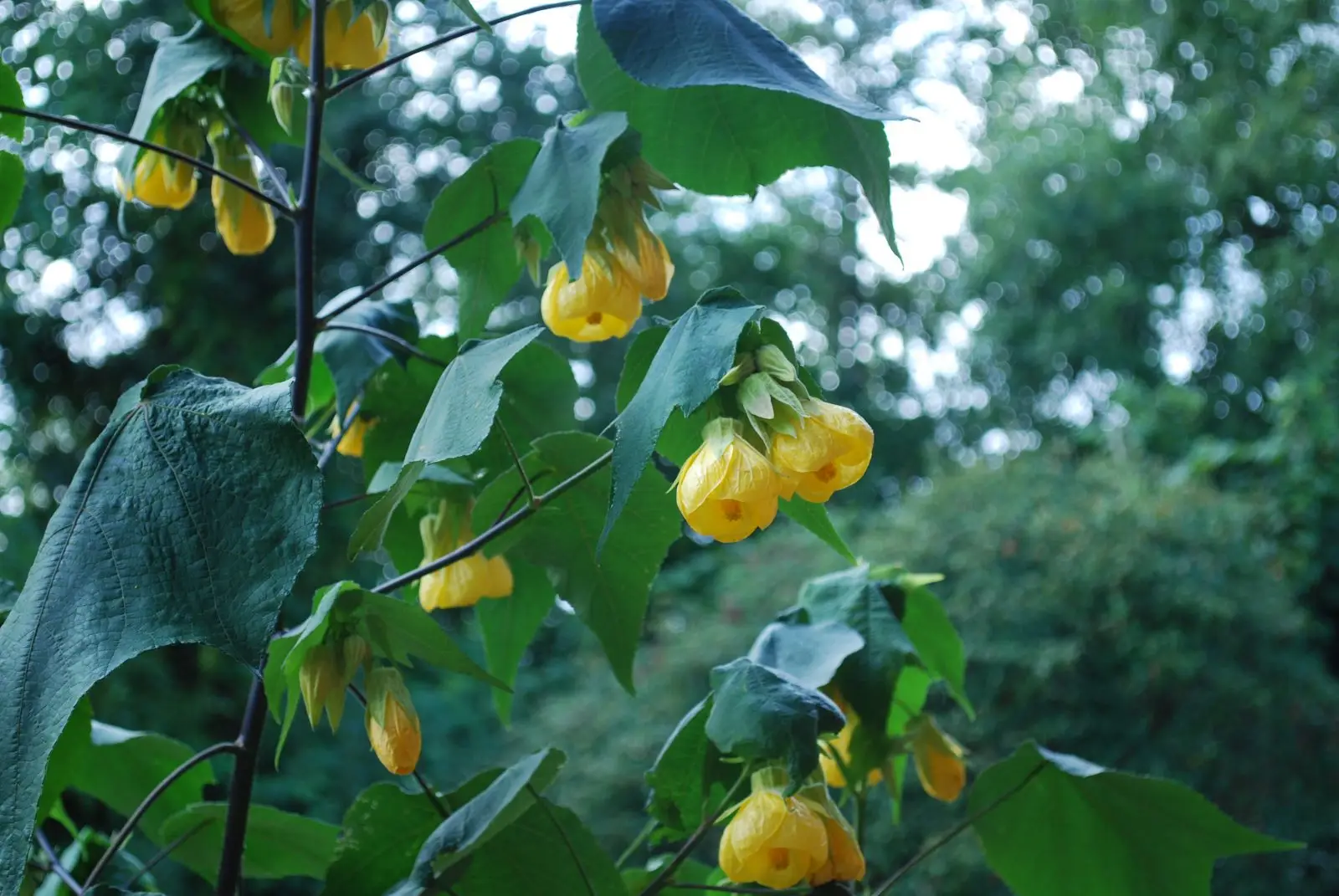
When ‘Canary Bird’ comes into its own, the display is nothing short of spectacular. The shrub smothers itself in pendulous, bell- to trumpet-shaped flowers that average 6–8 cm (2½–3 in) long. Hanging elegantly as solitary bells or in small, clustered constellations from the leaf axils and branch tips, the blooms are a masterclass in color purity.
- Unrivalled Color Purity: The petals glow in a clean, brilliant lemon- to canary-yellow. You won’t find any muddy red calyxes or heavy, distracting veins here.
- Exquisite Texture: The smooth petals flare open into a perfectly formed, welcoming bell.
- Pollinator Magnet: A dense tuft of prominent stamens pushes past the throat of the flower, adding delicate structural detail while drawing in local pollinators.
This cultivar is extraordinarily free-flowering. In temperate zones, the show stretches effortlessly from late spring right through autumn. Bring it into a frost-free conservatory or greenhouse, and it is entirely capable of blooming year-round. For those gardening in mild climates (like USDA zones 9–10), expect near-continuous color that peaks in early summer and refuses to quit until the first real frost.
Foliage and Texture
While the flowers catch your eye, the foliage does the heavy lifting in the landscape. The leaves provide a dramatic, structural contribution to the garden:
- Architectural Silhouette: The classic maple-like, palmately lobed leaves feature 3 to 5 distinct lobes with broadly ovate silhouettes.
- Rich Color and Touch: The mid- to dark green leaves carry a soft, slightly crinkled texture that catches the light beautifully.
- Tropical Presence: Individual leaves grow to a substantial 10–20 cm (4–8 in) across, establishing a bold, lush backdrop that makes the yellow bells pop.
Because these large leaves sit alternately along slender, airy petioles, the entire plant maintains an elegant, layered quality. This marriage of bold, structural foliage and delicate, dangling golden bells creates an iconic silhouette that is instantly recognizable in any garden setting.
Habit and Size
Left to its own devices in optimal conditions, ‘Canary Bird’ develops into a large, rounded evergreen to semi-evergreen shrub with an upright, gracefully spreading habit. For comprehensive guidance on structural frameworks and seasonal trimming techniques across different sizes, you can refer to the core flowering maple pruning routine outlined in our master guide. Expect a commanding 2.5–4 m (8–13 ft) under favorable conditions.
- Mature Height: Expect a commanding 2.5–4 m (8–13 ft) under favorable conditions.
- Mature Spread: It will easily match its height, spreading out 2.5–4 m (8–13 ft), though it stays narrower when confined to containers or kept in check with a pair of pruners.
- Growth Pace: It moves at a moderate to fast clip, reaching its full structural potential in about 5–10 years.
Winter throws an interesting twist into the mix. In cooler regions where sub-freezing temperatures cause dieback, ‘Canary Bird’ behaves like a large, multi-stemmed sub-shrub. Don’t worry if it gets nipped by frost; it rebounds vigorously from the base, easily putting on 2–3 meters of growth in a single warm season. If you are growing it as a patio container plant, its size is easily managed, staying a tidy 1.5–2 m (5–6½ ft) with just a little light seasonal pruning.
Landscape Positioning and Design Use
Structural Role in Planting Schemes
Given its grand scale and non-stop flowering window, ‘Canary Bird’ belongs in a starring role. This is a plant meant to serve as a focal-point shrub or a striking vertical accent, rather than sitting quietly in the background or acting as groundcover. With its bushy, rounded architecture and long, arching branches, it brings the commanding presence of a small tree to your design.
Consider deploying it in these high-impact roles:
- The Protected Border Specimen: Place it in a warm, sheltered border where its towering height and cascading flowers can be admired up close.
- The Glasshouse Star: Use it as a centerpiece in a greenhouse or conservatory, allowing it to grow as a free-standing specimen or training it flat as an elegant espalier against a sun-drenched wall.
- The Container Thriller: Plant it in a massive, premium container as the central “thriller,” underplanting it with lower, trailing foliage options that emphasize those pendulous yellow bells.
Colour and Texture Combinations
The pure, uncomplicated yellow of ‘Canary Bird’ combined with its bold green leaves makes it a dream for color theorists.
- Rich, Warm Borders: Lean into a high-summer look by pairing it with fiery orange, apricot, and deep bronze perennials. Plants like Helenium, Rudbeckia, and coppery Heuchera varieties create a stunning, molten-gold tapestry.
- Dramatic Cool Contrasts: For a scheme that truly sings, set it against deep blue or intense purple companions. Planting it alongside Salvia, Agapanthus, or Lavandula creates a classic, high-contrast complementary pairing that makes the yellow flowers look electric.
- Foliage Counterpoints: Contrast its broad leaves by interweaving fine-textured ornamental grasses like Stipa or Pennisetum. Alternatively, frame it with dark, moody foliage shrubs like Cotinus ‘Royal Purple’ or Berberis thunbergii f. atropurpurea to make the bright flowers leap forward.
If you love a tropical or jungle-style aesthetic, ‘Canary Bird’ fits right in. Group it alongside massive foliage icons like Fatsia, Musa (hardy banana), or vibrant Canna lilies to build a lush, multi-layered paradise.
Seasonal Interest
‘Canary Bird’ delivers a remarkably long return on your garden investment:
- Three-Season Color: Enjoy an uninterrupted outdoor flower show from spring through the depths of autumn, especially in protected microclimates.
- Winter Sanctuary Blooms: Keep the winter blues at bay by overwintering it under glass, where it will continue to throw flowers while the rest of the garden sleeps.
- Year-Round Architecture: Benefit from its permanent, evergreen structure in mild zones, or appreciate its rapid, resilient regrowth in colder climates where it acts as a robust, woody-based perennial.
Consumer Familiarity and Market Position
With over a century of commercial production backing it up, ‘Canary Bird’ possesses an invaluable asset: undeniable name recognition. In a market flooded with short-lived, unproven hybrids, this cultivar stands tall. It remains widely listed in top-tier UK and international nursery catalogues, holding its ground as the definitive, “go-to” yellow abutilon for gardeners who value reliability and classic elegance. Whenever a new yellow cultivar hit the market, ‘Canary Bird’ is almost always the benchmark used to judge its worth. For designers and homeowners alike, it represents a low-risk, high-reward investment that is easy to source and guaranteed to deliver.
How This Cultivar Differs from General Abutilon Hybrids
While the market offers plenty of generic “flowering maples,” ‘Canary Bird’ refuses to be lumped in with the crowd. It earns its standalone reputation through several distinct advantages:
- Unrivalled Color Purity: It offers a clean, bright, honest lemon-yellow. You won’t have to deal with the red-rimmed calyxes of A. megapotamicum or the muddy orange and apricot undertones common in modern seed-raised strains.
- Superior Architecture: It naturally forms a well-branched, beautifully rounded, and manageable shrub, avoiding the awkward, leggy, and sprawling habit that plagues so many other hybrids.
- A Documented Pedigree: This is a single, time-tested, stable clone dating back to 1890s Britain, not a variable, unpredictable seed mix sold under a loose umbrella term.
- The Royal Seal of Approval: Its long-standing AGM status from the RHS gives you ironclad peace of mind regarding its garden worthiness.
When you choose ‘Canary Bird’, you are choosing a plant with a distinct personality, a proud history, and an unmatched visual impact.