Dramatic Living Sculpture: Designing with the Weeping Nordmann Fir
The world of conifers is often dominated by rigid cones and static spheres, but Abies nordmanniana ‘Pendula’ breaks the mold completely. This exceptional evergreen cultivar is highly prized by designers for its strongly cascading branches, glossy dark-green needles, and an irregular, sculptural outline that commands attention. While lesser “weeping” conifers simply droop at the tips, this selection pushes its limbs distinctly downward, creating a narrow, vertical masterpiece with a far more dramatic silhouette than the naturally broad, pyramidal parent species.
At a Glance
| Feature | Description |
|---|---|
| Botanical name | Abies nordmanniana subsp. nordmanniana ‘Pendula’ |
| Common name | Weeping Nordmann fir; weeping Caucasian fir |
| Family | Pinaceae |
| Foliage | Evergreen, dark green, soft-textured needles |
| Habit | Strictly pendulous, often narrow and irregular |
| Mature scale | Commonly approximately 8–12 m tall and 2.5–4 m wide, though older specimens may become substantially larger |
| Ten-year size | More than 4 m under suitable conditions |
| Growth | Vigorous for a weeping conifer |
| Design role | Standalone specimen, conifer collection subject, large-scale focal point |
| Light | Full sun is generally preferred |
Keep in mind that the ultimate dimensions quoted for this cultivar vary considerably. Early training and staking dictate much of its future form, and older specimens frequently surprise growers by developing unexpected new leaders and unique branch arrangements. Local climate, soil fertility, provenance, and early nursery styling all play pivotal roles in its final size.
The Defining Silhouette
Strictly descending branches
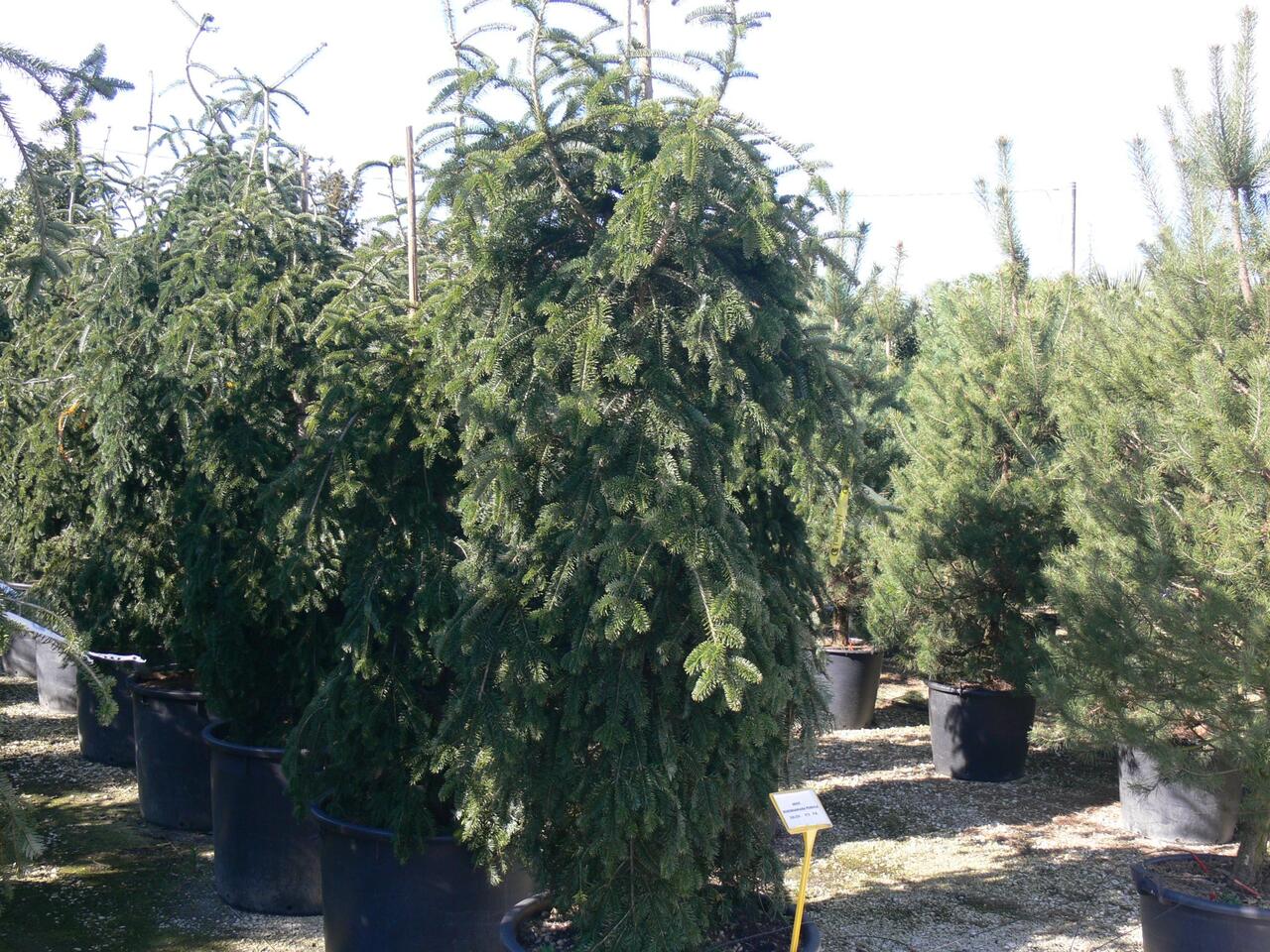
The true magic of ‘Pendula’ lies in its remarkable branch architecture. Instead of merely arching at the ends, the main limbs plunge downward along their entire length, casting off dense, needled curtains that hang like living tapestries from the structural framework.
This growth pattern creates an arresting vertical visual rhythm:
- The upper framework often makes a brief outward gesture before succumbing to gravity.
- Secondary branchlets spill downward in heavily layered curtains.
- The lowest skirts of growth frequently pool right at ground level.
- The overall outline embraces asymmetry over geometric perfection.
- Mature trees gradually evolve into deeply individual, contorted living sculptures.
Rather than a tidy, inverted cone, think of ‘Pendula’ as a narrow, cascading torrent of green, its form dictated by the weight of its own dense foliage and the path of its central leader.
Leader development
Horticulturalists know that ‘Pendula’ has a quirky personality when it comes to setting a leader. Some specimens establish a dominant central trunk effortlessly, while others require careful early staking to climb upward.
This juvenile phase is critical because early training sets the stage for the tree’s ultimate landscape effect:
- Staking young plants coaxes the tree into a taller, more majestic profile.
- Leaving a young plant unstaked allows it to mount up into a low, sprawling cascade.
- A trained central leader gains impressive height before letting its branches spill down.
- An irregular, self-selected leader results in a more dramatic, naturalistic feature.
Because of these variations, nursery-grown specimens are rarely carbon copies. Walk into a garden centre and you will see two plants of the same name with entirely different trunk movements, branch densities, and canopy starting heights.
Foliage and Seasonal Character
The needles offer the rich, velvety texture that makes Abies nordmanniana a favorite among true firs. Densely set and highly glossy, this deep-green foliage is wonderfully soft, lacking the sharp, prickly bite found in most spruces. Peek underneath a branch, and you will catch glimpses of pale stomatal bands that flash silver-white when the wind stirs the hanging boughs.
On the ‘Pendula’ cultivar, this lush foliage provides essential visual mass. Instead of looking like a skeletal collection of bare cords, the drooping branches read as thick, heavy ribbons of emerald. The effect is spectacular when viewed from the side or from a slightly lower vantage point, where the dense needles perfectly delineate the verticality of each branch.
While you won’t get the dramatic seasonal color shifts of a gold or blue conifer, ‘Pendula’ earns its keep through other ornamental values:
- Unwavering, year-round deep green saturation.
- A soft, invitingly touchable texture.
- Brilliant contrast against pale stonework, silver foliage, or winter snow.
- An rock-solid winter presence in the landscape.
- A dignified, woodland-born subtlety that outlasts loud, fleeting seasonal hues.
This plush foliage also makes it easy to differentiate from a weeping Norway spruce in mixed borders. While Picea abies ‘Pendula’ leans into a sharper, more angular, and often skeletal aesthetic, Abies nordmanniana ‘Pendula’ delivers a softer, denser, and far more substantial presence.
Size and Garden Scale
Though nurseries frequently sell ‘Pendula’ as a slim, compact specimen, do not mistake it for a true dwarf or a plant for a tight suburban plot. Given the right conditions and enough time, it matures into a magnificent, large-scale tree.
Its footprint can be deceptive. Because the branches drape vertically rather than reaching outward, it maintains a remarkably narrow profile in its youth. As the decades pass, however, the lower skirts broaden significantly, and an old specimen can claim a generous, unpredictable amount of ground space.
Anticipate its growth across three distinct phases:
- The Young Plant: Slim, highly vertical, and intensely focused on its downward cascade.
- The Established Specimen: Taller, increasingly dense, and developing a completely unique silhouette.
- The Mature Tree: A substantial landscape presence anchored by a wide, heavy apron of lower branches.
Plan to position it in open landscapes where its verticality can unfold naturally, free from the constraints of rigid, symmetrical pruning.
Origin and Cultivar History
The historical record of pendulous Nordmann firs is slightly tangled, and the name ‘Pendula’ has occasionally acted as a catch-all for a few distinct selections. The dominant clone found in today’s nursery trade traces its roots back to Young’s Nursery in Surrey, England, where it was selected prior to 1874.
However, nineteenth-century records note a second plant sharing the name, discovered and distributed by the French nurseryman Courtois. This European variation was described as more gently cascading than strictly drooping, though whether any authenticated specimens of this lineage survive in modern collections remains a mystery.
For collectors, historical estates, and arboreta, this background carries real weight:
- The common commercial ‘Pendula’ represents the intensely weeping, vigorous English selection.
- The elusive Courtois introduction likely possessed a softer, more arching architecture.
- Historic nursery nomenclature occasionally blurred the lines between genetically unique material.
- Preserving the exact provenance and documentation of old estate specimens is highly encouraged.
For standard landscaping goals, you can confidently expect the strongly weeping form of the Young’s Nursery tradition.
Landscape Positioning
A standalone focal point
To maximize its dramatic lines, treat ‘Pendula’ as a solo performer. Crowding it into dense mass plantings or surrounding it with too many competing eccentric shapes completely dilutes its sculptural impact.
Consider placing it in these prime locations:
- Anchoring the far view at the end of a formal garden axis.
- Standing alone on an open expanse of pristine lawn.
- Serving as a transitional anchor where managed gardens soften into wild woodland.
- Gazing over the edge of a pond or large water feature.
- Punctuation in a mixed conifer border, where its vertical drop contrasts beautifully with rounded mounds.
- Centred in an expansive courtyard, provided the long-term height is acceptable.
This tree truly shines when it can be appreciated from multiple angles. Because its growth is beautifully asymmetrical, a single, fixed viewpoint only tells half the story.
Formal and naturalistic combinations
Its weeping habit may be theatrical, but this fir is incredibly versatile, adapting seamlessly to both structured and informal garden styles depending on its companions.
In a formal setting, pair its weeping lines with clean geometry:
- Low, sharply clipped boxwood or yew hedges.
- Crisp, rectilinear stone paving.
- Beds of pale, uniform gravel.
- Massed architectural grasses with clean vertical stems.
- Repeated columns of strict evergreens.
- A simple, solid backdrop wall or a dark, flawless hedge.
Juxtaposing a disciplined environment against the tree’s irregular, dripping crown elevates the fir into a deliberate piece of fine garden art.
In a naturalistic or woodland garden, let it lean into its mountain heritage:
- Masses of large rhododendrons and native woodland shrubs.
- Textural drifts of ferns and shade-loving perennials.
- Moss-covered boulders and rock outcrops.
- The pale, ghost-like trunks of birch or beech trees.
- Low groundcovers with simple, understated green foliage.
- Broad-leaved evergreens that mirror its cool, forest-dwelling mood.
By surrounding it with native textures, you evoke the atmosphere of a cool montane forest rather than a manufactured conifer collector’s bed.
Design Values
Vertical movement
While most garden evergreens provide solid mass, dense screening, or predictable geometry, ‘Pendula’ contributes pure visual movement. Its branches act as a visual waterfall, pulling the observer’s eye down the leader, along the cascading skirts, and directly into the earth.
Use this dynamic property to solve specific design challenges:
- Injecting a powerful downward gesture into a static landscape.
- Providing a striking vertical counterpoint to expansive horizontal lawns or low terraces.
- Creating a sense of intimate enclosure without resorting to a solid, bulky hedge.
- Offering an ever-shifting focal point that transforms depending on your vantage point.
- Maintaining a stark, structural silhouette through the dead of winter.
Texture and mass
The heavy foliage creates a substantial, shadowy presence in the garden, yet the spaces between the hanging branches ensure the tree never looks like a solid block. In bright sunlight, the outer needles catch the light while the deep recessions between the curtains dissolve into intricate layers of shadow.
To accentuate this depth, contrast it with:
- Fine-textured ornamental grasses.
- Silver or pale-foliaged companion plants.
- Bright, golden-needled conifers.
- Trees showcasing stark white or exfoliating bark.
- Light-colored stone walls or gravel paths.
- Bold, matte-textured deciduous leaves.
Try to avoid boxing it in with other dark, dense evergreens. Its architecture needs a background that offers distinct tonal or textural separation to truly pop.
Winter presence
When winter strips away the deciduous canopy, ‘Pendula’ steps forward to hold the garden together. Heavy snow accumulations hug the downward paths of the branches, highlighting the architecture, while low winter light catches the edges of the layered foliage curtains.
This winter show becomes unforgettable when staged against:
- A clean, whitewashed or pale stone wall.
- The dark, intricate netting of a bare deciduous woodland.
- Fields of frosted, undisturbed grass.
- Trees with rich, dark, dramatic bark.
- The open reflections of a winter pond.
- A clear, vast winter sky.
For regions where dark winters outlast fleeting summer blooms, this steadfast structure is an invaluable asset.
How It Differs From Other Weeping Conifers
| Plant | Habit | Foliage impression | Main design difference |
| Abies nordmanniana ‘Pendula’ | Strongly pendulous, often narrow and irregular | Soft, dense, dark green | A substantial, sculptural hanging fir |
| Picea abies ‘Pendula’ | Weeping, often more angular or cascading | Sharper, pricklier, often more open | More coniferous drama and sharper branch definition |
| Abies alba ‘Pendula’ | Pendulous, generally elegant and strongly drooping | Soft green to dark green | Often read as a refined silver-fir cascade |
| Cedrus atlantica ‘Glauca Pendula’ | Broadly sweeping and cascading | Blue-grey, coarse-textured | Strong colour contrast and horizontal spread |
| Larix decidua ‘Pendula’ | Weeping but deciduous | Fine green needles, bare in winter | Seasonal openness rather than evergreen mass |
This distinction is fundamentally architectural: Abies nordmanniana ‘Pendula’ marries the dense, plush, luxury feel of a premium Nordmann fir with a strictly downward growth habit. It isn’t just a standard tree with tired branches; it is an entirely re-imagined form.
Choosing a Specimen
When shopping for this cultivar, step away from the catalog photos and closely evaluate the physical structure of the individual plant in front of you.
Keep a sharp eye out for these indicators of quality:
- A strong, healthy, clearly identifiable leader (or a framework that can be easily staked into one).
- Lush, deep-green needles without a hint of yellowing or stress.
- A good distribution of weeping branches originating at varied heights along the trunk.
- A pristine inner framework completely free from dieback.
- A branch arrangement that complements the specific angle from which it will be viewed in your garden.
- A clean, smooth, structurally sound graft union.
- Sufficient trunk maturity to give you a head start on the desired silhouette.
Be cautious of plants with very low grafts or stunted leaders; they are likely destined to remain low, wide mounds of greenery. While beautiful in their own right, they will never achieve the soaring, tree-like majesty of a well-trained specimen.
Botanical Context
The majestic parent species, Abies nordmanniana, finds its home in the rugged montane forests of the Caucasus and northeastern Anatolia, spanning Georgia, the Russian Caucasus, and Turkey. In these cool, high-altitude native haunts, it develops into a towering forest giant.
You can identify the species by its dense, lustrous, dark-green needles and unique flattened arrangement along the shoots. Its upright, cylindrical seed cones sit like candles on the upper branches, shifting from green and maroon hues to a deep wood-brown as they mature. True to the genus, these cones never fall to the forest floor intact; instead, they shatter while still high in the canopy, leaving behind only bare, needle-thin central cores.
The common name pays tribute to Alexander von Nordmann, the celebrated Finnish naturalist who first detailed this magnificent Caucasian fir for Western science during his travels along the eastern Black Sea in the nineteenth century.
Cultivation note: For baseline guidance on planting, soil preparation, watering, feeding, pruning, and general conifer care, see the Master Growing Guide for Abies and garden conifers.
The Verdict
Ultimately, Abies nordmanniana ‘Pendula’ should be embraced as a powerful, changing, evergreen installation rather than a mere dwarf novelty. Its brilliance lies in the juxtaposition of its soft, velvety, midnight-green needles against a strictly weeping, gravity-defying architecture.
Introduce it to your landscape when you need an unyielding focal point with strong vertical mechanics and an imposing winter presence. It will reward you handsomely if you give it ample breathing room, set it against a contrasting backdrop, and let it celebrate its own magnificent asymmetry rather than forcing it into a conventional mold.