Acalypha wilkesiana ‘Marginata’: The Elegant, Clean-Bordered Copperleaf for Vibrant Tropical Landscapes
This striking selection belongs to Acalypha wilkesiana Müll.Arg., a prominent member of the spurge family, Euphorbiaceae. While modern botanical treatments occasionally reclassify the plant as Acalypha amentacea subsp. wilkesiana, leading taxonomic authorities and contemporary references maintain A. wilkesiana at the species rank.
The species name honors Charles Wilkes (1798–1877), the American naval officer who commanded the United States Exploring Expedition that gathered the original type material in Fiji. Though deeply intertwined with Fiji and neighboring South Pacific islands, centuries of widespread tropical cultivation make pinning down the shrub’s exact wild origin a difficult botanical puzzle.
It is important to note that ‘Marginata’ is a cultivated foliage selection rather than a distinct botanical species. In older literature, you will find it cataloged as Acalypha wilkesiana var. marginata or Acalypha marginata J.J. Sm.—designations that modern horticulture now groups under cultivar selections within the broader copperleaf complex.
What makes ‘Marginata’ distinct
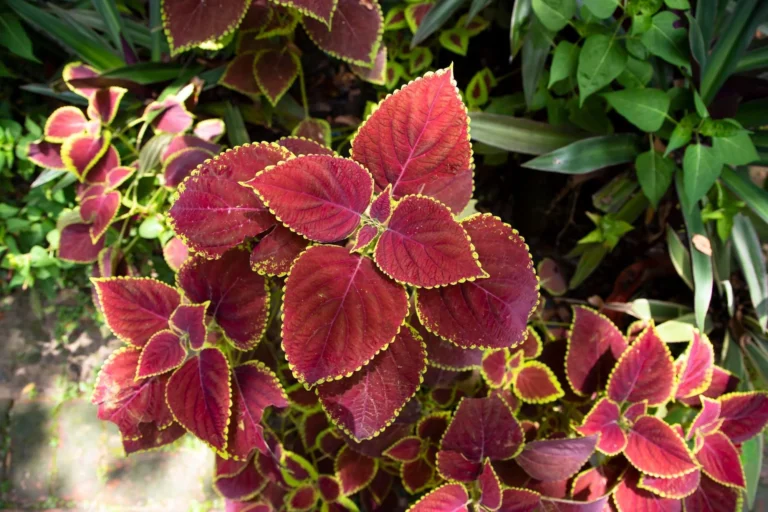
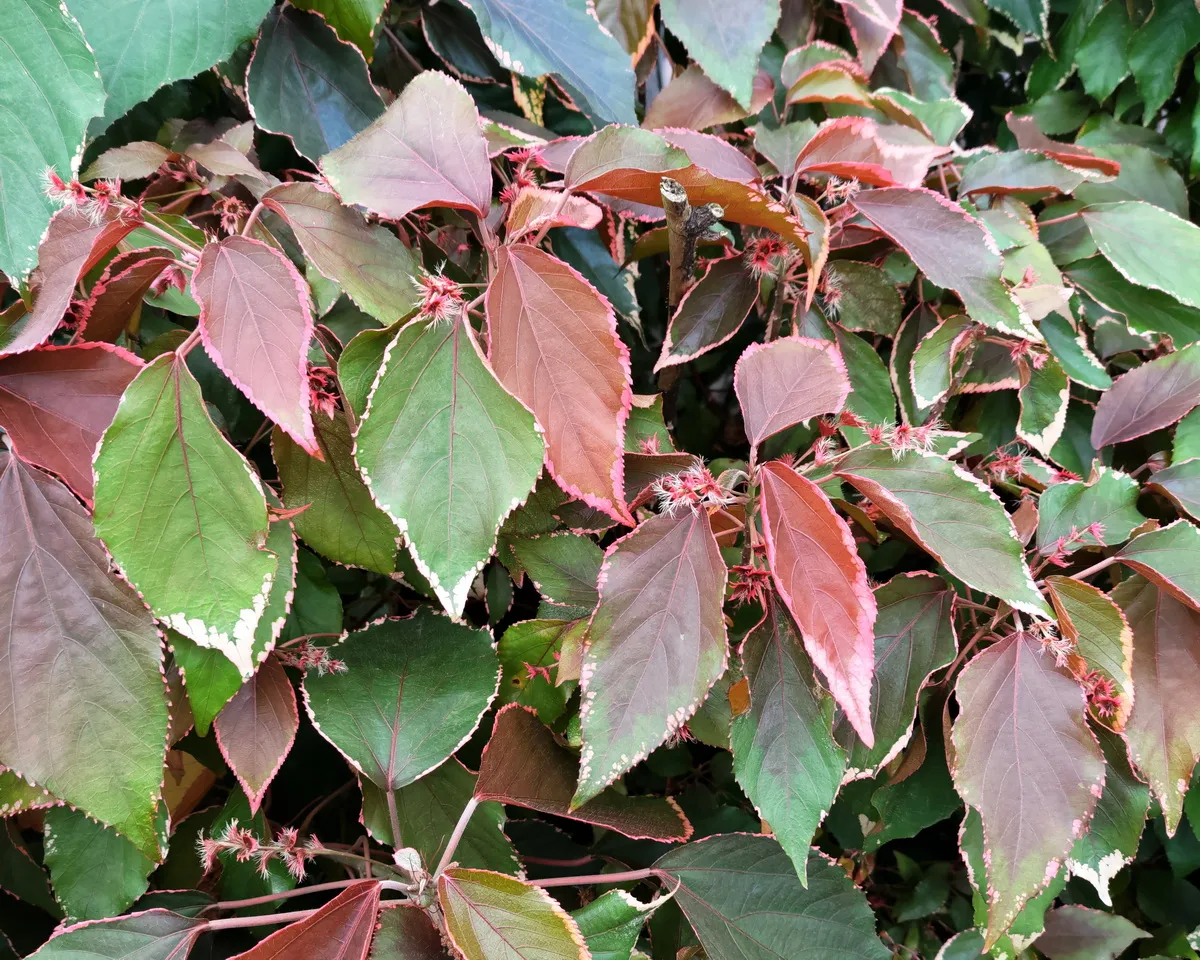
The defining feature of this cultivar is its crisp, two-tone foliage. A rich center of coppery green to deep bronze is framed by a bold, highly visible margin of pink or vivid crimson. This is not the speckled, mottled variegation common to mosaic-style copperleafs; instead, it is a clean, structural border that commands attention from across the garden.
The leaves themselves are broadly ovate to elliptic with distinctly toothed margins, giving the shrub a dense, lushly tropical texture. Environmental factors play a major role in the color show: bright, warm sunlight coaxes out the most intense bronze tones and radiant pink edges, whereas deep shade or environmental stress can dull the center to a muted green.
Key features of the cultivar
- Foliage center: Coppery green to bronze
- Leaf margin: Broad pink to crimson edge
- Leaf shape: Broadly ovate to elliptic, toothed
- Habit: Dense, multi-branched, upright to rounded shrub
- Typical landscape role: Hedge, screen, border accent, mass planting
- Best color display: Bright, warm light; weaker in shade
Size and garden presence
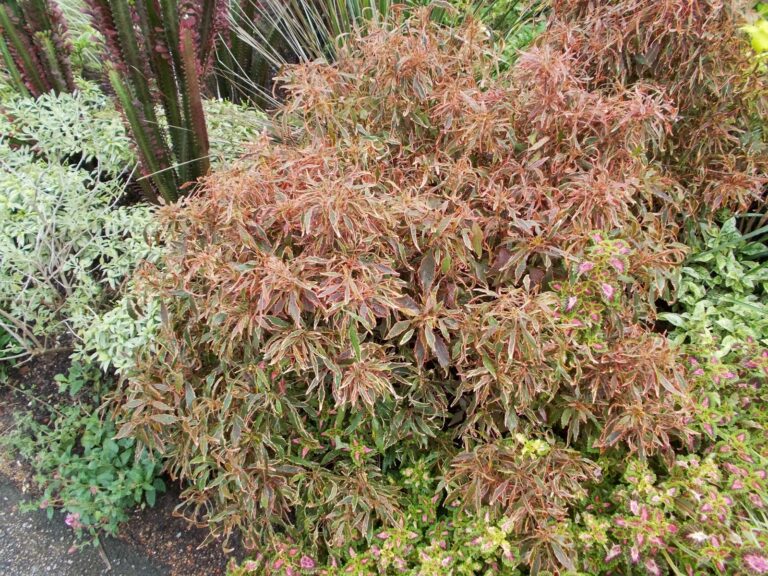
In the right climate, copperleaf is a remarkably fast-growing evergreen. Data from the University of Florida/IFAS notes that the baseline species can soar to heights of 8–12 feet (2.4–3.7 meters) with a spread of roughly 8 feet (2.4 meters), developing upright branches that gracefully arch outward over time. In well-maintained residential gardens, individual cultivars like ‘Marginata’ are typically kept much smaller through selective pruning. When managed alongside various Acalypha varieties, following the comprehensive guide for universal care metrics will ensure optimal health and vigor.
When planning a privacy screen or a colorful hedge, IFAS suggests spacing individual plants 3–5 feet (0.9–1.5 meters) apart on center. This spacing leverages the plant’s dense branching habit to quickly weave a solid, leafy wall. ‘Marginata’ truly shines in informal, softly sculpted hedges where its glowing, colorful borders can break up the hard lines of a property boundary.
Historical and horticultural importance
‘Marginata’ holds a significant place in horticultural history. It marks one of the earliest instances where breeders categorized copperleaf selections by clean, marginal borders rather than the typical mosaic mottling. Early botanical documents frequently noted that while the wild species leaned toward solid copper or bronze, distinct forms emerged with “white- or pink-margined” leaves, establishing var. marginata as a cornerstone of early tropical gardening.
As the species spread through frost-free regions worldwide, many of these historical varieties were reclassified as distinct cultivars chosen for their stable foliage patterns. The Plant Resources of South-East Asia (PROSEA) inventory explicitly recognizes ‘Marginata’ alongside other classic copperleaf forms such as ‘Ceylon’, ‘Hoffmanna’, ‘Macafeeana’, ‘Macrophylla’, ‘Miltonia’, ‘Moorea’, ‘Musaica’, and ‘Obovata’.
While newer introductions flood the market with chaotic splashes of yellow, orange, cream, and red, ‘Marginata’ remains a favorite for its disciplined elegance. It offers a sophisticated, legible color palette: deep, moody bronze sharply defined by a luminous frame of pinkish red.
Landscape and design value
Designers value ‘Marginata’ as a structural anchor. The heavy leaves and high-contrast edges make it an excellent choice for mapping out garden rooms, masking plain walls, or serving as a dark backdrop that pushes pale-flowered perennials and silver foliage into the spotlight.
Strategic landscape applications
- Informal hedge or screen: The naturally dense, heavily branched structure offers reliable, year-round privacy without relying on fleeting seasonal blooms.
- Tropical border anchor: It serves as an excellent recurring dark element to ground bright greens, chartreuses, silvers, or hot-toned flowers.
- Mass planting: Planted in bold sweeps, it creates a striking band of color that works beautifully alongside long driveways, wide courtyards, or expansive garden beds.
- Architectural accent: A single specimen, pruned to perfection, creates an elegant focal point against light masonry walls or dark green backdrops.
- Contrast planting: The pink edges offer a natural bridge to nearby dark green tropical plants, while the bronze centers keep the overall composition from looking washed out.
Colour behavior in the garden
Unlike traditional flowering shrubs that cycle through periods of bloom and green dullness, ‘Marginata’ maintains its vibrant display across the seasons through its leaves alone. The intensity of this display is directly tied to light quality: full, intense sunlight warms and saturates the crimson edges, while low-light conditions cause the distinct border to fade into a softer, less defined green.
Siting this shrub is therefore a critical design choice. Place items in full sun if you want maximum color saturation and sharp contrast. Opt for partial shade only if you prefer a quieter, more blended tapestry of muted greens and soft pinks.
Relationship to other copperleaf forms
Taxonomic clarity is important here: ‘Marginata’ should never be confused with Acalypha marginata (Poir.) Spreng., an older botanical name that belongs to an entirely separate species group. The cultivated copperleaf we use in gardens is strictly a selection of Acalypha wilkesiana, prized for its bronze core and pink-to-crimson framework.
It also stands apart from mosaic or “painted” options like ‘Musaica’. Where those selections focus on unpredictable, multicolored blotches, ‘Marginata’ stays true to its clean, geometric borders. It occupies a highly specific design niche, delivering legible, two-tone simplicity rather than busy variegation.
Growing context
From a design perspective, always remember that this shrub is a true child of the tropics. The University of Florida/IFAS specifies that copperleaf thrives best in USDA hardiness zones 9B–11B, demanding full sun and completely frost-free microclimates to reach its full potential.
Why it remains worth growing
Acalypha wilkesiana ‘Marginata’ continues to earn its place in modern gardens because it solves a perennial design dilemma: creating a reliable, highly colorful tropical screen without relying on short-lived flowers. Its deep bronze and radiant pink leaves provide architectural form, warmth, and movement, while its rich history cements it as a true classic of the copperleaf family.
For gardeners who favor timeless elegance over fleeting novelties, ‘Marginata’ remains a premier option—bold enough to anchor a feature bed, uniform enough to form a repeating hedge, and distinctive enough to recognize at a glance.