The Chenille Plant: How to Grow Acalypha hispida’s Fiery, Weeping Tassels
Few tropical shrubs command attention quite like Acalypha hispida. Cultivated not for its leaves but for one of the most theatrical floral displays in the botanical world, this tender evergreen produces long, weeping, scarlet catkins that mimic strands of plush chenille yarn or a playful cat’s tail. Far from a mere copperleaf cultivar, this distinct and singular species in the spurge family (Eugevphorbiaceae) proudly holds the prestigious Royal Horticultural Society (RHS) Award of Garden Merit.
Botanical Identity and Origins
Kew’s Plants of the World Online recognizes Acalypha hispida Burm.f. as the definitive scientific name for this spectacular specimen. A prominent member of the vast genus Acalypha within the Euphorbiaceae family, it answers to an array of evocative common names across the globe, including chenille plant, red-hot cat’s tail, foxtail, Philippine medusa, and red cat’s tail.
The plant traces its roots to the sun-drenched, tropical South Pacific, calling New Guinea and the Malay Archipelago (specifically Malesia and Papuasia) home. Because of these equatorial origins, gardeners in temperate zones treat it as a prized houseplant, conservatory treasure, seasonal bedding focal point, or patio container specimen. However, in frost-free tropical landscapes, it matures into a magnificent, year-round flowering shrub.
The Flowers: A Defining Visual Spectacle
Acalypha hispida is dioecious, meaning individual plants are strictly male or female. You will almost exclusively find the female form in cultivation, as the male blossoms are small and visually unremarkable. The female plants, by contrast, carry the breathtaking ornamental display that gardeners crave.
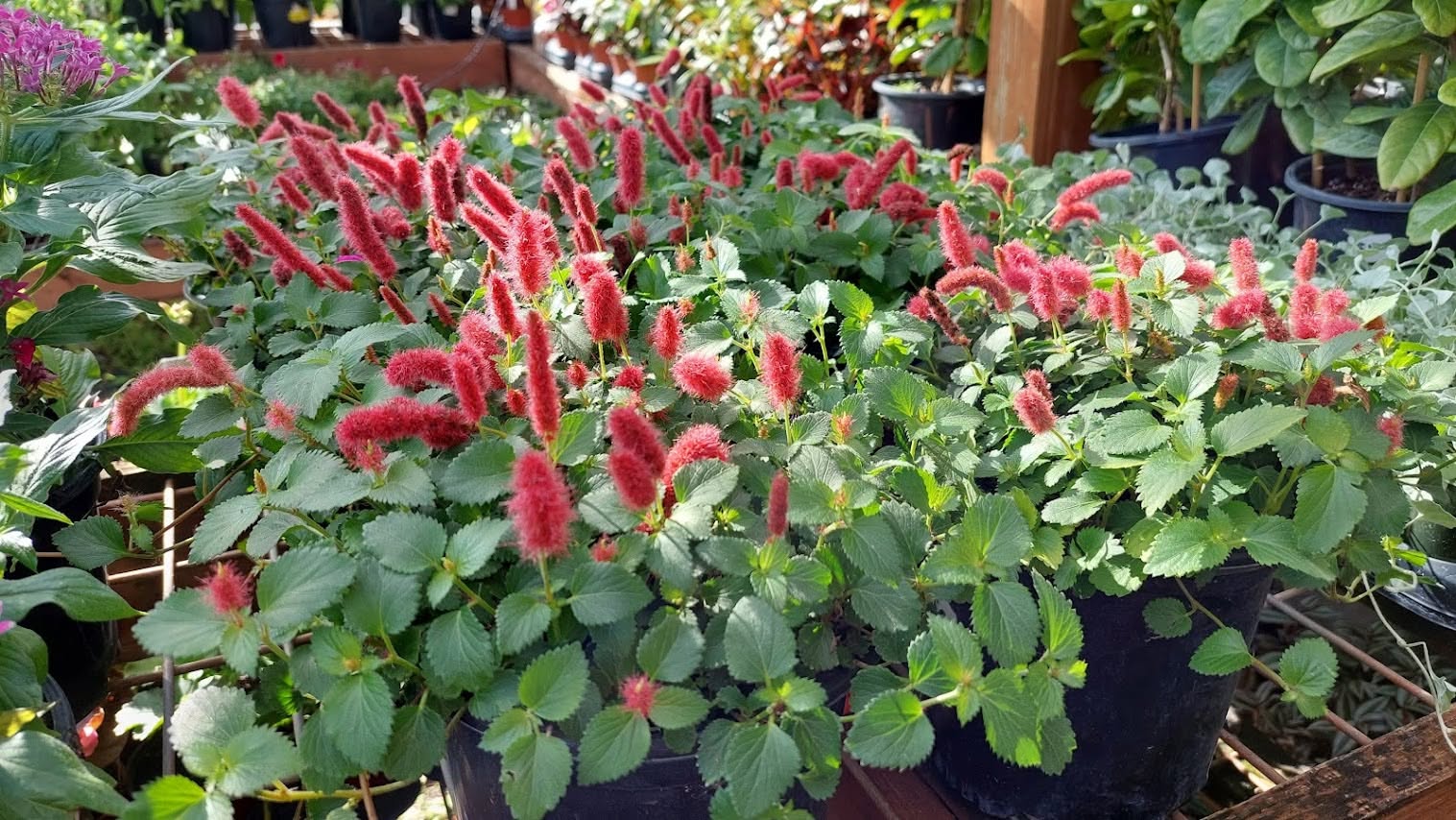
Each show-stopping inflorescence is actually a pendulous raceme tightly packed with thousands of microscopic, feathery pistillate flowers. While an individual blossom is modest on its own, they cluster together to form dense, velvet-soft tassels. These pendulous blooms are typically a vivid crimson to brilliant scarlet, though striking pink variants occasionally appear.
- Impressive Scale: The pendulous catkins regularly stretch anywhere from 15 to 45 cm (6 to 18 inches) long.
- Curtain Effect: Emerging directly from the leaf axils, they cascade straight downward in a dramatic, weeping fashion.
- Year-Round Potential: Provided they receive consistent warmth, these shrubs can push out blooms during any season, often flowering through the dead of winter when kept indoors.
- Simple Maintenance: The fuzzy tassels are remarkably long-lasting. They will eventually fade and turn brown with age, but snips of the spent catkins will instantly stimulate fresh waves of growth.
Form, Foliage, and Proportions
Beneath the dramatic floral display sits an erect, evergreen tropical shrub clothed in medium-green, oval to heart-shaped leaves. The foliage carries a slightly bristly, nettle-like texture, though it completely lacks any stinging hairs. While the dense green canopy provides a handsome, structural backdrop, it intentionally plays a supporting role to the brilliant red tassels cascading over it.
In its native tropical habitats, Acalypha hispida can easily develop into a substantial woody shrub, reaching heights of 1 to 3 meters. When restricted to containers or grown indoors, it maintains a far more compact silhouette. Even so, its arching stems require adequate clearance so those iconic flowers can dangle without obstruction. For universal soil parameters, potting requirements, and detailed instructions on seasonal winter transitions for tender varieties, please refer back to our comprehensive Master Acalypha Genus Guide to keep your entire collection flourishing year-round.
Maximizing Impact Indoors and out
This species truly shines when positioned in a sun-drenched conservatory, bright sunroom, heated porch, or as a bold focal point in a spacious indoor container. Elevating the plant is the secret to unlocking its full design potential. Utilizing hanging baskets or raised pedestals allows the 18-inch flower spikes to plunge freely into empty air rather than pooling and rotting on the damp soil surface.
When designing a space around the chenille plant, treat it as an undeniable focal point rather than a background filler plant:
- Exotic Patio Groupings: Pair it alongside bold-leaved cannas, vibrant coleus, or architectural bananas to construct a lush, jungle-inspired summer patio display.
- High-Impact Hanging Baskets: Let the scarlet tassels spill over the edges of a deep basket, contrasting sharply against its own simple green foliage.
- Conservatory Vignettes: Station it as an eye-level accent alongside delicate ferns, neon bromeliads, or other moisture-loving tropical companions.
- Seasonal Summer Annuals: Gardeners in northern climates can use it to anchor temporary summer borders, lifting the containers to bring indoors well before the first autumn frost.
Pollinator and Wildlife Dynamics
Because the horticultural trade focuses exclusively on female clones, male plants are virtually non-existent in backyard gardens. As a result, these plants rarely, if ever, set viable seed in a cultivated setting.
The irresistible, fuzzy texture of the catkin comes entirely from dense clusters of female reproductive parts, not actual hairs. While a outdoor summer placement might draw in a few curious local pollinators, the true value of this plant remains purely aesthetic: its extraordinary red tassels, its near-perpetual blooming cycle in warm climates, and the striking architectural contrast it creates against standard green backdrops.
Notable Cultivars and Colour Variants
The Classic Red Type
This is the quintessential nursery offering that features the iconic, scarlet-to-crimson tassels. When people refer to the chenille plant or the red-hot cat’s tail, this is the magnificent form they mean.
Acalypha hispida ‘Alba’
For a completely different mood, ‘Alba’ swaps out the fiery red for soft, creamy white catkins. It provides a luminous, elegant touch that looks particularly magical when backlit in a partially shaded conservatory corner or paired with dark-leaved companion plants.
Acalypha hispida ‘White Margined’
This multi-tonal selection boasts pale, cream-coloured tassels accompanied by a delicate line of creamy-white teeth along the leaf margins. The subtle variegation delivers a brighter, lighter aesthetic than the standard solid-green species.
Acalypha hispida ‘Mini Red’
The RHS recognizes this dwarf cultivar with its own individual Award of Garden Merit. ‘Mini Red’ offers the exact same vibrant scarlet tassels but on a significantly scaled-down frame, making it the premier choice for tight windowsills, small tabletops, or restricted indoor containers.
Understanding the RHS Distinction
The Royal Horticultural Society features both the straight Acalypha hispida species and the compact ‘Mini Red’ on its coveted Award of Garden Merit list. It carries a hardiness rating of H1b, which denotes a highly tender plant requiring warm, bright, completely frost-free conditions to survive.
This rating is critical for British growers to note. You cannot plant this as a permanent, hardy fixture in a garden border in Rochdale or similar UK locations. Instead, it must be treated as a temporary summer patio luxury or maintained year-round as a protected conservatory resident.
Masterful Companion Plantings
The most sophisticated garden compositions pair these soft, weeping red catkins with upright, highly structural foliage. Because the flowers read as pure texture and motion, avoid companions that feature fine, feathery, or fuzzy elements that might compete for attention.
- Bold-Leafed Counterpoints: Broad-leafed tropicals like cannas, bananas, taro, and oversized coleus offer a heavy, solid contrast that anchors the airy, dripping tassels.
- Deep, Moody Tones: Planting the chenille plant against a backdrop of deep purple or near-black foliage makes the scarlet catkins appear impossibly luminous, intensifying their fiery hue.
- Textural Green Frameworks: Surround the base with glossy ferns or fine, grass-like species to highlight the unique, yarn-like softness of the Acalypha blooms.
- Crisp White Accents: When working with the pale tassels of ‘Alba’ or ‘White Margined,’ utilize white-flowering or silver-leafed neighbors to keep the entire design feeling weightless, bright, and harmonious.
Essential Safety Protocols
As a member of the spurge family (Euphorbiaceae), Acalypha hispida contains a milky, irritating sap common to many plants in this genus. Always wear thick gloves when pruning or propagating, and wash your hands immediately if you accidentally bruise the stems or foliage. Position the container well out of reach of curious pets and toddlers who might be tempted to pull or chew on the dangling, rope-like blossoms.
Why the Chenille Plant Endures
Acalypha hispida has maintained its devoted following for generations because it effortlessly merges absolute novelty with tropical luxury. The unforgettable red tassels offer instant visual intrigue, the blooming window spans nearly all twelve months when given proper indoor warmth, and the weeping habit makes it uniquely suited to elevated containers where the flowers can cascade naturally. For any gardener eager to inject genuine sculptural drama into an indoor display, a sunroom shelf, or a summer patio container, few plants can transform an ordinary space into a tropical event quite like this one.