The Showstopping Lantern Flower: How to Grow Abutilon ‘Souvenir de Bonn’
If you judge a plant by its ability to command attention before a single blossom opens, Abutilon ‘Souvenir de Bonn’ belongs at the very top of your wish list. This heirloom flowering maple is a masterclass in visual texture, grown just as much for its architectural, brightly bordered leaves as for its structural, lantern-like flowers.
In the temperamental climate of Great Britain, this tender beauty is best treated as a prized conservatory specimen, a seasonal patio showstopper, or a dramatic anchor for summer borders. Give it the right microclimate, and it will happily reach a commanding 1.5 to 2.5 metres in both height and spread.
Identification and Botanical Background
Taxonomic Identity
Walk into a nursery and you will most likely find this plant sold under its reliable trade name, Abutilon ‘Souvenir de Bonn’. However, if you dive into academic botanical literature, you will frequently see it tied to Abutilon pictum. Modern taxonomists have recently shaken things up, shifting Abutilon pictum over to Callianthe picta—a reclassification that tracks the evolutionary realities of plants long grown under the Abutilon umbrella.
For everyday gardening and sourcing, sticking to Abutilon ‘Souvenir de Bonn’ remains your best bet to avoid blank stares at the garden center. As a proud member of the mallow family (Malvaceae), it shares a family tree with hibiscus and true mallows, a heritage proudly displayed in its fused central staminal columns.
The wild bloodlines behind this cultivar hail from the heart of South America, with Abutilon pictum tracing its roots back to southern Brazil, Paraguay, Uruguay, and northeastern Argentina. Today, these showy shrubs have escaped their native riverbanks to captivate gardeners across the globe.
Historical Significance
This is no fleeting, modern bedding hybrid bred for a quick burst of color before collapsing. ‘Souvenir de Bonn’ is a dignified, historic cultivar that perfectly encapsulates the Victorian obsession with bold, variegated foliage.
Records suggest it was already making waves in horticultural circles by the late nineteenth century, likely distributed by the celebrated French nurseryman J. Sallier, even if absolute primary proof remains buried in time. Its enduring excellence was officially recognized in 1993, when the Royal Horticultural Society awarded it the prestigious Award of Garden Merit (AGM). Generations later, institutions still champion it as a premier flowering maple, revered for its illuminated leaves and soft, peach-toned blossoms.
Foliage and Seasonal Transitions
The Illumination of Cream-Edged Leaves
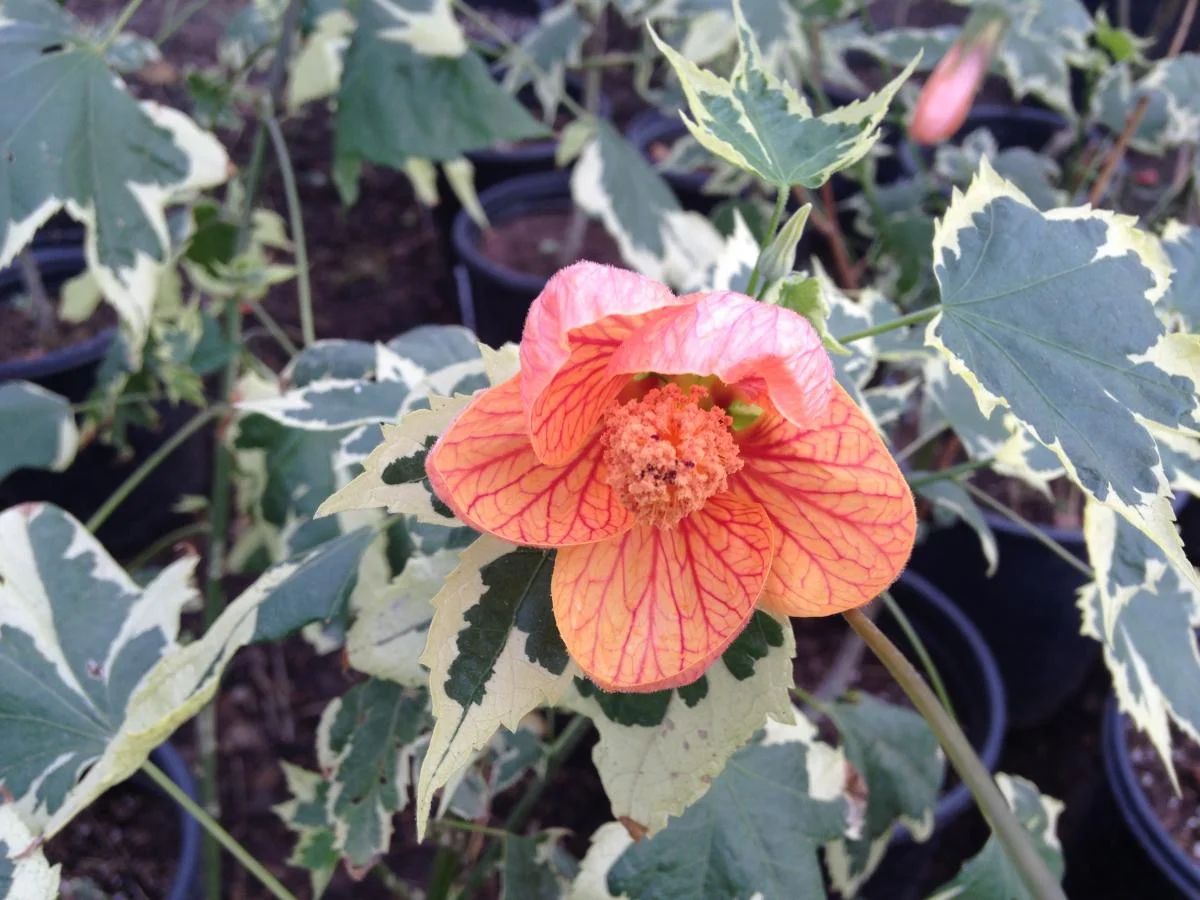
The foliage is the real headline act here. Each leaf is deeply palmate, mimicking a classic maple leaf with three, five, or occasionally more pointed, sharply serrated lobes. The structural centers are a rich, deep forest green, which serves as a stark canvas for a thick, irregular border of bright cream to buttery white.
Up close, the variegation reveals its true charm:
- Cream borders trace every single twist, turn, and tooth of the leaf lobes.
- The pale band waxes and wanes unpredictably, creating unique individual leaves.
- Fresh spring growth emerges with an intense brightness, making the branch tips look lit from within.
- The substantial green centers ground the plant, preventing the variegation from looking pale or sickly.
- The shrub retains its immense structural value even during brief lulls in the blooming cycle.
This is not a delicate, pin-striped variegation. Instead, you get splashy, confident cream margins and occasional solid pale blocks. This delightful irregularity gives the entire plant a kinetic, living energy rather than a stiff, mechanical pattern.
The Year-Round Rhythm
If you can provide a consistently warm, sun-drenched sanctuary, this abutilon will happily keep its leaves all winter long. In standard British gardens, however, chilly temperatures will cause it to drop foliage or demand indoor protection. Its behavior changes drastically with the seasons:
- Spring: Fresh, emerald shoots break out, sporting brilliant cream margins while early flower bells begin to dangle from accelerating stems.
- Summer: The plant hits its peak performance, pairing its most luxurious leaf display with a non-stop parade of orange lanterns. The interplay between the cool cream borders and warm petals is dazzling in bright summer light.
- Autumn: Stems continue to branch out and push blooms late into the season, providing a brilliant, structural backdrop before the first frost threatens to halt the show.
- Winter: Tucked inside a frost-free conservatory, it stays lush and green. Out in the open garden, it either succumbs to the cold or relies on you to treat it as a temporary, seasonal resident.
Anatomy of the Bloom
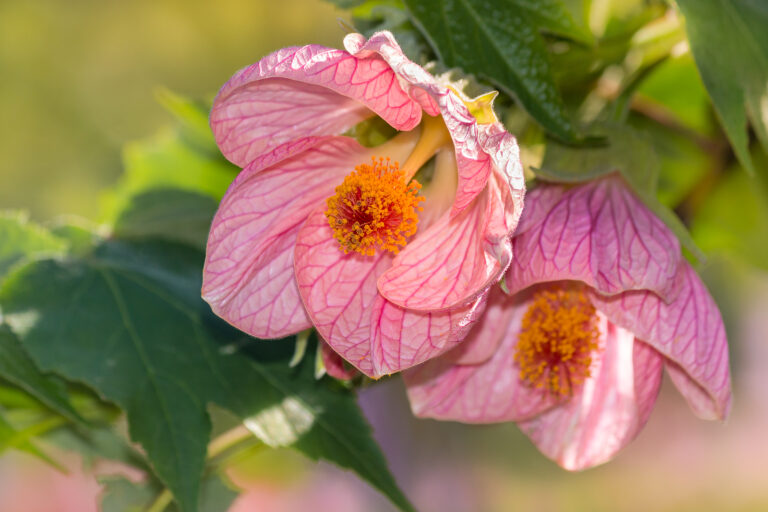
The flowers themselves are pendulous, gently nodding bells or lanterns that reach about 6 cm in length. You won’t find them crammed into dense, heavy clusters at the ends of branches; instead, they hang elegantly, one by one, from leaf axils along the young, supple wood. Their coloration is a brilliant study in warm tones—ranging from soft coral and peach-orange to a rich, luminous apricot, all shot through with an intricate network of crimson or cerise-red veins.
The anatomy of each bloom features:
- A soft, warm peach-to-orange corolla.
- Pencil-sharp crimson or cerise-red veining.
- A delicate, papery, pendant bell structure.
- An explicit, protruding central staminal column.
- An uninterrupted production of flowers, provided the plant is kept warm and growing.
That fine red veining is crucial to the plant’s identity. It gives the delicate bells structural definition from afar and ties them contextually to the darker green hearts of the leaves. From across the lawn, they register as vibrant pops of warmth; up close, they reveal a captivating, lace-like complexity. Because they emerge as individual ornaments nestled in the foliage, position the plant where people gather—alongside a garden path, near a patio seating area, or flanking a conservatory door where you can look up into the nodding bells.
Growth Habit and Dimensions
Left to its own devices, ‘Souvenir de Bonn’ grows into an upright, somewhat relaxed, bushy shrub with highly flexible branches. Like many of its wild cousins, it can get a bit leggy or sparse if it has to compete for light. Think of its branches not as a dense, clipped hedge, but as a graceful, open framework designed to display swinging lanterns and patterned leaves.
Mature sizes are highly dependent on your local climate, container restrictions, and whether it spends its life under glass. Given free rein in perfect conditions, expect it to hit 1.5 to 2.5 metres in height and spread. In colder regions or restricted pots, it behaves beautifully at a much more modest scale.
When mapping out its spot in your design, keep these habits in mind:
- Potted specimens stay tidy, compact, and easily managed.
- Ground-planted specimens with unrestricted root runs and long, warm summers will explode into large, expansive shrubs.
- The natural silhouette is delightfully informal, avoiding any rigid architectural geometry.
- Training the plant as a clear-stemmed standard offers an elegant, tree-like vertical accent.
Ultimately, view its final size as a reflection of its environment. A plant coddled in a heated winter conservatory will naturally dwarf a summer patio specimen that gets hard-pruned or replaced year after year.
Garden Design Strategies
A Foliage-First Specimen
Unlike its plain-green relatives, ‘Souvenir de Bonn’ commands attention the moment its leaves unfurl. Those wide cream borders are fantastic for illuminating a gloomy, sheltered corner, anchoring a patio collection, or breaking up monotonous blocks of solid green foliage in a conservatory.
To maximize its dramatic potential:
- Elevate the plant so the intricate leaf margins sit right at eye level.
- Set it against a rich, dark backdrop—such as deep evergreen yews, a dark-painted fence, or a shaded brick wall—to make the cream borders pop.
- Keep it near walkways so visitors can appreciate the hanging bells from underneath.
- Give its arching branches plenty of breathing room so neighboring plants don’t swallow its graceful form.
It also shines as a seasonal thriller in large, mixed containers. Pair it with a dark, moody companion foliage plant to accentuate the cream trim, or underplant it with low-profile, simple annuals that won’t compete with the main event.
High-Contrast Companions
The intersection of cream margins and fiery orange petals gives you a rich, warm palette to play with. Consider these stellar design pairings:
- Deep purple or burgundy foliage plants, which create a striking double-contrast against both the pale cream leaves and bright orange bells.
- Glaucous blue or steel-grey foliage, which cools down the surrounding space without clashing with the delicate red veins.
- Soft apricot, pale yellow, or cream blossoms to build a sophisticated, warm, monochromatic vignette.
- Lush, deep-green ferns or bold-leafed evergreens to provide a quiet, textured backdrop.
- A restrained touch of silver foliage to mirror the cream borders while keeping the orange flowers center stage.
A word of warning: resist the urge to surround it with other highly variegated plants. Too many competing patterns create visual chaos, diluting the clean, historic elegance of this particular cultivar.
Container and Conservatory Placement
For gardeners living in frost-prone regions, keeping this abutilon in a pot is the ultimate shortcut to success. Its upright architecture adds crucial height to a cluster of patio pots, bringing the hanging flowers right up where they can be enjoyed up close.
It is equally exceptional for:
- In-ground conservatory borders.
- Bright, sunlit indoor plant collections.
- Warm, sheltered microclimates against south-facing walls in coastal towns.
- Generous, seasonal mixed containers.
- Subtropical or jungle-themed summer bedding schemes.
- Elegant, hand-trained standards and formal topiary shapes.
Cultivation Profile
This section focuses exclusively on the unique quirks and behaviors of this specific cultivar. For standard protocols on soil mixing, watering routines, feeding schedules, general pruning, propagation, and step-by-step overwintering, please consult the Master Abutilon Growing Guide.
Light Requirements and Exposure
To maintain that crisp, high-contrast variegation and tight, bushy growth, a bright location is non-negotiable. Without enough light, the green centers expand and the plant grows weak and leggy.
However, balance is key. Under intense midday summer sun—especially when magnified by greenhouse glass—those delicate, unpigmented cream edges can easily scorch. Aim for a position bathed in bright, filtered light or one that offers protection from the scorching midday sun to keep the foliage pristine without sacrificing flower production.
Hardiness and Winter Protection
Make no mistake: ‘Souvenir de Bonn’ will not survive a harsh British winter unprotected. To keep it thriving long-term, rely on one of these strategies:
- A completely frost-free conservatory.
- A heated greenhouse.
- A highly sheltered, urban courtyard or a mild coastal garden.
- An outdoor summer vacation on the patio followed by a cozy winter indoors.
- Treating it as an annual, seasonal accent plant.
If you want it to remain truly evergreen, keep the ambient temperatures high enough to ward off frost, and ensure it gets plenty of natural light through the darkest months of the year.
Soil and Root Environment
This shrub craves a decadent, moisture-retentive yet free-draining soil mix. The trick with this variegated cultivar is consistency: pushing out massive leaves and continuous flowers requires a lot of energy, but stagnant, waterlogged soil will quickly rot the roots of this tender woody plant.
Never let the root zone oscillate wildly between bone-dry drought and soggy saturation. That kind of environmental whiplash triggers massive leaf drop, puny new shoots, and a lackluster, washed-out color display.
Pruning and Shaping
Because abutilons produce flowers exclusively on fresh, current-season wood, regular pruning is your best tool for generating a constant supply of new blooming shoots. This versatile cultivar can be shaped into multiple forms:
- A classic, well-branched shrub.
- A formal, clear-trunked standard.
- An elegant espalier trained against a warm wall.
- A tight, compact potted plant.
- A tall, arching conservatory feature.
Your main goal when pruning should be to stimulate enough lateral branching to show off the spectacular foliage, while keeping the interior open enough so the lantern flowers have room to hang freely. Avoid shearing it into a dense, solid hedge; its loose, airy grace is its finest attribute.
Propagation and Authenticity
If you want to clone this exact plant, stick exclusively to softwood cuttings harvested in the spring. This ensures every new plant inherits the precise cream border, veined flowers, and growth habit of the parent. Raising it from seed is a gamble, as the resulting seedlings will vary wildly and lose the distinct characteristics of the cultivar.
In the trade, you might run across this plant under a few different names, such as Abutilon pictum variants or common typographical errors like ‘Souvenier de Bonn’. Don’t worry—these are rarely distinct varieties. Check the plant in person: if it features large, maple-shaped leaves with wide cream borders and pendulous, dark-veined orange bells, you are looking at the true historic masterpiece.
Pests, Diseases, and Real-World Challenges
When grown indoors or kept confined for the winter, this plant can become a magnet for classic greenhouse pests: glasshouse whitefly, two-spotted spider mites, mealybugs, and scale insects. Out in the garden, common aphids may occasionally gather on juicy, tender new spring growth.
The biggest challenge, however, isn’t a bug—it’s winter care. Bringing a large specimen indoors to overwinter can cause it to drop leaves if the room is too dark, overly blasted with dry indoor heat, or neglected. A bright, cool, frost-free room is the gold standard for preserving its leaves and keeping those orange bells nodding late into the year.
Finally, a quick note for your skin: the fuzzy coating on the leaves can trigger mild dermatitis in people with sensitive skin. Slipping on a pair of gardening gloves is a smart move whenever you are pruning or handling these plants in large quantities.
The Verdict
Abutilon ‘Souvenir de Bonn’ is an exceptional, dual-purpose plant with an unmistakable personality. Its bold, cream-trimmed leaves carry the show from day one, while its spectacular, crimson-veined orange bells provide a steady pulse of warm color from late spring until the autumn chill arrives.
It is an absolute must-have if you are searching for:
- A variegated focal point with far more charisma than a standard green bush.
- A hard-working patio container plant that delivers beautiful foliage and flowers.
- A permanent conservatory resident with multi-season appeal.
- An authentic, Victorian-era heirloom with deep historical roots.
- A centerpiece plant for close-up viewing near patios and sheltered walkways.
Because of its tender nature, this is not a plant to leave unprotected in an exposed, cold northern garden. But if you treat it as a protected collector’s piece or a seasonal summer highlight, ‘Souvenir de Bonn’ delivers one of the most stunning, high-contrast combinations of graphic foliage and intricate blooms found anywhere in the botanical world.