Jing Orange Okra: The Showstopping Asian Heirloom Your Edible Border Needs
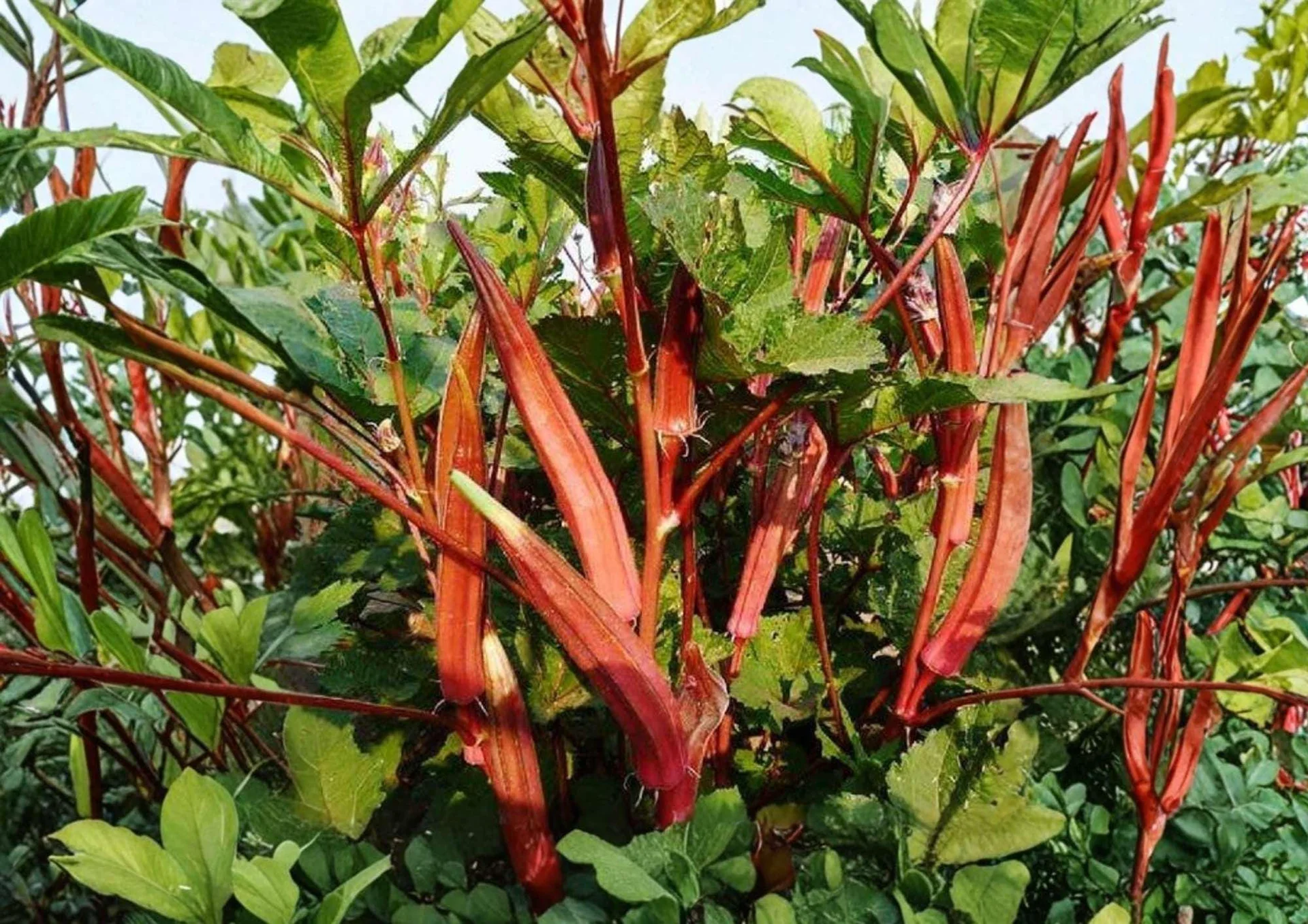
Abelmoschus esculentus ‘Jing Orange’ is a spectacular open-pollinated okra cultivar that effortlessly bridges the gap between striking ornamental beauty and heavy culinary yield. Skyrocketing to an imposing 5 to 6 feet in a single season, this vigorous heirloom commands attention in the summer garden with its unusually vivid, fiery red-orange pods.
While traditional green okras melt into the background, ‘Jing Orange’ punctuates the patch with warm color, architectural structure, and bold seasonal contrast. It is a natural fit for sophisticated kitchen gardens, mixed borders, and productive living screens where visual impact matters just as much as harvest weight.
Growing guide: For baseline cultivation information—including planting, soil, watering, fertilising and general pest management—refer to the Abelmoschus Master Growing Guide.
Plant identity and character
As a proud member of the Malvaceae family, ‘Jing Orange’ belongs to Abelmoschus esculentus, the beloved species known across the globe as okra or ladies’ fingers. According to Kew’s Plants of the World Online, this annual thrives in conditions mimicking its native range, which stretches from the seasonally dry tropical environments of southwestern Uttarakhand through western and central India. Today, the species enjoys worldwide cultivation, celebrated for its deep culinary, cultural, and practical history. powo.science.kew
In seed circles, ‘Jing Orange’ is frequently categorized as an Asian or Chinese heirloom. While commercial catalogs stop short of pinpointing its exact village of origin or original breeder, its roots in Asian agrarian traditions are undeniable. Because its specific, hyper-local history remains lightly documented, growers should treat overly precise provenance claims with a bit of healthy skepticism.
Crucially, this is an open-pollinated cultivar rather than a modern F1 hybrid. Gardeners who practice proper seed-saving techniques can expect future generations to reliably mirror the parent plant’s signature form, habit, and brilliant color—provided other okra varieties aren’t flowering nearby to cross-pollinate them.
Distinctive appearance
Red-orange pods
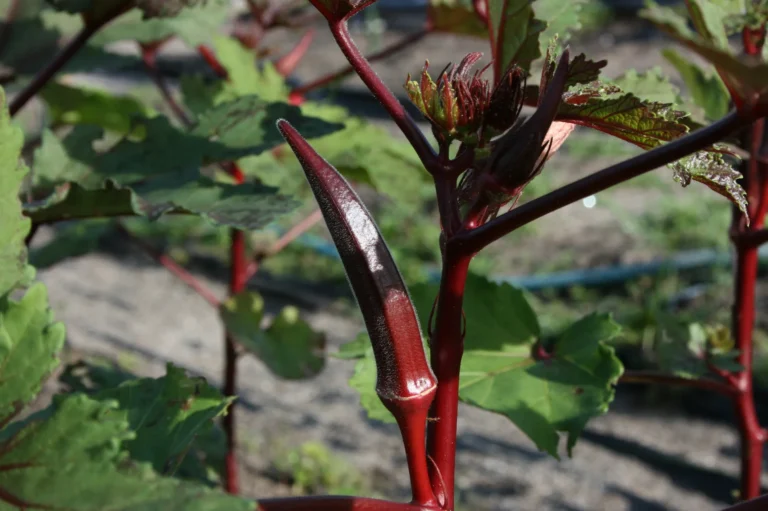
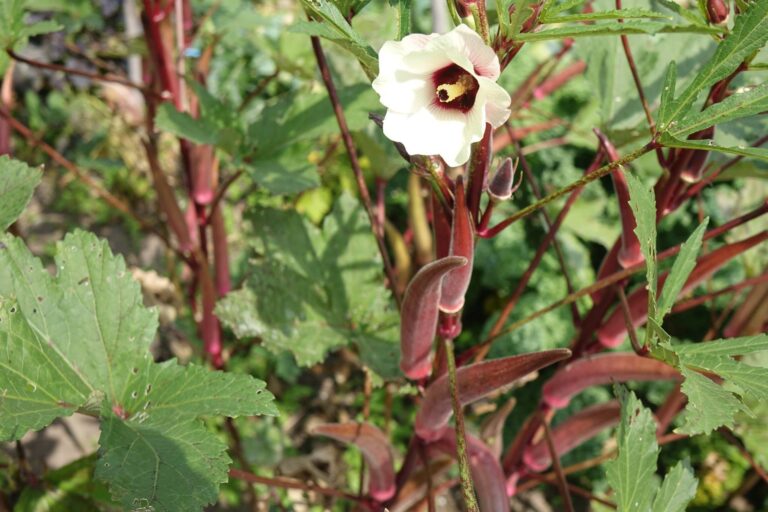
The glowing pods are the undeniable crown jewels of ‘Jing Orange’. Developing in shifting shades of bright orange-red to deep, smoldering reddish-orange, they put on a far more dramatic and conspicuous show than common green varieties. Under favorable growing conditions, these elongated, heavily ridged pods consistently reach 6 to 7 inches long, with some exceptional specimens stretching to 8 inches. rareseeds
When sliced, they reveal the familiar, star-like cross-section that gives okra its graphic charm. The pods are fundamentally spineless, saving gardeners from the irritating skin prickles associated with older varieties, and they retain their tender snap even at a larger size. However, timing is everything: if left hanging too long on the stalk, they will inevitably turn fibrous and woody.
Keep in mind that this brilliant coloration is a pre-culinary treat. Cooking causes the pods to lose their intense red-orange pigment, shifting toward a more muted, greenish hue. To maximize its aesthetic currency, showcase ‘Jing Orange’ in the garden, at the harvest basket stage, or as part of a fresh centerpiece display. rareseeds
Flowers
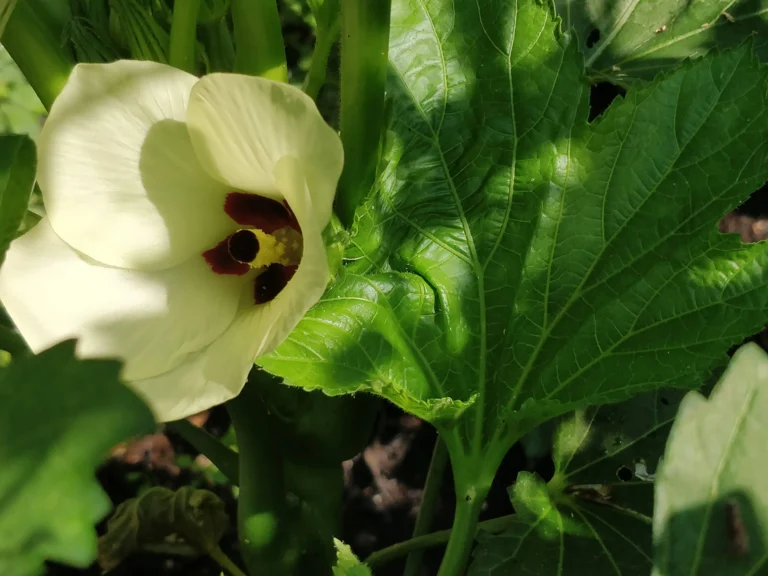
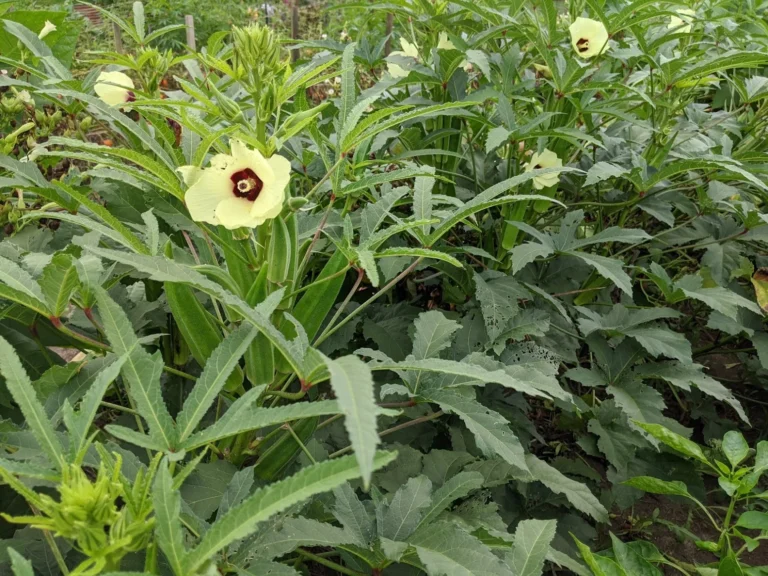
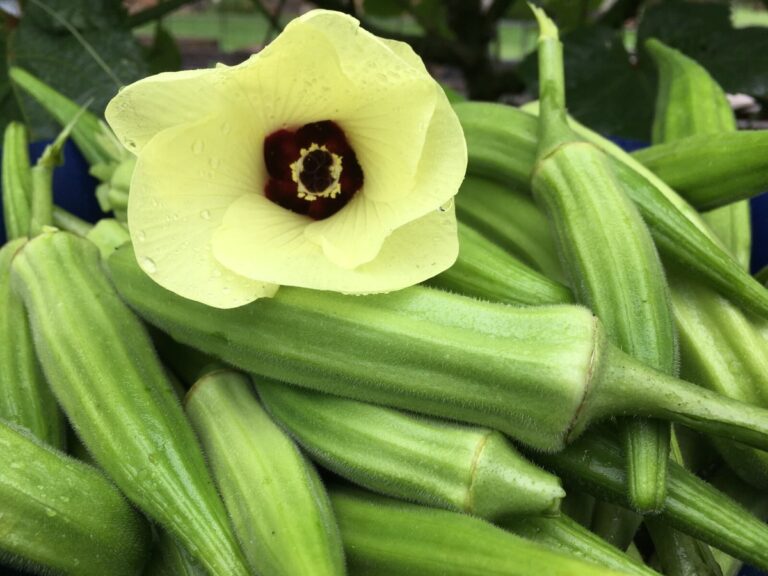
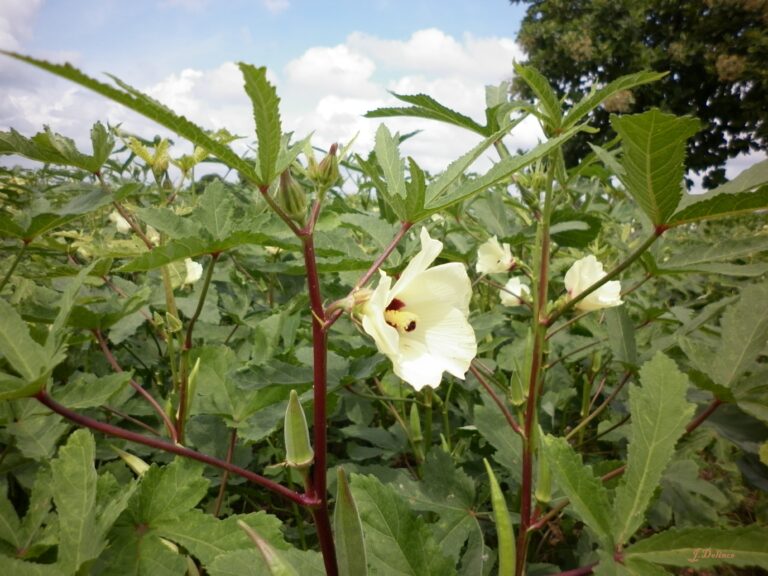
Long before the pods form, the plant delivers true hibiscus-like elegance. The large, five-petalled blooms open in shades of cream or soft yellow, each anchored by a rich, contrasting throat of maroon, purple, or deep crimson.
Though individual flowers last only a single day, the plant pumps them out continuously throughout the heat of summer. This relentless cycle creates a beautiful vertical rhythm: pale, dark-eyed blossoms cluster near the top of the canopy while glowing orange-red pods mature just below.
Foliage and stems
The architecture is supported by broad, deeply lobed leaves that carry the rough, tactile texture typical of the mallow family. While the foliage remains a deep, healthy green, the stems and prominent leaf veins frequently take on rich purple or reddish undertones, especially when grown under the intense light of full summer sun.
Because these secondary color traits can vary based on your local microclimate and soil conditions, they should be viewed as delightful potential bonuses rather than guaranteed certainties. The reliable, unmistakable signature of ‘Jing Orange’ always comes back to its soaring verticality, beautiful blooms, and fiery fruit.
Size and garden presence
Make no mistake: ‘Jing Orange’ is a giant among okras. Most sources report a mature height of 5 to 6 feet, though commercial listings note that a long, hot growing season can push plants anywhere from 4 to 7 feet tall. ufseeds
This impressive stature opens up brilliant design possibilities in the landscape:
- Deploy it as a fast-growing, temporary summer screen to divide garden rooms.
- Anchor it at the back of a vegetable bed or within an ornamental edible border.
- Use it to create bold vertical accents rising above low-growing companions like basil, peppers, bush beans, or lettuce.
- Position it strategically to avoid casting unwanted shade on smaller sun-lovers nearby.
- Enjoy a lush, tropical silhouette without committing to a permanent, woody shrub.
For formal garden spaces, a tightly grouped block or a clean row creates a striking architectural panel. In a relaxed cottage garden, intermingle it with intense color companions like blue salvia, purple-leaved basil, dark amaranth, or cheerful marigolds. For a modern edible landscape, repeat small clusters at regular intervals so the glowing pods read as a intentional, rhythmic design element.
Because okra demands intense summer heat and cannot tolerate a whisper of frost, its structural impact is a seasonal treat in cooler climates where it is grown strictly as an annual. Baker Creek notes that it will only persist as a perennial in the frost-free winters of USDA zones 9 and 10. rareseeds
Harvest and culinary value
Expect to see your first harvest around 60 to 70 days after planting. Once production begins, the plants will continuously throw out new pods for months, provided you keep up with the harvest. rareseeds
For peak culinary quality, harvest the pods while they are young, supple, and snap easily. While ‘Jing Orange’ is famous for staying tender up to 6 or 7 inches, rely on your sense of touch rather than a ruler. A prime pod should bend slightly and yield cleanly to a sharp knife; if it feels rigid and unyielding, it has gone too far.
University of Georgia extension specialists emphasize that okra pods develop rapidly and require picking every few days. Allowing pods to mature fully on the stalk signals the plant to slow down production and turns the fruit woody. Regular harvesting keeps ‘Jing Orange’ productive and visually pristine, preventing a cluttered buildup of dull, overgrown pods. site.extension.uga
In the kitchen, these versatile pods excel at:
- High-heat frying and pan-searing.
- Thickening rich soups, stews, and classic gumbos.
- Fast-paced stir-fries.
- Clean, geometric slicing for raw displays or stir-fry rounds.
- Elevating fresh harvest baskets and mixed edible floral arrangements.
The natural mucilage released during cooking acts as an excellent built-in thickener for broths. To minimize the perception of sliminess, opt for dry-cooking methods like roasting, grilling, or charring, or introduce acidic ingredients to balance the texture.
Handle your harvest with care, as fresh okra bruises easily. For short-term storage, the University of Georgia recommends keeping pods in a moist environment right around 45 to 50°F, which maintains top quality in the refrigerator for about a week. site.extension.uga
Cultural and historical context
The global story of okra is vast and deeply rooted. While Abelmoschus esculentus points botanically back to the Indian subcontinent, the crop itself migrated beautifully across Africa, the Middle East, Asia, the Caribbean, and the American South. It is a foundational ingredient woven into countless international foodways rather than belonging to a single culture.
Its close genetic kinship to hibiscus and cotton shines through in every silken blossom. This botanical connection perfectly explains why okra works so beautifully on multiple levels: it is a heavy-yielding vegetable, a stunning landscape ornamental, and a plant steeped in global cultural history.
‘Jing Orange’ perfectly demonstrates that heirloom vegetables don’t have to choose between utility and beauty. Its fiery color isn’t a modern gimmick; it changes how we look at an edible plot, turning the act of food production into a deliberate visual celebration against a sea of green foliage.
Ornamental uses
To get the most out of ‘Jing Orange’, treat it as a true edible ornamental. Its design currency comes from an unforgettable combination of traits:
- A commanding, upright structural form.
- Large, dramatic, hibiscus-like blossoms.
- Luminous, warm red-orange pods.
- Richly pigmented stems and contrasting leaf veins.
- An extended, heat-loving display that peaks when other plants flag.
Plant it where the eye can appreciate the pods at or just below eye level, such as the back of a prominent border or flanking a garden pathway—just ensure the mature canopy won’t block the walkway.
To create striking color harmonies, pair ‘Jing Orange’ with:
- Deep purple basil or dark ornamental peppers for an intense, moody contrast.
- True blue flowers, like salvia, to play with classic warm-cool color theory.
- Rich yellow or gold blossoms to amplify the fiery undertones of the pods.
- Dramatic dark foliage, such as burgundy amaranth, for a theatrical centerpiece.
- Cool, silver-leaved companions to create a sophisticated, toned-down palette.
The pods also make a fantastic addition to seasonal arrangements. University of Georgia experts explicitly highlight okra’s versatility in dried floral crafts as well as culinary applications, though the pods offer their most intense color punch when cut fresh. site.extension.uga
Cultivar profile
| Feature | ‘Jing Orange’ |
| Botanical name | Abelmoschus esculentus ‘Jing Orange’ [1] |
| Plant type | Warm-season vegetable, commonly grown as an annual [1] |
| Habit | Upright, vigorous and tall [1] |
| Typical height | About 5–6 feet; broader reports range from 4–7 feet [1] |
| Pod colour | Red-orange to deep reddish orange [1] |
| Pod size | Commonly about 6–7 inches; some descriptions report 6–8 inches [1] |
| Pod texture | Tender when harvested young; often described as spineless [1] |
| Maturity | Approximately 60–70 days [1] |
| Pollination status | Open-pollinated [1] |
| Main garden value | Edible crop with strong ornamental colour and vertical structure [1] |
| Best design position | Back of a border, tall vegetable row or seasonal screen [1] |
Height expectations and pod dimensions are sourced from variety-specific seed listings, while general harvesting guidelines align with university extension standards. rareseeds
What makes it different
‘Jing Orange’ earns its place in the spotlight by refusing to be just another row crop. It occupies a rare, highly desirable middle ground in garden design.
Its definitive advantages include:
- An Unmistakable Color Identity: The brilliant red-orange pods offer an instant, vivid departure from standard green okras.
- Stature and Presence: Reaching 5 to 6 feet tall, it delivers a spatial and architectural impact far beyond compact dwarf varieties.
- A Continuous Visual Show: The elegant transition from buttery yellow flowers to glowing pods provides non-stop interest.
- Culinary Adaptability: The spineless pods handle everything from frying and stir-frying to low-and-slow stews with ease.
- A Living Global Connection: It embodies the rich diaspora of okra through global cuisines, offering a conversation piece with a beautifully open history.
- Design-Forward Landscaping: It integrates flawlessly into ornamental color schemes without sacrificing a single ounce of harvest potential.
For the gardener who wants height, vibrant color, and rich flavor all packed into a single plant, Abelmoschus esculentus ‘Jing Orange’ stands out as one of the most rewarding heirlooms you can grow.