Abelia × grandiflora ‘Confetti’ (‘Conti’) – Complete Growing Guide
If you are designing a compact backyard, mapping out a foundation planting, or trying to tease big personality out of a tight garden border, you know the design dilemma. You want a shrub that works hard all twelve months of the year, looks high-end, stays naturally neat, and refuses to be eaten to the ground by neighborhood deer or rabbits.
Meet Abelia × grandiflora ‘Confetti’ (often sold under its trade designation, ‘Conti’).
While standard glossy abelias are legendary, indestructible workhorses, they can also become massive, sprawling ten-foot fountains. ‘Confetti’ scales that rugged durability down into a perfectly behaved dwarf package. Discovered in 1992 as a natural foliage mutation (a “sport”) of the compact variety ‘Sherwoodii’, this stable, variegated introduction maxes out at a manicured 2 to 3 feet tall and 3 to 4 feet wide. It trades aggressive, wild growth for a dense, mounded form, offering a multi-season color show in a fraction of the space.
Botanical Blueprint & Background
To understand why this plant performs so well, it helps to look at its family tree. The overarching species, Abelia × grandiflora, is a time-tested natural hybrid between Abelia chinensis and Abelia uniflora, combining the heavy flowering power of one parent with the glossy, resilient foliage of the other. As a member of the Caprifoliaceae (Honeysuckle) family, it shares that signature trait of producing highly fragrant, nectar-rich, tubular blooms.
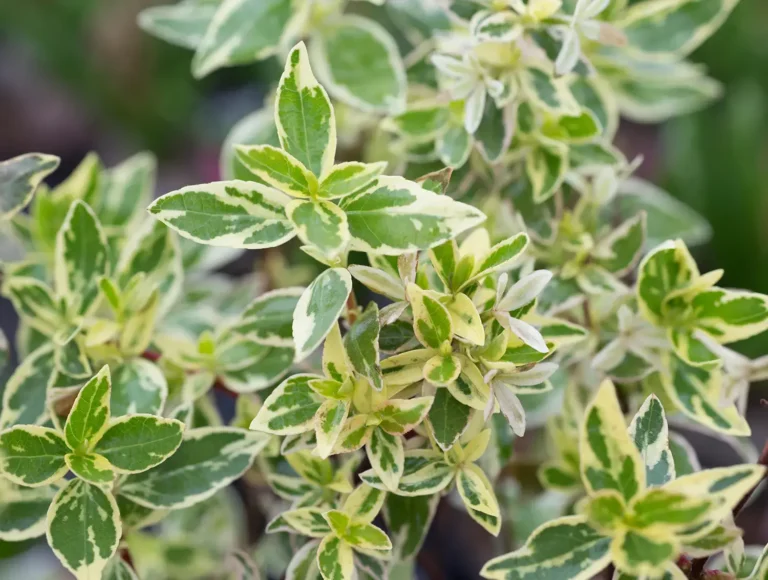
The unique magic of ‘Confetti’ is structurally locked into its genetics as a periclinal chimera. This is a botanical term meaning the cell layers in the leaf growing points are genetically distinct. The inner layers produce a classic sage green, while the outer layers lack chlorophyll, creating a permanent, stable border of creamy white that will not easily revert back to plain green.
The Four-Season Foliage Transformation
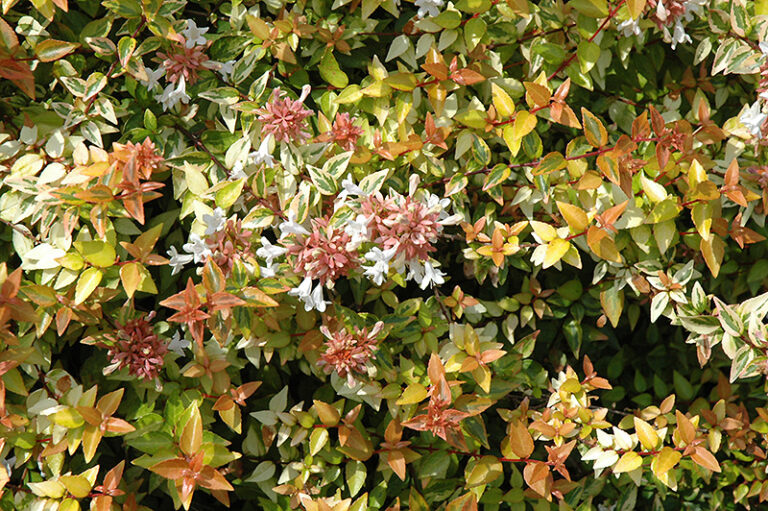
While many shrubs offer a single fleeting moment of spring glory, ‘Confetti’ is grown primarily for its dynamic, shifting wardrobe. A single leaf is a masterclass in visual texture, with a soft grey-green center that accounts for roughly 70% of the surface, beautifully framed by bright, ivory-white margins.
Because of its unique cellular makeup, this foliage reacts beautifully to changing temperatures throughout the year:
- Spring: New growth emerges tight and elongated. The fresh leaves open with narrow, pale yellow edges that quickly brighten to cream as the days warm up.
- Summer: The plant establishes a clean, cooling presence in the landscape. The crisp white-and-green leaves offer a brilliant, illuminating backdrop that makes surrounding dark green or purple plants pop.
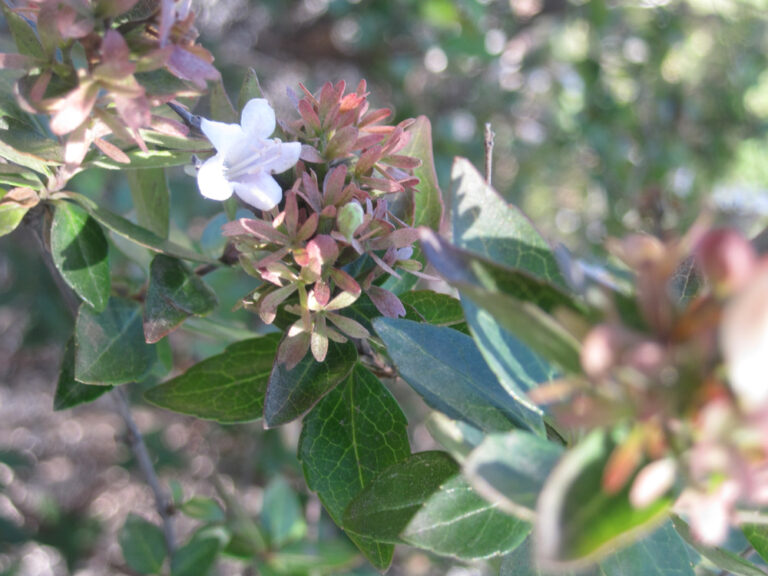
- Autumn: As the first crisp nights arrive, the plant undergoes its best transformation. The creamy-white borders absorb the cool weather and flush a distinct, rosy-pink to deep wine-pink.
- Winter: In USDA Zones 7 through 9, ‘Confetti’ holds onto the majority of this pink-flushed foliage as a reliable, semi-evergreen fixture. In colder Zone 6 climates, it acts as a deciduous shrub, dropping its leaves to reveal dense, gracefully arching stems that mature into an attractive, exfoliating greyed-purple bark.
Flowers and Pollinator Value
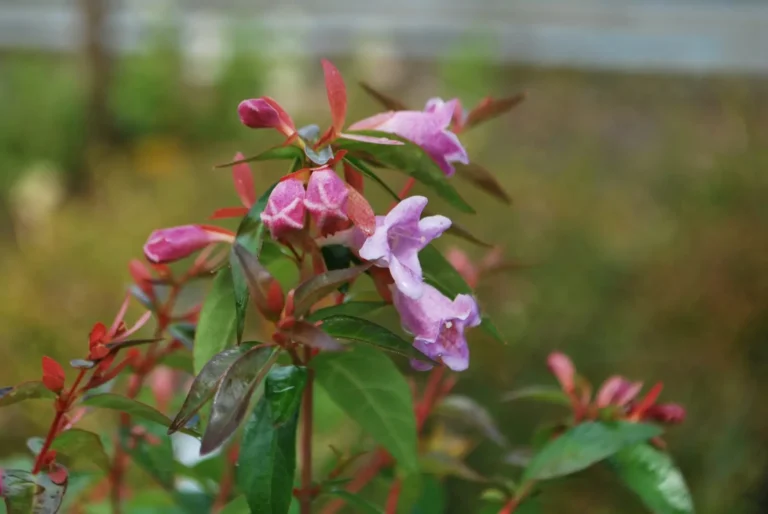
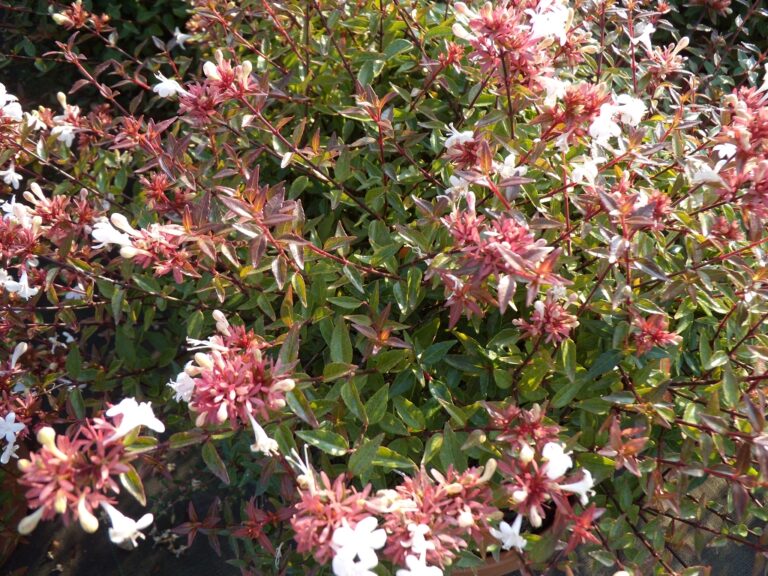
Just when the rest of your landscape begins to look tired and baked by the midsummer heat, ‘Confetti’ steps up to the plate. From June all the way through October, the shrub blankets itself in pairs of small, trumpet-shaped, pure white flowers.
The bloom performance is remarkably efficient because abelias flower on new wood (the growth produced in the current season). This means winter cold snaps or early spring pruning will never cut off your summer flower display.
The fragrance is light, clean, and sweet—reminiscent of wild honeysuckle but soft enough that it won’t overwhelm a patio seating area. If you sit quietly near a mature patch on a warm afternoon, you will notice an absolute hive of activity. Bees, butterflies, and hummingbirds utilize this extended, late-season bloom window as a crucial nectar buffet when other food sources are scarce.
Master Class Care: Soil, Sun, and Water
Abelia is widely considered low-maintenance, but matching its specific environmental preferences will unlock its full aesthetic potential.
1. The Sun Factor
To get the most out of ‘Confetti’, plant it in full sun (at least six hours of direct sunlight daily). While it is highly adaptable and will survive in partial shade, a lack of light causes two distinct aesthetic downgrades: the white variegation will fade to a duller green, and the summer flower production will be significantly sparser.
2. Soil and Drainage Foundations
This shrub is incredibly resilient regarding soil pH, cruising through acidic, neutral, and alkaline soils without missing a beat. Its absolute non-negotiable requirement is impeccable drainage. It will quickly decline in heavy, waterlogged clay. If you are dealing with poorly drained soil, elevate the root ball by planting on a slight slope, building a dedicated raised bed, or amending the planting area with generous amounts of organic compost and coarse grit to break up the soil structure.
3. Watering Protocols
- Year One: Keep the soil consistently moist but never soggy. Water deeply once a week, increasing the frequency to twice a week during intense midsummer heatwaves to help the root system anchor deep into the soil.
- Established Plants: Once its root architecture is mature, ‘Confetti’ is exceptionally drought-tolerant. It can easily handle dry spells with only occasional, deep supplemental waterings.
- Containers: If growing ‘Confetti’ in patio pots, check the soil moisture more frequently. Use a high-quality, free-draining potting mix and water whenever the top two inches of soil feel dry to the touch.
4. Fertilizer Needs
Abelias are light feeders. An overabundance of synthetic fertilizer—especially high-nitrogen formulas—will force long, weak, green growth that dilutes the beautiful variegated pattern and leaves the plant susceptible to winter frost damage. A single, light application of a balanced, slow-release shrub fertilizer or a two-inch top-dressing of rich organic compost in early spring is all it needs for the entire year.
Step-by-Step Planting Guide
Timing and depth are everything when establishing a new shrub. Follow these steps to guarantee success:
- Timing: Plant in early spring after the danger of hard frost has passed, or in early autumn (at least six to eight weeks before your area’s typical first freeze). This gives the root system plenty of time to knit into the native soil without being stressed by extreme heat or extreme cold.
- The Hole: Dig a hole exactly the same depth as the nursery container, but twice as wide. This loosened ring of soil allows the tender outer roots to expand horizontally with minimal resistance.
- Placement: Gently slide the plant out of its pot. If the roots are tightly bound or circling the base, use your fingers to lightly tease them outward. Position the shrub in the hole so that the top of the root ball sits exactly level with, or slightly above, the surrounding soil grade. Settling too deep can trap moisture against the base and invite stem rot.
- Backfill and Water: Fill the hole halfway with your native soil (blended with a bit of compost if your soil is poor), then flood the hole with water to settle the earth and eliminate underground air pockets. Finish filling the hole and firm the soil gently with your hands.
- Mulch: Apply a 2- to 3-inch layer of shredded bark mulch around the entire drip line of the shrub. This insulates the roots, traps vital moisture, and keeps competing weeds at bay. Crucial rule: Pull the mulch back two inches away from the main wooden stems to prevent moisture entrapment and bark disease.
Advanced Winter Protection (Zone 6 Strategy)
Standard green abelias are generally solid down to USDA Zone 5, but the variegated cell structure makes ‘Confetti’ slightly more frost-tender. While it sails through winters in Zones 7, 8, and 9 with minimal color loss, Zone 6 gardeners should apply a few protective strategies:
- Microclimate Placement: Plant ‘Confetti’ in a sheltered microclimate, such as against a south- or west-facing brick wall or house foundation. The structures absorb solar heat during the day and radiate it back to the plant at night, while shielding it from biting, desiccating winter winds.
- Heavy Autumn Mulching: In late November, increase the mulch layer around the base of the plant to 4 inches to protect the crown from aggressive freeze-thaw cycles.
- The Worst-Case Scenario: If an unprecedented arctic blast rolls through and kills the top growth down to the ground, do not dig the plant up in spring. Because its roots are incredibly hardy and it blooms exclusively on new wood, the shrub will frequently push vigorous new variegated shoots straight from the base and still manage to flower beautifully by midsummer.
Pruning: Working With Nature, Not Against It
The single biggest mistake homeowners make with dwarf abelias is treating them like formal boxwood hedges. Running over a ‘Confetti’ abelia with electric hedge trimmers destroys its elegant, arching habit and clips away the very wood meant to hold summer flowers.
Instead, adopt a relaxed, selective pruning strategy in late winter or early spring before the new buds begin to swell:
- Annual Maintenance: Inspect the shrub and remove any dead, damaged, or winter-killed stems down to healthy wood. To maintain its tight, rounded shape, selectively snip back the previous year’s longest shoots by about one-third using sharp hand pruners. Make your cuts at a 45-degree angle just above an outward-facing leaf bud.
- Rejuvenation (Every 3–4 Years): Over time, the interior of a dwarf shrub can become congested with old, unproductive, grey twigs. To hit the reset button, use the “one-third rule.” Locate the oldest, thickest wooden stems near the center of the plant and cut them completely down to the ground. This opens up the interior to sunlight and airflow, stimulating a flush of vibrant, heavily variegated new growth.
- Handling Reversion: On rare occasions, a variegated plant may produce a rogue shoot that grows entirely green. Because green shoots contain more chlorophyll, they grow much faster than variegated wood and will eventually overtake the plant if ignored. Simply trace that green stem down to its point of origin and prune it out completely.
Designing and Styling with ‘Confetti’
Thanks to its bright, multi-toned palette and soft, structural footprint, ‘Confetti’ functions beautifully as a design blender in the landscape.
- The High-Contrast Drama: Pair the fine texture and ivory-pink edges of ‘Confetti’ against bold, coarse-leaved companion plants. It looks spectacular planted alongside deep purple coral bells (Heuchera), midnight-hued fairy candles (Actaea simplex), or the structural, dark green blades of dwarf conifers.
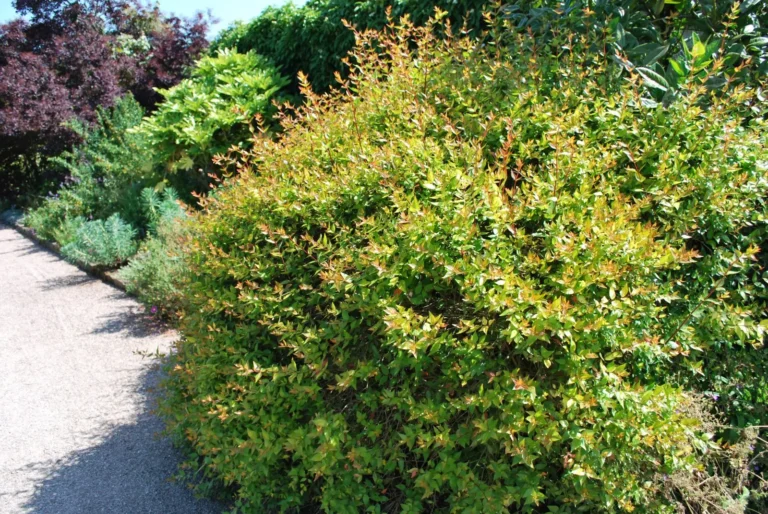
- The Ground Cover Sweep: Because of its low, spreading nature (maturing wider than it is tall), planting ‘Confetti’ in a staggered row spaced 2 feet apart creates an exceptional, low-maintenance, informal border edging or a solid ground cover for sunny slopes.
- The Premium Container Centerpiece: ‘Confetti’ is perfectly scaled for large, high-quality resin or ceramic pots on a sunny patio. Use it as your permanent, structural “thriller,” and surround its base with trailing silver dichondra, dark purple sweet potato vine, or vibrant seasonal annuals.