Growing Acantholimon glumaceum: The Ultimate Guide to the Prickly Thrift
Few alpine plants command a space quite like Acantholimon glumaceum. For gardeners designing for a baking, sun-drenched rockery, this slow-growing evergreen offers an architectural masterclass. It forms a dense, structural cushion of dark, needle-sharp foliage that, come early summer, erupts with short, geometric spikes of funnel-shaped, deep pink blossoms. While typical alpine cushions remain tightly restricted, this resilient species eventually spreads into a broad, living green dome, making it an invaluable asset for texturing gravel gardens, scree beds, and vertical stone walls.
The Botanical Roots of the Prickly Thrift
To understand the sheer grit of this plant, one must look to its origins. Belonging to the leadwort family, Plumbaginaceae—sharing lineage with sea lavender (Limonium)—Acantholimon glumaceum is known colloquially as the conspicuously-glumed prickly thrift. Its wild roots trace back to the rugged terrain stretching from the Caucasus to Asia Minor, with dense populations charting across eastern Türkiye, the northwestern reaches of Iran, and the southern Transcaucasus.
Its botanical name tells the story of its defense mechanisms and anatomy. Acantholimon fuses the Greek akantha, meaning thorn, with limon, nodding to its sea-lavender cousins. The specific epithet glumaceum translates to “having glumes,” pointing directly to the prominent, papery bracts that clasp its flower clusters. As a suffruticose perennial, it possesses a semi-shrubby architecture. While its soft flowering shoots die back with the autumn frosts, its persistent, woody lower framework remains perfectly intact, holding the vital buds that will renew the green cushion next spring.
An Architectural Needle Cushion for All Seasons
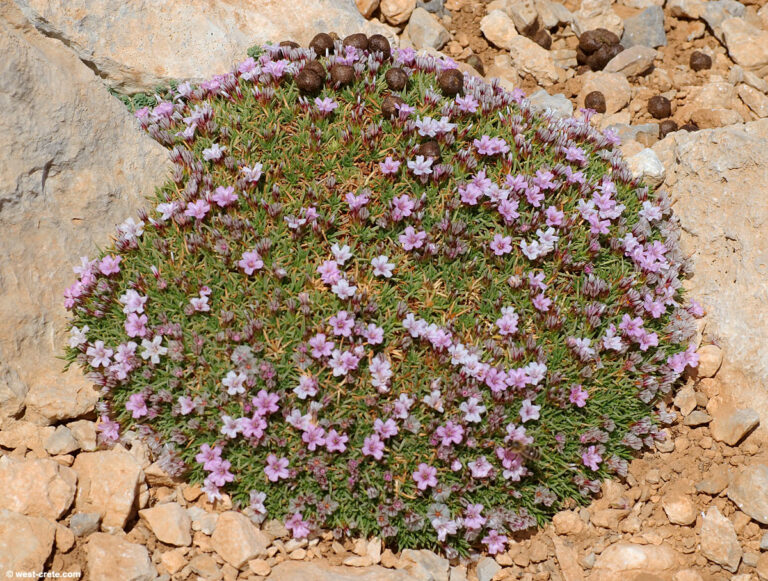
The primary year-round signature of this species is its striking, architectural form. It builds tight, structural rosettes composed of rigid, sharply pointed, three-angled leaves. These present visually as rich, dark-green needles rather than standard foliage. As the plant adapts to the changing seasons, its summer leaves stretch between 2 and 4 cm long, whereas the spring-emerging growth stays noticeably shorter. In a garden setting, the result is a bristly, tightly packed hummock that creates a stark, dramatic contrast against soft-leaved alpines, shimmering silver foliage, and weathered stone.
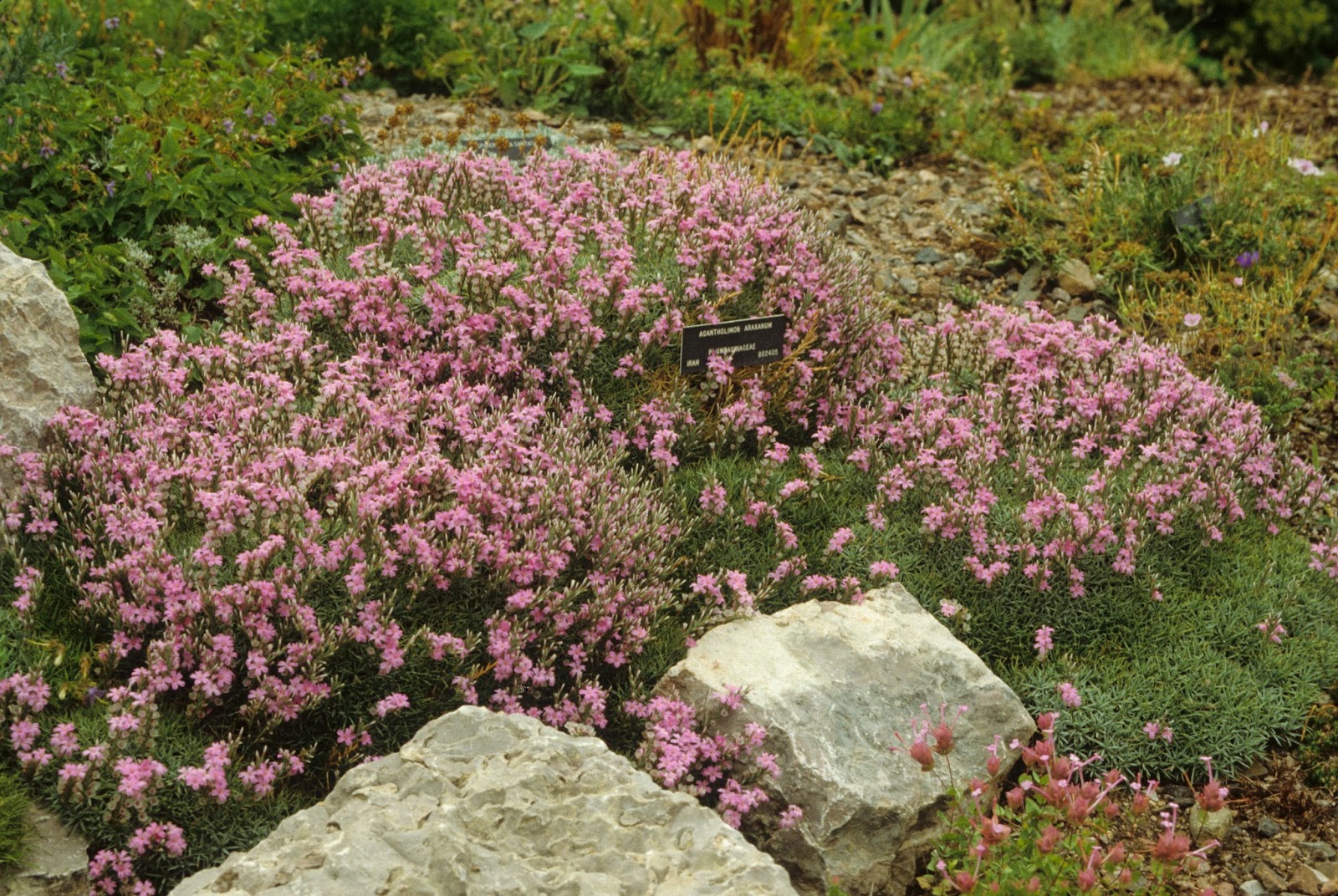
Do not mistake this for a soft, delicate, mossy alpine cushion. These leaf blades are hard-textured and spine-tipped, a defensive characteristic forged by its native steppe environments. This structural toughness ensures the plant retains its substantial visual weight throughout the bleakest months of winter. While mature wild specimens across mountain slopes can occasionally span up to 50 cm in diameter, cultivated garden plants typically establish a dense dome around 10 cm in height, maintaining a controlled spread of 0.1 to 0.5 metres. Given time and ideal conditions, mature garden specimens can stretch substantially wider.
Summer Brilliance: Funnels of Deep Pink
When July arrives, Acantholimon glumaceum transitions from a structural anchor to a vibrant focal point. The flowering season typically spans about a month, though exceptionally warm, favorable summers can coax cultivated plants into bloom even earlier. The bright pink to purple, funnel-shaped blossoms are held in compact panicles of 5 to 10 stalkless spikelets, riding on short scapes that elevate the color just above the dark needle canopy. To better understand how these blooms compare to white-flowering or ultra-compact varieties within the broader genus, review the master Acantholimon guide for a full comparative directory.
While the burst of summer color catches the eye from afar, the true magic of the floral display is revealed upon close inspection. Every single blossom is framed by distinctive, papery glumes. Long after the bright petals fade and drop, these persistent calyces remain highly ornamental for weeks on end, introducing a pale, silvery, dried-flower texture to the evergreen mound. Because of this intricate detail, the plant is best positioned where it can be appreciated at arm’s length—tucked tightly along a raised rockery edge, framing stone steps, or anchored at the front of an alpine trough.
Visual Profile and Cultivation Metrics
Habit
Dense evergreen mat, cushion, or low dome
Height
Typically up to 10 cm; well-established cultivated domes can eventually reach 20–25 cm
Spread
Generally 0.1–0.5 m; can grow significantly wider in aged, ideally sited garden positions
Foliage
Dark green, rigid, three-angled, needle-like leaves with sharply pointed tips
Flowers
Deep pink to purple, funnel-shaped blossoms clustered on short spikes just above the foliage
Peak Season
Early to midsummer, most reliably throughout July
Best Settings
Rock gardens, scree beds, crevice walls, gravel gardens, and alpine containers
Part of the plant’s distinct allure is its slow, deliberate maturation, often requiring 5 to 10 years to reach its full aesthetic potential. This patience is amply rewarded. Instead of merely growing larger and loose, the plant becomes increasingly sculptural with age, taking on the dense, weathered, timeless look of a miniature mountain outcrop.
Design Partnerships and Garden Integration
Acantholimon glumaceum functions beautifully as a living textural anchor rather than a mass-flowering filler perennial. Its dark, bristly foliage establishes a crisp, low horizon line, while its summer flower spikes inject a concentrated hit of color without compromising the clean, minimalist look of a dry planting scheme.
To maximize its dramatic form, consider pairing it with these stellar companion plants:
- Silver-Foliaged Alpines: Integrate small Achillea varieties, dwarf Artemisia, or woolly Stachys selections to make the dark green needles and deep pink blossoms visually pop.
- Rosette-Forming Succulents: Position compact saxifrages and Sempervivum nearby; their broad, geometric rosettes offer a spectacular textural counterpoint to the needle-fine bristliness of the prickly thrift.
- Creeping Groundcovers: Weave low-growing thymes and creeping soapworts around the perimeter to soften the harsh edges of a scree bed while keeping the clean dome of the acantholimon fully visible.
- Natural Mineral Backdrops: Plant against pale or warm stone, tufa, gravel, and weathered rock, which reflect the plant’s high-altitude origins and cause the deep pink flowers to glow with greater luminosity.
Given its natural evolution on dry, sun-baked, rocky slopes with lean, base-rich soils, this species thrives best in a curated “mountain steppe” environment. Create a raised pocket filled with a gritty mineral mulch, place a few strategic pieces of character stone, and select low-stature companions that will never crowd or shade out its slow-spreading cushion.
A Time-Tested Choice for Serious Plantsmen
First described botanically in the nineteenth century, this species has maintained a dedicated following among alpine enthusiasts for generations. It perfectly bridges the gap between the meticulous precision of a delicate cushion plant and the sheer durability of a steppe perennial.
Within the broader Acantholimon genus—a group celebrated for producing dense mats of needle-thin foliage and papery summer flowers—A. glumaceum holds a premier position. It stands out distinctly from its close relatives by virtue of its exceptionally dark, rich green color and its reliable ability to forge a broader, more substantial, and more assertive garden footprint than other tighter, finicky cushion varieties.
Ideal Garden Placement
For the best results, site Acantholimon glumaceum where its crisp geometry can be spotlighted and admired year-round. It belongs at the absolute front of a well-drained rock garden, tucked horizontally into a vertical crevice of a drystone wall, nested into a scree pocket, or showcased in a shallow alpine pan. It is equally spectacular in modern gravel gardens and patio troughs, where its low, evergreen symmetry provides structure through the winter months before its brief, vivid flowering season takes center stage as a major summer event.