Beyond the Green Carpet: Choosing and Growing Blue New Zealand Burrs
For gardeners hunting down a pewter, steel-blue, or glaucous groundcover, these New Zealand burrs offer an extraordinarily architectural alternative to ordinary green mats. Their delicate pinnate leaves, creeping stems, and small, burr-like flower heads inject a wild, alpine character directly into the landscape.
While Acaena caesiiglauca and the nursery favorite sold as Acaena ‘Blue Haze’ are closely related, they are by no means interchangeable. Both weave a low, cool-toned carpet of finely cut foliage, but they have distinct identities. The Royal Horticultural Society (RHS) officially taxonomizes the popular cultivar as Acaena saccaticupula ‘Blue Haze’, whereas A. caesiiglauca stands alone as a distinct, endemic South Island species.
The Visual Magic of Glaucous Foliage
The compelling allure of both plants lies entirely in their glaucous foliage. This waxy, blue-grey surface bloom transforms ordinary leaves into a smoky, metallic canvas. In fact, the species epithet for Acaena caesiiglauca explicitly celebrates this grey-blue coloration.
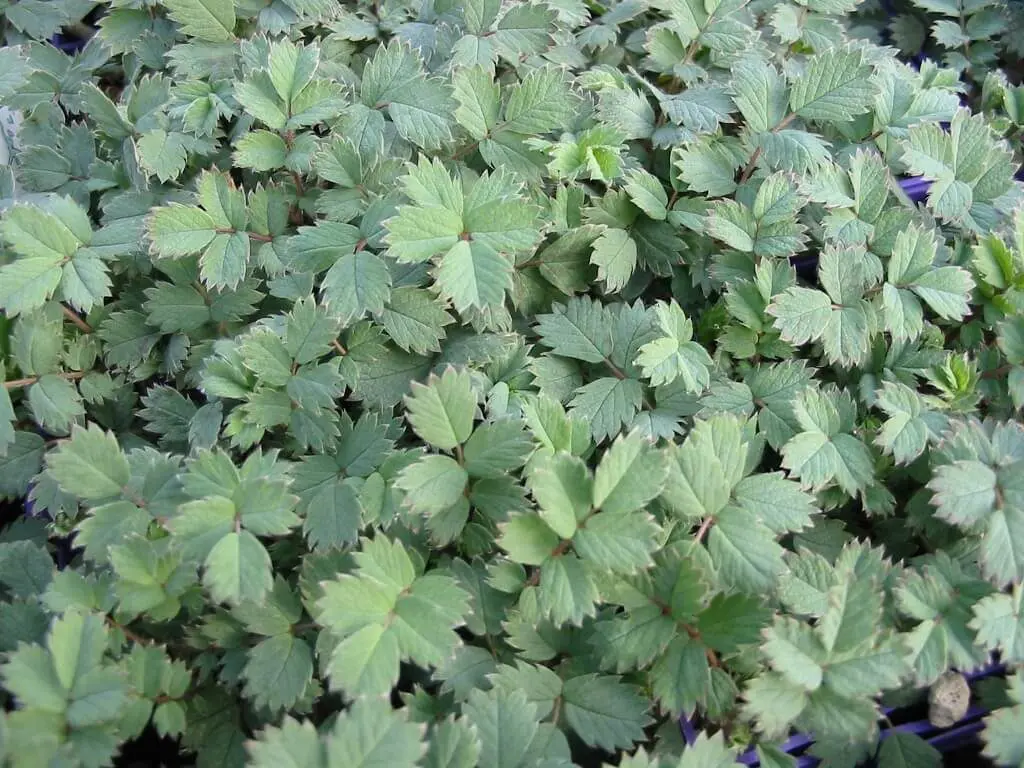
Up close, the finely divided, pinnate leaflets lining the slender stalks create a soft, fern-like texture. Step back to view them across a garden bed or paving joint, and that texture knits into a dense, low-profile blue carpet.
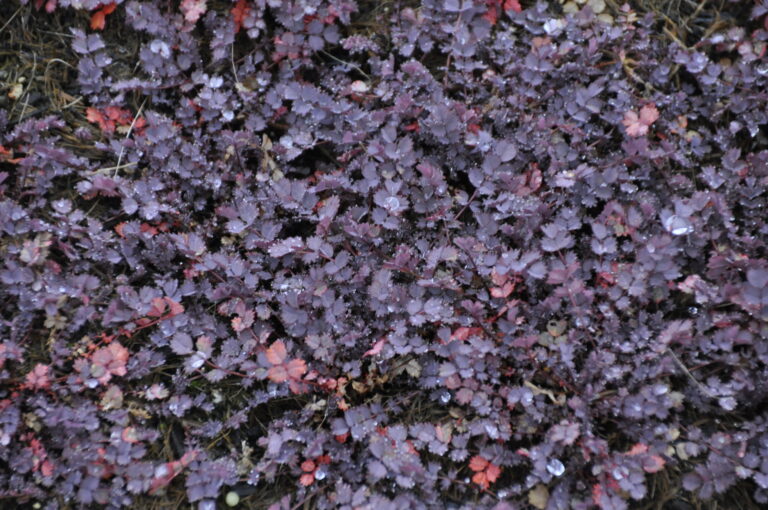
This coloration is dynamic rather than static. Shifting light, seasonal temperatures, and the age of the growth constantly alter the foliage from pale silver-blue to deep grey-green. Furthermore, A. caesiiglauca frequently flashes subtle pinkish, mauve, or light-brown tints along its leaf margins and teeth.
Profile: Acaena caesiiglauca
Botanical Identity
As a New Zealand endemic perennial, Acaena caesiiglauca belongs to the Rosaceae (rose) family. It hails from the South Island, thriving primarily east of the Southern Alps in montane to alpine tussock grasslands and scree margins at elevations between 600 and 1,500 meters. Over the years, taxonomists have shifted its classification, historically publishing it under names like Acaena sanguisorbae subsp. caesiiglauca and Acaena sanguisorbae var. pilosa. For foundational care metrics, refer to the Master Growing Guide for Acaena.
Foliage and Form
This stoloniferous, prostrate perennial creeps along the soil, rooting reliably at its nodes to form a loose, expansive mat. It reaches a modest height of roughly 10 centimeters while spreading up to 1 meter across. Hairy stems support pinnate leaves that typically carry 7 to 11 leaflets.
The foliage commands attention with:
- Silvery blue to blue-green upper leaf surfaces.
- Finely toothed leaflet margins tipped with delicate hairs.
- Soft, hairy undersides that amplify the plant’s pale, matte finish.
- Occasional flushes of pink-purple or light-brown on the teeth and edges.
In a thoughtful garden layout, A. caesiiglauca behaves less like a manicured lawn substitute and more like an authentic alpine carpet. Its loose structure showcases trailing stems while perfectly knitting together around rocks, stepping stones, and pathway edges.
Flowers and Seed Heads
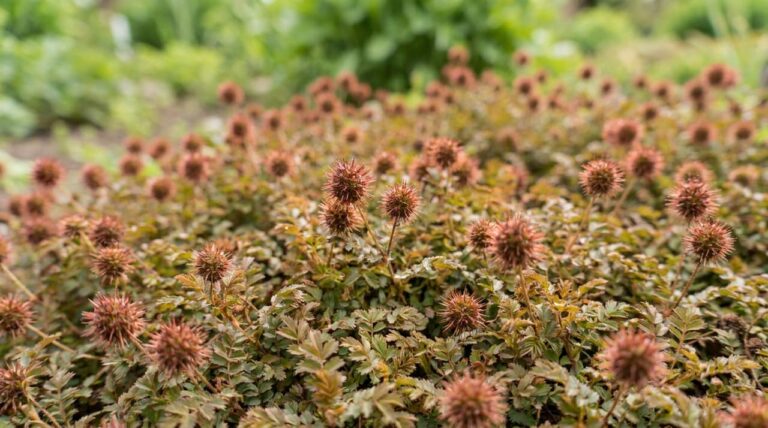
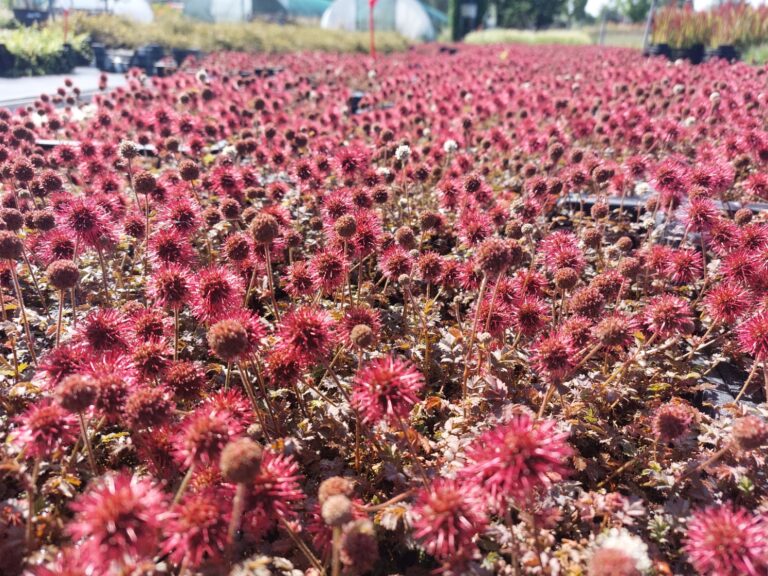
While the initial greenish, pincushion-like flower heads are relatively modest, they eventually transform into the bold red-brown burrs that define the genus. These spiny fruits contribute immense wild character to the garden. However, because they readily hitch a ride on clothing, fur, and wool, think carefully before planting them right against high-traffic walkways.
Profile: Acaena ‘Blue Haze’
Cultivar Identity
This plant is widely distributed in the nursery trade as Acaena saccaticupula ‘Blue Haze’, which matches the official RHS listing for the blue goose leaf ‘Blue Haze’. You will find it shortened to Acaena ‘Blue Haze’ in some catalogs, while other references mistakenly lump it directly under A. caesiiglauca because they share a similar visual silhouette. For absolute accuracy on plant labels and source materials, stick with Acaena saccaticupula ‘Blue Haze’ and avoid treating the two plants as simple synonyms.
Foliage Character
‘Blue Haze’ serves up finely divided, evergreen foliage in a striking steel-blue to pewter spectrum. Frequently marketed as the definitive “blue form” of New Zealand burr, it boasts a vigorous creeping habit that forms an incredibly dense ground layer. Its color reads as significantly cooler and more uniformly blue than other Acaena varieties, bypassing their typical bronze or red undertones to create a shimmering metallic wash that gleams in low morning or evening light.
Mature Dimensions and Coverage
Growth habits can fluctuate slightly depending on your regional climate and soil conditions, but regional data confirms its low-slung, spreading nature:
Ultimately, regard this plant as a small-scale, spreading accent groundcover rather than a massive lawn alternative. It shines brightest when tasked with filling a few square feet with rich, silver-blue texture—think border fronts, rocky pockets, container rims, or the edges of garden steps.
Flowers and Fruit
During the summer months, ‘Blue Haze’ pushes up rounded, white-to-greenish flower heads on short stems. They play second fiddle to the stunning foliage, but the dark-red, burr-like fruits that follow provide a lovely, understated seasonal transition.
Design Value: Leveraging the Cool Counterpoint
The compelling reason to introduce these plants to your landscape is sophisticated color contrast. Blue-grey foliage acts as a brilliant neutral in garden design, but it brings far more moodiness than standard grey leaves; it tempers scorching hot colors, elevates dark greens, and sharpens the impact of pale blossoms.
Perfect Planting Partners
Both ‘Blue Haze’ and A. caesiiglauca harmonize beautifully alongside:
- Deep green foliage: Hebes, dwarf conifers, ferns, or petite grasses use the blue mat as a luminous backdrop.
- Dark-leaved specimens: Black mondo grass, deep-toned heucheras, purple sedums, or dark-flowered geums establish dramatic tonal contrast.
- Silver and grey companions: Santolina, Artemisia, Stachys byzantina, or low-growing dianthus form a seamless Mediterranean or alpine tapestry.
- Warm accents: Apricot, coral, orange, or yellow blooms pop with newfound intensity against the cool blue floor.
- Pale stone and masonry: The foliage mirrors the cool tones of grey paving stones while softening hard, structural edges. ‘Blue Haze’ looks particularly striking spilling over concrete steps.
Strategic Landscape Roles
Deploy these plants wherever a highly tactile, architectural carpet yields more value than a short-lived floral display:
- Pockets and crevices within rock gardens.
- The absolute front edge of mixed perennial borders.
- Tucked between flagstones (provided the latching burrs won’t cause frustration).
- Softening retaining walls, steps, or container edges.
- Small-scale erosion control on slopes where a tight, creeping cover is required.
- caesiiglauca delivers a slightly wilder, more authentic botanical vibe due to its alpine heritage and looser matting habit. Conversely, ‘Blue Haze’ presents itself as a deliberate, color-forward ornamental groundcover with a uniform architectural statement.
The Changing Seasons
In milder winter zones, both options remain reliably evergreen, preserving a cool-grey structural footprint when surrounding herbaceous perennials have completely died back to the ground. While A. caesiiglauca is classified as evergreen, expect minor foliage loss during particularly harsh winter snaps.
The absolute peak show runs from late spring through summer, when the fresh spring growth flushes its brightest blue and the button-like flower heads emerge. On ‘Blue Haze’, the white-green spheres hover just clear of the foliage mat. On A. caesiiglauca, the subsequent red-brown burrs give the entire carpet a highly textured, ruggedly beautiful finish.
Side-by-Side Comparison
Sorting Out the Nomenclature
Grouping these two under a single banner like “Acaena caesiiglauca / ‘Blue Haze’” makes practical sense at the garden center because they fill the exact same design niche. However, don’t let that shorthand trick you into thinking ‘Blue Haze’ is just a selection of A. caesiiglauca. Botanists maintain A. caesiiglauca as its own separate species, while the RHS firmly hitches the cultivar to Acaena saccaticupula.
Out in the real world, you are bound to encounter messy labeling. The most definitive way to evaluate the plant in front of you is by looking at it closely: assess the saturation and consistency of the blue hue, the density of the creeping mat, and the color of the burrs if they are present. If you want a guaranteed, uniform, silver-blue ornamental carpet, reach for ‘Blue Haze’. If you prefer a botanically distinct New Zealand native with a wilder, more relaxed growth habit, track down the true Acaena caesiiglauca.