The Wine-Red Cushion Bromeliad: Growing and Designing with Deuterocohnia lotteae
Few plants ground a desert-inspired landscape or container collection quite like Deuterocohnia lotteae. This remarkable, cushion-forming terrestrial bromeliad builds dense, architectural mounds of spiny rosettes that look more like geometric sculpture than typical garden foliage. Known historically in specialist circles under the moniker Abromeitiella lotteae, modern morphological and DNA testing has firmly nestled it within the Deuterocohnia genus. Despite the scientific name shift, it remains one of the most coveted “cushion bromeliads” for growers who appreciate structural eccentricity.
In the garden, this species thrives as a high-impact, drought-tolerant accent. Whether nestled into a rockery, anchored in a minimalist desert bed, or showcased in a premium container, its tightly domed silhouette and jewel-like summer blossoms offer year-round texture and a burst of sophisticated seasonal colour.
Taxonomy and Naming
Current Name and Synonymy
- Accepted Name: Deuterocohnia lotteae (Rauh) M.A. Spencer & L.B. Smith
- Synonym: Abromeitiella lotteae Rauh
The genus Deuterocohnia sits within the Bromeliaceae family under the subfamily Pitcairnioideae. These terrestrial and lithophytic (rock-dwelling) plants hail from the arid stretches and high-elevation slopes of South America. Botanists eventually dismantled the small sister genus Abromeitiella, absorbing its four core species—D. lotteae, D. brevifolia, D. abstrusa, and D. scapigera—into Deuterocohnia after genetic and structural data proved they shared an evolutionary branch.
Origin of the Name
The genus name Deuterocohnia pays tribute to the nineteenth-century German botanist and pioneering microbiologist Ferdinand Julius Cohn. Because another plant group had already claimed the name Cohnia, botanists tacked on the Greek prefix “deutero-” meaning “second”. The specific epithet lotteae honors Lotte Hromadnik, an avid plant collector who discovered the original type material alongside her husband, Dr R. Hromadnik, during an expedition through southern Bolivia.
Botanical Description and Visual Traits
Growth Habit and Form
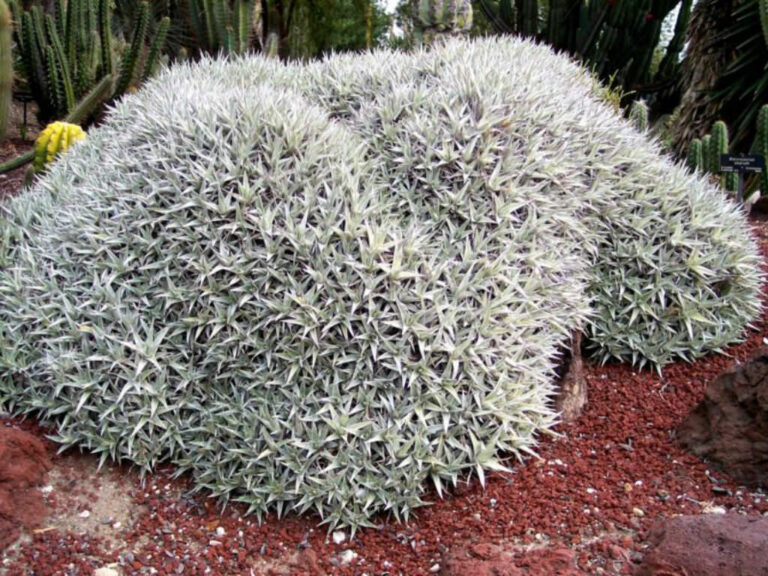
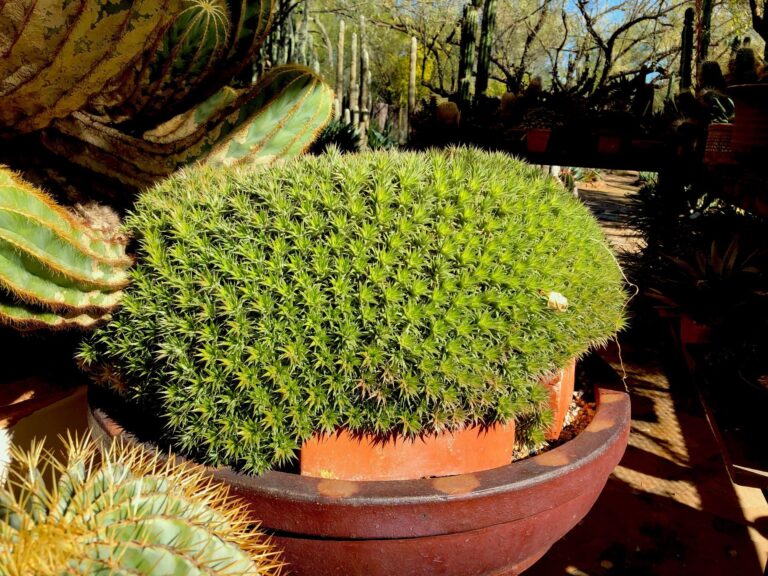
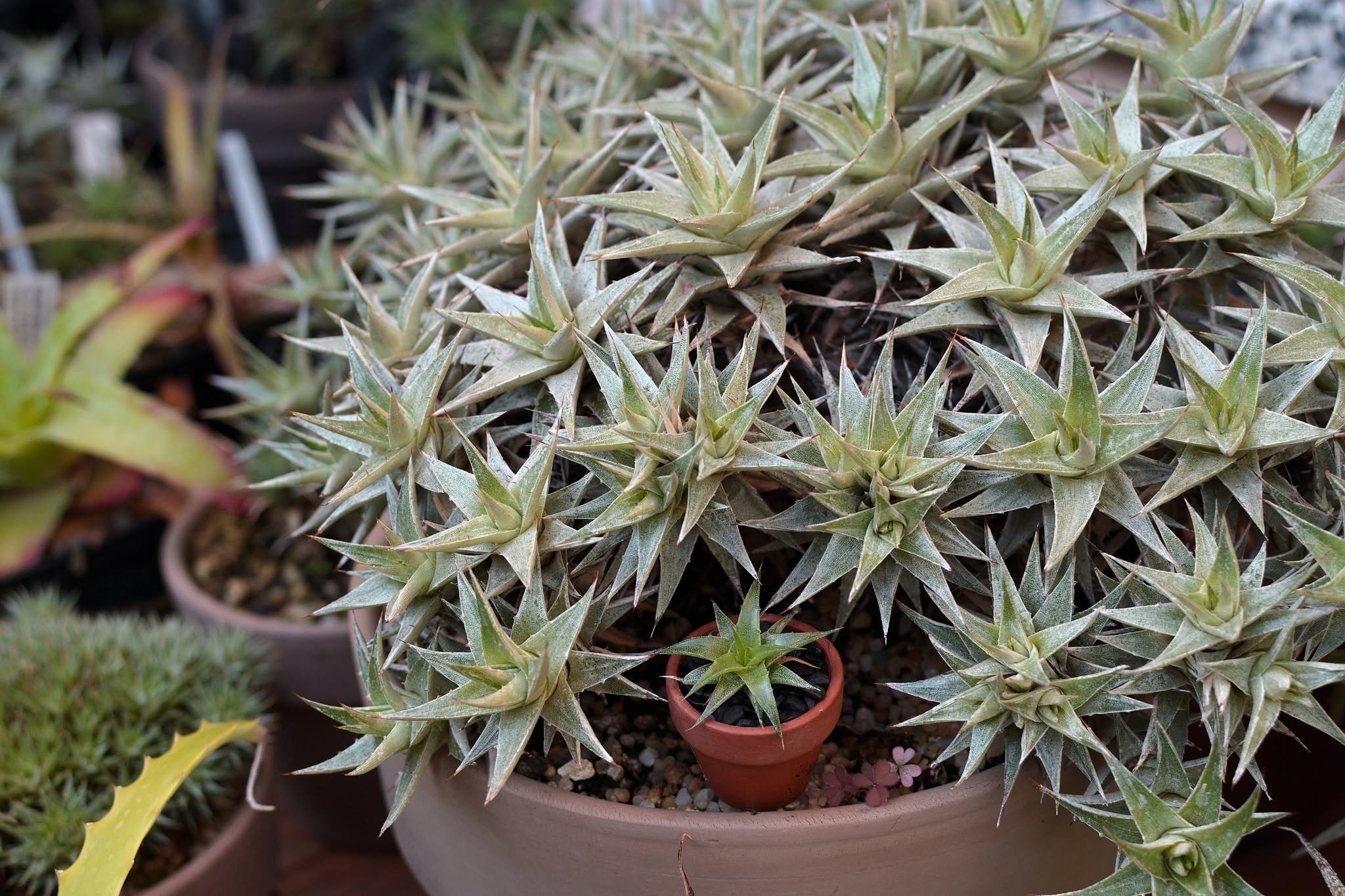
Deuterocohnia lotteae develops as a low, ultra-dense cushion composed of hundreds of miniature rosettes. Over years of slow growth, these individual rosettes multiply and knit together into a seamless, dome-shaped mound. A mature specimen can spread anywhere from 30 to 60 cm (12 to 24 inches) across, mimicking the appearance of a massive, living pin-cushion.
This tightly compressed, rounded silhouette makes the plant an exceptional choice for small-space gardens and specialized containers. Rather than spreading wildly or falling open, the “cushion-shrub” habit remains compact and pristine, delivering clean lines that fit perfectly into modern landscape designs.
Foliage
The leaves are sharply triangular, highly succulent, and packed tightly into individual rosettes. Touch the plant, and you will find it stiff and fiercely spinescent; each leaf terminates in a sharp point and features tiny, defensive spines along its margins.
The mature foliage carries a rich green color, often muted by a dusty, grey-green cast that underscores its desert origins. Because it is entirely evergreen, this dramatic structure persists through every season. The spiky, forbidden texture creates an wonderful visual tension when paired with its otherwise soft, cloud-like overall shape.
Flowers and Inflorescence
While the foliage is captivating, the true drama unfolds when D. lotteae blooms, instantly distinguishing itself from its more common sibling, D. brevifolia:
- Flower Form: Small, tubular blossoms emerge directly from the heart of individual rosettes. They sit on incredibly short, sessile inflorescences tucked down low against the green cushions.
- Color Palette: The tubular perianth displays a sultry, deep purplish-red to maroon hue—famously cataloged by botanist Werner Rauh as “brown-wine red”—tipped with contrasting, vivid green petal tips.
- The Brevifolia Contrast: While Deuterocohnia brevifolia hides its monochromatic, emerald-green flowers against its matching leaves, D. lotteae proudly punctuates its mounds with these moody, wine-dark blossoms.
The flowers make their appearance in the heat of summer, popping up sporadically across different sections of the mound like scattered jewels. Because the blossoms sit flush against the leaves, the display feels intimate, rewarding close-up inspection or placement on an elevated surface where it can be appreciated at eye level.
Natural Distribution and Habitat
This species is an endemic treasure of Bolivia, where it clings to the rugged Andes at elevations ranging from 2,500 to 3,000 meters above sea level. In these high-altitude realms, it braves harsh elements on:
- Exposed rock outcrops and sheer, rocky slopes
- Arid, sun-baked mountain margins and high-Andean scrublands
Life in these punishing environments forced the plant to evolve a highly water-conservative, sun-worshipping physiology. While major horticultural databases (such as NParks) note that it adapts well to cultivated tropical climates, it always retains its core ancestral preferences: blistering full sun to light afternoon shade, impeccable soil drainage, and a strict “less-is-more” approach to watering.
Horticultural Status and Availability
In mainstream gardening, D. lotteae remains a rare gem. It is arguably the most elusive of the former Abromeitiella group, actively hunted down by bromeliad purists and serious succulent collectors. Specialized boutique nurseries and exotic plant growers offer it in limited quantities, typically sold as small, rooted divisions or tight cluster plugs. You may find it listed under either Deuterocohnia lotteae or its old name Abromeitiella lotteae depending on the grower’s taxonomic preferences. This scarcity, paired with its exceptional look, commands a premium in collector markets.
Landscape and Design Uses
Primary Roles in the Garden
Designers prize D. lotteae for its structural power and texturally complex foliage. It serves beautifully in several curated garden roles:
- Rockery and Alpine Houses: It perfectly mimics high-alpine turf, making it a natural fit for scree beds, crevice gardens, and unheated alpine frames where it behaves like a desert moss colony.
- Feature Container Planting: The plant shines in shallow stone troughs, unglazed terracotta pots, or concrete bowls that mirror its domed geometry and bring the intricate flowers closer to the viewer.
- Architectural Anchors: In minimalist landscapes, a single mound provides a clean, unchanging focal point that anchors shifting seasonal plantings.
Because the margins are heavily armed with spines, this is not a plant for high-traffic paths or borders where bare ankles might brush past. Instead, position it as a prized specimen where it can be admired safely from a slight distance.
Visual Design Values
- Geometric Form: The dense, hemispherical mounds introduce a powerful sense of punctuation and geometry among looser, softer garden plants.
- Tactile Texture: The bristly, living-stone texture of the rosettes creates a magnificent contrast next to smooth-leaved agaves, delicate ornamental grasses, or soft perennial foliage.
- Subdued Color Harmony: The muted grey-green leaves combined with deep maroon, green-tipped flowers offer a sophisticated color palette. This look intensifies when set against pale gravel mulches, dark basalt stone, or raw concrete.
- Proportional Scale: Maxing out at roughly 60 cm wide, its manageable size makes it an excellent choice for foreground positions, raised ledges, and tabletop containers.
Effective Planting Combinations
From a composition standpoint, D. lotteae pairs exquisitely with companion plants that share its love for sharp drainage:
- Mix it alongside other mat-forming succulents, dwarf Puya species, or colorful Dyckia hybrids to build an intricate, tapestried carpet across a sun-drenched slope.
- Combine it with fine-textured, neutral-toned grasses that sway in the wind, softening the bromeliad’s rigid spikes without hiding its form.
- Set it against pale river stones or light-colored stone planters, which bounce ambient heat back to the plant and make the deep wine-red flowers visually pop.
Relationship to Deuterocohnia brevifolia and Other Cushion Species
To truly appreciate D. lotteae, it helps to stack it against its closest relatives from the old Abromeitiella family tree.
Deuterocohnia brevifolia (syn. D. chlorantha)
- Growth Habit: It forms nearly identical, tightly woven green cushions of a similar or slightly smaller scale.
- Flowers: It produces pure emerald-green flowers that blend seamlessly into the leaves, rendering the bloom cycle almost invisible.
- Design Value: D. brevifolia operates purely as a structural foliage plant, whereas D. lotteae offers both incredible foliage and a contrasting floral show.
When planted side-by-side, D. brevifolia acts as a solid, carpet-like green backdrop, allowing the rich wine-red tones of D. lotteae to command center stage.
Other Former Abromeitiella Cousins
- Both Deuterocohnia abstrusa and Deuterocohnia scapigera display the same cushion-like growth, but their floral mechanics differ significantly. D. scapigera, for example, exhibits a looser mound architecture and yields pale yellow-green flowers on more extended stems.
- Recent phylogenomic studies confirm that D. abstrusa, D. brevifolia, and D. lotteae share a tight evolutionary clade, proving their shared survival strategy against the drying winds and intense radiation of the high Andes.
For the dedicated collector, D. lotteae remains the clear standout of the cushion group whenever floral color is a priority.
Historical and Collectors’ Context
The journey of D. lotteae from Andean cliffs to modern collections is a classic tale of mid-20th-century botanical exploration. The legendary German botanist and succulent authority Werner Rauh first described the species after evaluating wild material brought back from the remote mountains of southern Bolivia.
Serious growers still hunt for the specific clone distributed as ISI 2003-8 by the Huntington Botanical Gardens. This famous introduction originates directly from live material shared by Rauh in the mid-1980s, serving as the primary cultivated line (clonotype) in Western horticulture. Owning a piece of this plant isn’t just about aesthetics; it connects the grower directly to the golden era of xerophytic bromeliad discovery.
Key Identification Points for Gardeners and Designers
When verifying your plant’s identity at a specialty nursery, check for these definitive traits:
- The Mound: A low, rock-hard, dome-shaped cushion composed of tightly packed, miniature rosettes scaling up to 60 cm wide.
- The Leaves: Rigid, triangular, succulent green leaves armed with sharp tips and tiny marginal teeth.
- The Blooms: Summer-emerging, tube-shaped flowers in a distinct maroon/wine-red shade with bright green tips, sitting flush against the foliage.
- The Deciding Factor: If the summer flowers are brilliant emerald green, you are looking at D. brevifolia; if they are rich purplish-red with green tips, it is a true D. lotteae.
Suitability for Specific Garden Styles
This adaptable mountain survivor excels across a variety of structured garden themes:
- Rock and Alpine Landscapes: It perfectly mimics the slow-growing cushion flora of high elevations, thriving in gravelly, sharply drained grit.
- Xeriscapes: An exceptional candidate for low-water designs where bold, structural form must replace thirsty turf.
- Minimalist and Contemporary Design: Its clean geometric lines, perfect domes, and moody, restrained flower palette pair naturally with modern architecture.
- Curated Containers: Its slow growth rate and unique silhouette make it an outstanding standalone specimen or focal point in a mixed succulent arrangement.
Keep it safely away from high-traffic zones, pets, and children’s play areas to avoid accidental pricks, and showcase it on raised walls, stone steps, or patio plinths where its structural beauty can be safely celebrated.
Propagation in Brief
Increasing your stock of D. lotteae requires a patient hand. Because it is a slow-growing clump, propagation is achieved almost exclusively by careful division of the main cushion. Growers use a sharp blade to separate small, rooted offset clusters from the parent mound. This vegetative method ensures that the resulting plants preserve the exact growth symmetry and unique wine-red flower coloration of the original clone.
Visual Summary for Designers
- Form: Rigid, ultra-dense, hemispherical cushion mound.
- Size: Low-profile, slowly reaching 30–60 cm (12–24 inches) in width.
- Foliage: Triangular, succulent, grey-green leaves with sharp tips and spine-toothed margins.
- Flowers: Deep purplish-maroon tubular blooms with green tips, nesting flat against the rosettes in summer.
- Best Uses: Alpine rockeries, specialized container collections, modern xeriscapes, and architectural accents.
- Primary Distinction: Displays wine-red flowers with green tips, whereas D. brevifolia bears solid green flowers.
Cultivation details including soil mixes, specific winter hardiness thresholds, watering schedules, and pest control can be found in the comprehensive Master Growing Guide for Deuterocohnia.