Master Growing Guide: How to Grow Radiant Acacia (Wattle) in Your Garden
Few horticultural experiences match the sheer joy of witnessing an acacia burst into bloom. Commonly known as wattles—or mimosa, in the case of Acacia dealbata—these spectacular evergreen trees and shrubs deliver an intoxicating explosion of fragrance and golden, pompom-like blossoms precisely when the rest of the garden is asleep. Cultivated for their exquisitely fine, silver-grey or luminous green foliage, they offer an invaluable architectural presence. Whether you plant them as dramatic specimen trees, train them against a sheltered wall, or showcase them in premium patio containers, acacias bring unparalleled vibrancy to late-winter and early-spring landscapes.
While the vast majority of garden-worthy acacias hail from the sun-baked landscapes of Australia, the genus also stakes its claim across Africa, Southeast Asia, the Pacific, and the Indian Ocean region. In UK and Irish gardens, these sun-worshippers thrive best in mild coastal, urban, or microclimatic pockets. For gardeners facing colder inland winters, these plants adapt beautifully to container life, allowing you to wheel them under glass when the hard frost threatens.
Botanical background
As a prominent member of the legume family, Fabaceae, Acacia shares a fascinating evolutionary trait with peas and beans: the ability to partner with specialized soil bacteria to fix atmospheric nitrogen. While this biological superpower aids their survival in poor soils, savvy gardeners should still invest in proper soil preparation and targeted seasonal feeding to maximize visual performance.
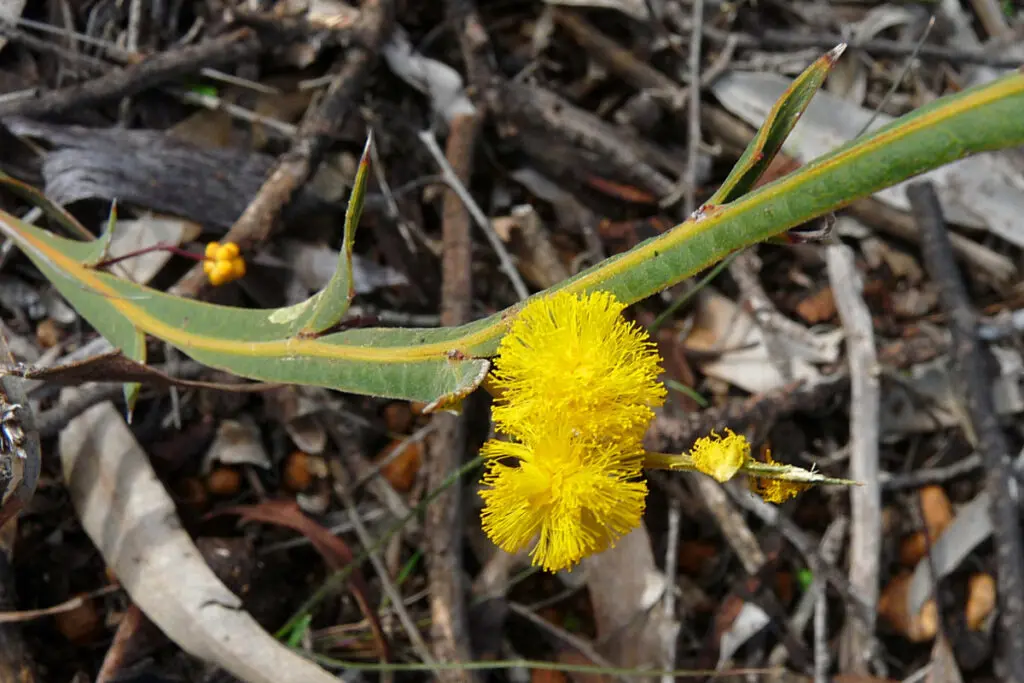
The genus is incredibly diverse, encompassing evergreen and deciduous trees, sprawling shrubs, and vigorous climbers. However, the real botanical magic of the Australian species lies in their “phyllodes”. These are not true leaves, but rather cleverly modified, flattened leaf stalks that handle photosynthesis while drastically reducing water loss. This brilliant evolutionary adaptation gives wattles their signature feathery, blue-green, or metallic-silver look, allowing them to breeze through seasonal droughts and bask in intense sunlight.
Best Acacia varieties for gardens
Selecting the right acacia requires balancing your local climate with your design goals. The genus offers everything from towering, bloom-heavy specimen trees to texture-rich foliage shrubs and dramatic, cascading groundcovers.
Acacia dealbata and its best mimosa forms
The quintessential silver wattle, Acacia dealbata, remains an undisputed favourite among cold-season flowering trees. This vigorous grower commands attention by cloaking itself in a haze of finely divided silver foliage, followed closely by an absolute profusion of sweetly scented, golden-yellow flower heads as winter gives way to spring.
To get the most out of this species, site it in full, unfiltered sun and neutral-to-acid, sharply drained soil. The RHS gives it an H3 hardiness rating, meaning it comfortably withstands temperatures down to -5°C to 1°C in coastal and sheltered locales, but demands a protected microclimate or winter wrapping elsewhere.
Acacia dealbata ‘Gaulois Astier’ stands out as a premier selection for standard residential gardens. It tames the wild vigor of the species into a highly ornamental, upright tree that typically tops out around 6 metres in UK conditions. It rewards the grower with deeper, glossier, filigree foliage and an exceptionally heavy crop of intensely fragrant winter blooms. It shares the parent species’ H3 hardiness profile and aversion to alkaline soil, making it a stellar candidate for a prominent, sheltered sunny border or a large, protected courtyard container.
Acacia baileyana: Cootamundra wattle
If you are dealing with a more intimate garden footprint, Acacia baileyana (the Cootamundra wattle) is an award-winning choice. Maxing out at a manageable 4 metres, this elegant, arching tree features dense sprays of steel-blue, feathery foliage that look magnificent year-round. Come late winter, the entire canopy transforms into a cloud of fluffy yellow blossoms. Rated RHS H3, it responds beautifully to having its lower limbs limbed up, creating a highly sophisticated, clean-trunked small specimen tree.
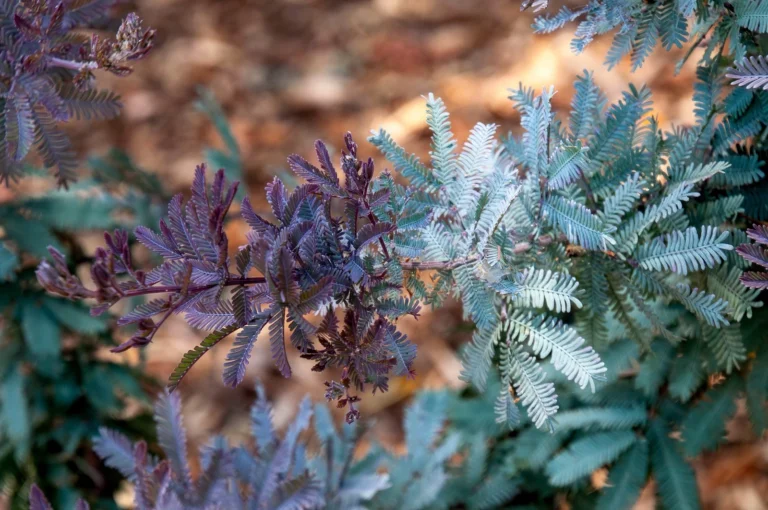
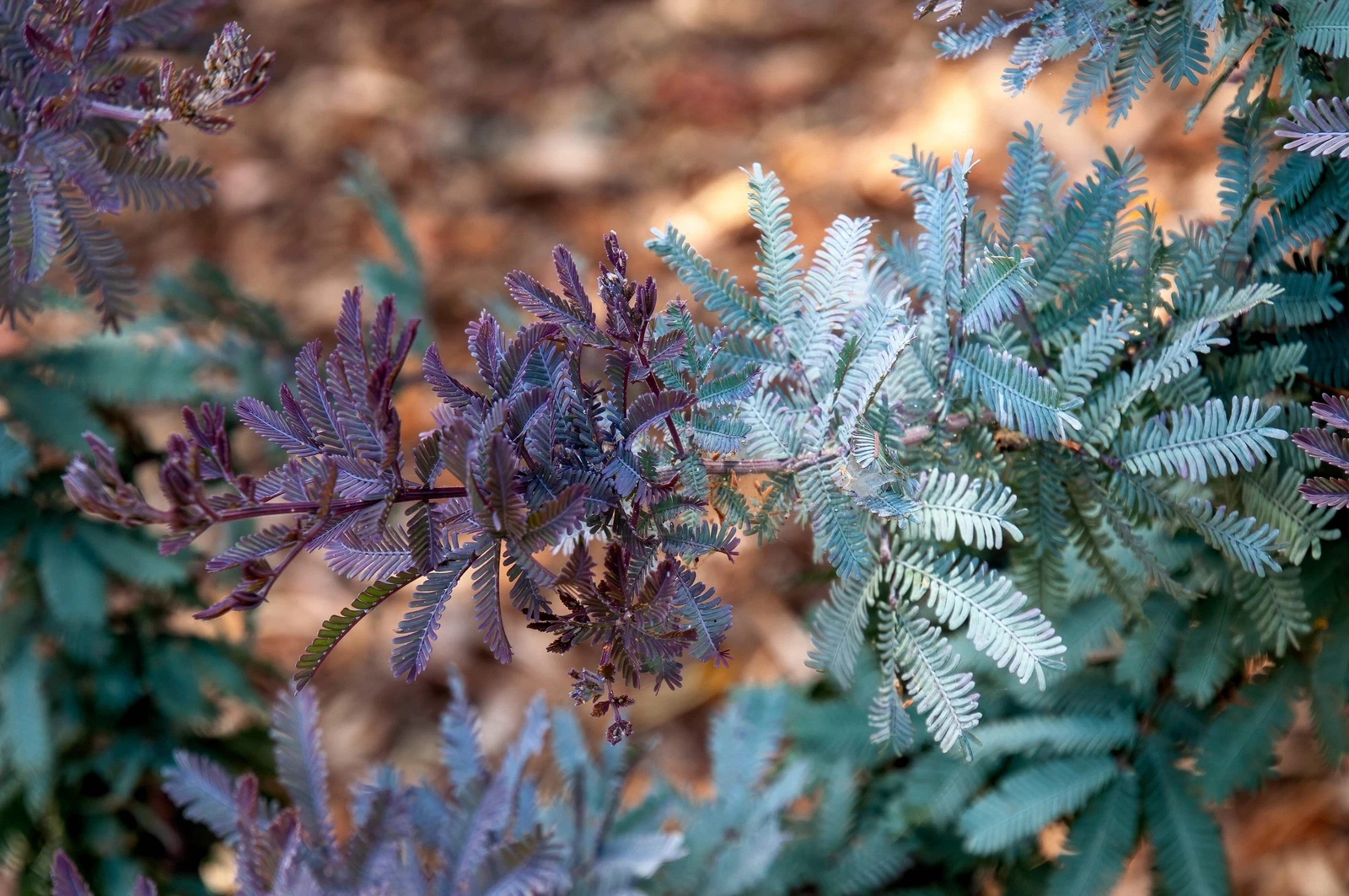
Acacia baileyana ‘Purpurea’ is the ultimate choice for foliage connoisseurs. This dramatic cultivar turns heads with flush after flush of intense purple, plum, and bronze new growth that gradually matures into a cooling blue-grey. This constant shift in foliage tones creates a spectacular backdrop for its bright golden-yellow spring flowers. Give it identical H3 conditions—blazing sun, shelter, and immaculate drainage—or treat it as a statement container plant that can be safely overwintered under cover. For a detailed breakdown of this cultivar’s landscape dimensions, seasonal color transitions, and design pairings, explore our comprehensive Acacia baileyana ‘Purpurea’ profile to maximize its visual impact in your garden layout.
Acacia pravissima: Ovens wattle
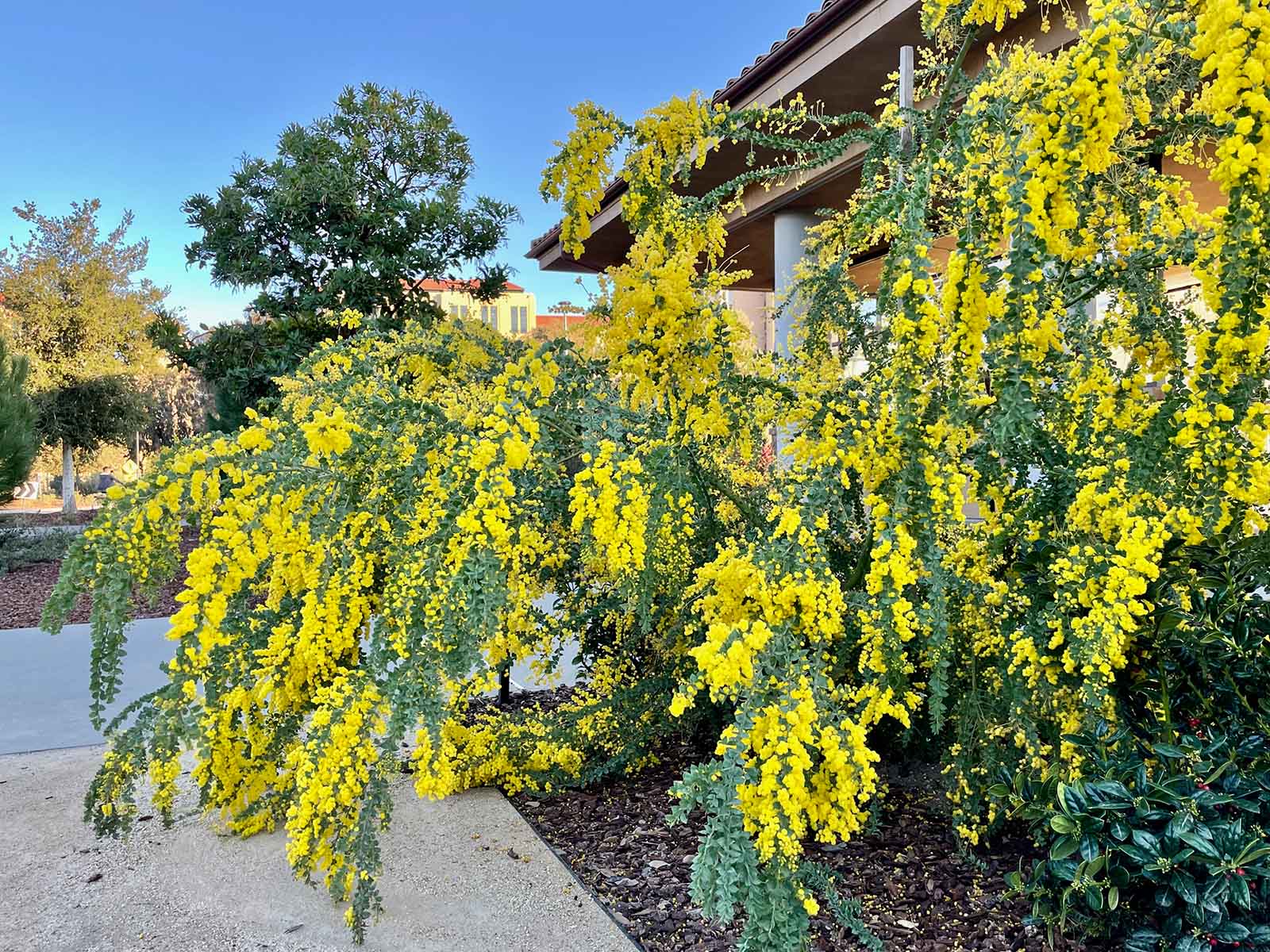
For an architectural focal point, Acacia pravissima, the Ovens wattle, offers an entirely different geometric aesthetic. Instead of traditional feathery leaves, its weeping branches are tightly packed with fascinating, triangular, sage-green phyllodes. In late winter, every cascading stem becomes weighed down by masses of mustard-gold flower globes. This relaxed, touchable habit makes it an exceptional choice for training flat against a south- or west-facing brick wall. It holds an RHS H3 rating, requiring a free-draining, neutral-to-acid soil recipe.
Acacia pravissima ‘Golden Carpet’ flips the script on the genus by taking a completely prostrate form. Rather than stretching skyward, this selection hugs the contours of the earth, spilling over retaining walls, trailing down stone steps, or cascading dramatically from raised beds. It is a brilliant option for adding high-texture foliage to compact urban spaces.
Acacia cognata: foliage wattles
When your design brief calls for subtle, contemporary elegance rather than loud floral displays, look to the cultivars of Acacia cognata. Grown almost exclusively for their touchable, weeping textures, these evergreen shrubs form incredibly dense, mounded shapes composed of thread-like foliage that catches the slightest breeze.
Acacia cognata ‘Limelight’ is the undisputed star of this group. It forms a perfectly rounded, architectural dome of luminous, chartreuse foliage that retains its eye-catching brightness through the darkest months of the year. It is the perfect graphic anchor for a minimalist gravel garden, a modern border, or a sleek, premium container.
Gardeners seeking slight variations in form can explore related selections like ‘Bower Beauty’, ‘River Cascade’, and ‘Waterfall’
. While they all share that signature fine-textured, foliage-first personality, they offer distinct variations in final scale and weeping intensity, making them fun to contrast when planting up an artistic bank or contemporary courtyard.
Rare and collector Acacia forms
For the plant collector, the deep corners of specialist nurseries occasionally yield hidden treasures. Keep an eye out for rare, weeping, or prostrate iterations of the Cootamundra wattle, such as ‘Goldilocks’ and ‘Prostrata’. You may also stumble across color variants sold under names like ‘Aurea’ or ‘Rubra’, or scarce Acacia dealbata cultivars including the pendulous ‘Pendula’, the low-slung ‘Kambah Karpet’, or the refined ‘Lisette’.
While these boutique selections are immensely rewarding, their availability is unpredictable and their naming conventions can be fluid. Treat them as delightful garden experiments rather than structural design necessities. The same rule of thumb applies to the cascading Acacia pravissima ‘Kuranga Cascade’; it is a phenomenal plant for trailing over a sunny wall, but if you need a guaranteed, readily available groundcover, stick with the proven track record of ‘Golden Carpet’.
Growing conditions
The secret to success with acacias lies in mimicking their native habitats. Provide them with a trio of essential elements: unbounded light, reliable radiant heat, and a root zone that never holds stagnant moisture.
- Light: Give them full, unapologetic sun. Siting them against a reflective south- or west-facing masonry wall works wonders in temperate zones.
- Soil: Most species demand neutral-to-acid, loose soil. Heavy, compacted clay is an absolute dealbreaker unless it is drastically opened up with grit and organic matter.
- pH: Aim for slightly acidic to neutral ground. A few specific cultivars can tolerate a touch of chalk, but sharp drainage is always far more critical than forcing a plant to struggle in highly alkaline soil.
- Hardiness: With many core varieties sitting at RHS H3, they are fundamentally built for coastal warmth or urban heat islands, meaning prolonged sub-zero freezes will cause damage.
- Climate: Sheltered, maritime, or urban gardens suit them best. If you garden inland where winters bite, pack the root zone with thick mulch, plant against a warm wall, or default to container culture.
- Wind and frost: Biting, dry winter winds and deceptive late-spring frosts are the twin nemeses of young acacias. Wind shelter is non-negotiable for newly installed specimens.
Planting
Timing is everything. Plant your acacias in mid-to-late spring once the soil has warmed and the threat of severe frost has safely passed. This provides a long, luxurious growing season for the root system to anchor itself before the arrival of winter wet.
Scout out your warmest microclimate, avoiding any low-lying frost pockets where cold air settles at night. When prepping the site, clear out all competing weeds and work well-rotted organic matter deeply across the wider planting zone. Do not drop rich compost directly into the planting hole, as this encourages the roots to stay lazy and confined. If your soil drains poorly, plant the root ball slightly proud of the surrounding ground level to encourage surface runoff.
For structural trees, stake them low and firmly right at planting to prevent wind-rock from snapping the tender new anchoring roots. For container specimens, opt for a heavy, broad-based terracotta pot packed with a premium, free-draining, peat-free loam-based or ericaceous compost mix. Pop the container up on pot feet during the winter months to guarantee drainage holes never get clogged with ice or slush.
Care through the seasons
Watering
During their inaugural summer, water your acacias deeply and regularly to assist establishment. Once their roots find their footing, garden-grown specimens develop admirable drought tolerance. Containerized acacias, however, are entirely dependent on you; keep them consistently hydrated through the summer, but scale back drastically in winter. Cold, waterlogged winter soil will kill an acacia far faster than dry compost.
Feeding and mulching
Potted acacias appreciate a balanced liquid feed once a month throughout the active spring and summer push. In contrast, open-ground acacias require very little supplemental feeding if planted in decent soil. Steer clear of high-nitrogen fertilizers, which stimulate lush, watery growth that gets instantly zapped by the first autumn frost. Apply a clean, thin layer of bark or gravel mulch in spring to lock in moisture, but keep it a few inches away from the main trunk to ward off bark rot.
Pruning acacias
Acacias hate hard, structural pruning, so approach them with a light touch and a clear plan. Never hack back into old, leafless wood, as it rarely regenerates. Schedule your tidy-up for mid-spring—typically April—once the frost risk has fully dissipated.
For young trees, practice smart formative pruning. Clean off the side branches on the lower third of the main stem, cut the side shoots on the middle third back by half to encourage trunk girth, and leave the top leader completely unpruned except to remove damage. For mature trees, restrict your cuts to removing dead, crossing, or frost-bitten wood. Immediately after the blooms fade, trim the spent flowering side shoots back to two or three healthy buds to keep the canopy tight and stimulate next year’s flower wood. Wall-trained specimens respond well to Pruning Group 13 protocols, while free-standing shrubs naturally align with Pruning Group 8.
Propagation
Pure species can be started from seed, but Australian acacia seeds possess incredibly tough coats designed to survive wildfires. To break this dormancy, pour near-boiling water over the seeds and let them soak for 24 hours until they swell before sowing.
For choice cultivars like ‘Purpurea’, ‘Limelight’, or ‘Gaulois Astier’, you must use vegetative propagation to clone the exact traits of the parent plant. Take semi-ripe cuttings in mid-to-late summer, treating them with rooting hormone and placing them in a propagation bench with bottom heat and high humidity. While commercial growers use specialized grafting techniques to boost vigor, home gardeners will find sourcing a certified nursery-grown plant far more reliable. Whatever you do, never attempt to propagate acacias via root division; their woody, singular root networks will not tolerate it.
Pests and diseases
In the right microclimate, acacias are remarkably resilient, pest-resistant plants. The vast majority of failures stem from environmental stress rather than biological attacks.
- Frost damage: This shows up as blackened growth tips or bleached, scorched foliage following a cold snap. Resist the urge to prune immediately; wait until late spring when you can clearly see where the healthy new buds are breaking.
- Root and stem rot: The direct consequence of stagnant water around the crown. Elevate your planting, use grit-rich soils, and clear mulch away from the base of the stems.
- Aphids and scale insects: These sap-suckers occasionally colonize soft new shoots or hide under the phyllodes. Encourage beneficial insects like ladybirds to do the heavy lifting, or knock them back with a sharp blast of water from the hose.
- Leggy, weak growth: A classic cry for more sunlight or an indicator of an overly rich diet. Shift the plant to a brighter location and stop over-fertilizing.
- Suckering: Wild forms of Acacia dealbata can throw up unwanted suckers from the root zone. Do not just chop them off at ground level; dig down and snap them off directly where they emerge from the parent root to prevent them from multiplying.
Design and uses in the garden
Acacias are exceptional design tools for injecting a touch of exotic, Mediterranean style into temperate gardens. Use the airy scale of Acacia dealbata or Acacia baileyana to create stunning light-filtering canopy trees. Their delicate foliage offers a brilliant architectural contrast when paired with bold, solid-leaved companions like Phormium, Fatsia japonica, Melianthus major, or massive tree ferns.
The deep plum tones of Acacia baileyana ‘Purpurea’ create breathtaking vignettes when offset by silver-leaved cardoons, dark-flowered dahlias, or rich, deep green evergreens. Meanwhile, ground-hugging wattles are invaluable for softening the rigid lines of concrete steps, stone retaining walls, or steep banks. Use the compact mounded forms of Acacia cognata to bring essential structure to low-maintenance gravel gardens. As an added bonus, their winter blooms provide a crucial, lifesaver food source for early-emerging pollinators, and their dense ever-present canopies offer superb nesting cover for garden birds.
Common problems and troubleshooting
Poor flowering
If your wattle refuses to bloom, it is likely starving for light, has had its flower buds zapped by a sharp winter freeze, or was pruned too late in the season, removing the flowering wood. Move container plants to maximum sun and wrap them during deep freezes.
Leggy growth
Spindly growth is a sign the plant is stretching for light. Ensure it is getting full sun and execute a light formative pruning program right after the spring bloom to encourage a bushier, self-supporting habit.
Yellowing foliage
Chlorotic or yellowing leaves point directly to root stress. It usually indicates waterlogged, suffocating soil or a cold, wet compost mix. Let the media dry out thoroughly between waterings and re-evaluate your pot drainage.
Dieback after winter
Do not panic if you see winter dieback. Hold off on any major cuts until May. Once the fresh growth reveals the true extent of the damage, trace the dead wood back to clean, green growth and make your pruning cuts there.
Failure after planting
An acacia that collapses shortly after planting is usually suffering from root disturbance, severe wind-rock, or a lack of deep watering during its critical first few weeks. Always plant in spring, secure the stem with a sturdy stake, and provide deep, infrequent waterings rather than shallow daily splashes.
FAQs