Beyond the Green: Why Your Garden Needs the Purple Cootamundra Wattle
A Visual Profile of Acacia baileyana ‘Purpurea’
Few evergreen trees command attention quite like the purple Cootamundra wattle. For the gardener blessed with a mild, sheltered microclimate, this fast-growing Australian native offers an unparalleled architectural silhouette. While its late-winter floral display is undeniably striking, the true genius of this cultivar lies in its shifting, multi-hued canopy.
| Feature | ‘Purpurea’ Specification |
|---|---|
| Botanical name | Acacia baileyana ‘Purpurea’ |
| Common names | Purple Cootamundra wattle, purple fernleaf acacia, purple-leaf Bailey acacia |
| Habit | Evergreen large shrub or small tree with a broad, spreading, somewhat weeping canopy |
| Foliage | Bipinnate, fern-like leaves; new growth purple to lavender, ageing to blue-grey and silver |
| Flowers | Small, rounded, fragrant golden-yellow heads in late winter and spring |
| Typical UK scale | Often around 4–8 m tall and 2.5–4 m wide at maturity; may remain smaller in cooler gardens |
| Recognition | RHS Award of Garden Merit (awarded in 1993) |
The Art of the Shift: Foliage as a Design Element
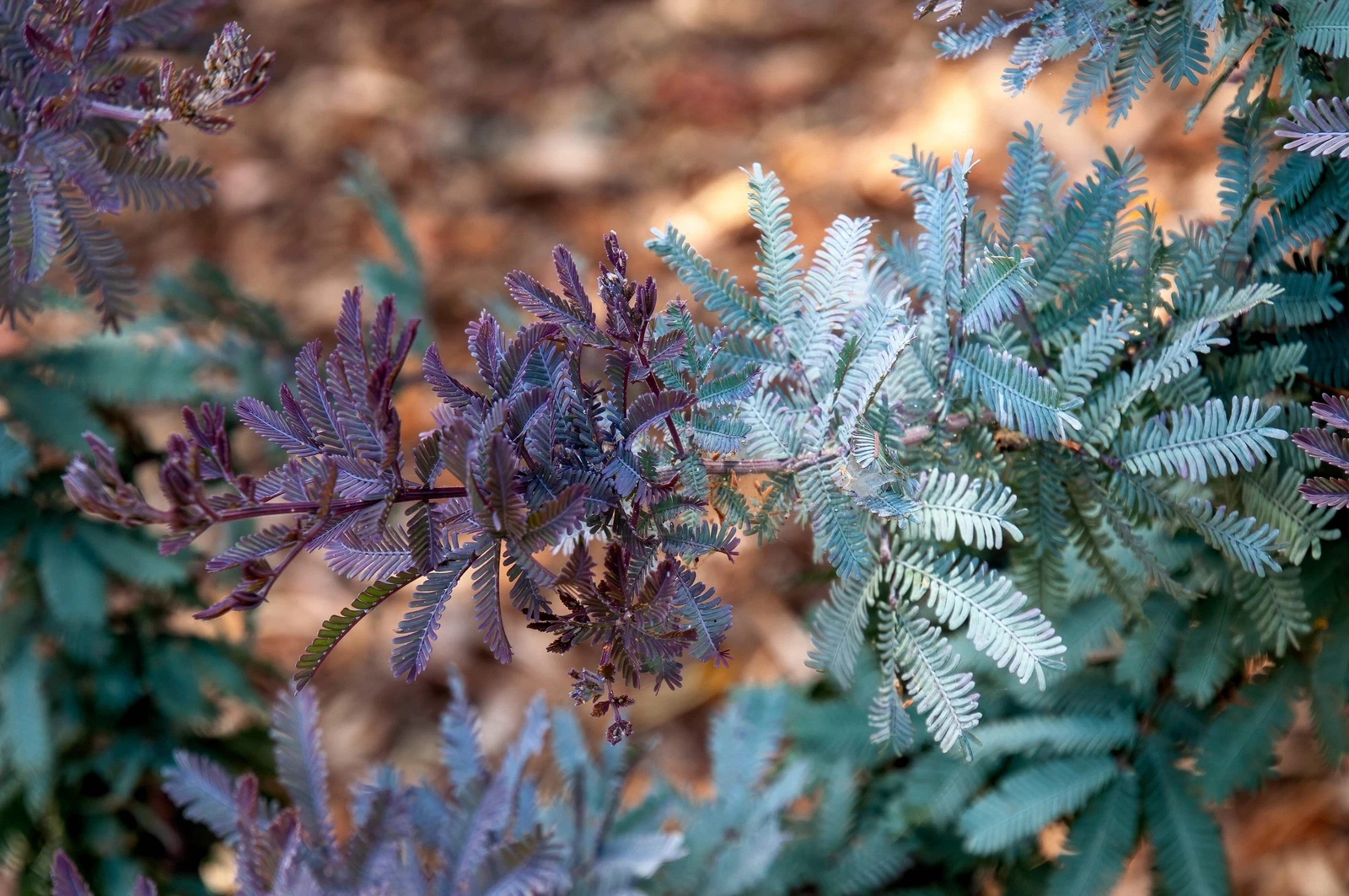
Look closely at the canopy, and you will find that ‘Purpurea’ is fundamentally a masterclass in texture and shifting tone. The tiny, linear leaves are arranged in an intricate, two-pinnate, fern-like architecture. This delicate structure gives the tree a soft, weightless quality, allowing the entire crown to ripple and catch the light in the gentlest breeze.
The defining magic of this cultivar is its constant color evolution:
- The Vanguard: Fresh shoots emerge in a vivid flush of deep magenta, lavender, and intense purple, charting the tree’s active growth spurts.
- The Transition: As these leaves mature, the brilliant purple pigments gradually recede, giving way to a sophisticated palette of gunmetal, pewter, and metallic blue-grey.
- The Backdrop: The fully mature canopy settles into a cool, glaucous silver-blue, creating a luminous, high-contrast matrix that makes neighboring garden colors pop with sudden saturation.
Do not plant this expecting the dense, heavy block of color you would get from a purple beech or a dark smoke bush. Instead, ‘Purpurea’ offers an airy, layered tapestry—vibrant purple tips floating over a misty, smoke-like backdrop of silver-blue. It is an exceptionally sophisticated interplay of light and pigment, proving exactly why the Royal Horticultural Society saw fit to grant it the prestigious Award of Garden Merit.
Winter Gold and Seasonal Rhythms
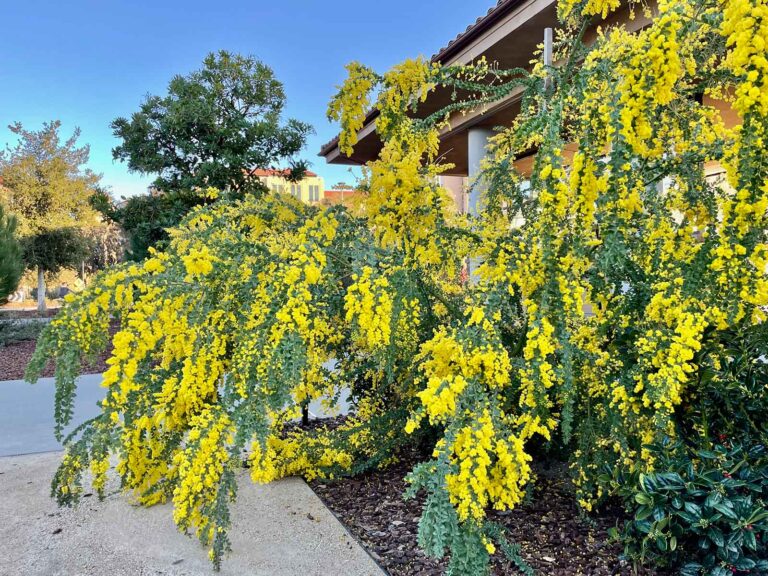
Just as winter begins to drag, ‘Purpurea’ shifts the narrative. From late winter into early spring, the branches erupt with clusters of small, spherical, golden-yellow flower heads. They carry a sweet, intoxicating fragrance, throwing a remarkably warm, brilliant contrast against the cool pewter-grey of the older leaves.
Interestingly, this purple-leaved cultivar typically flowers with a slightly lighter touch than the straight, all-green species. For design-focused growers, this is a distinct advantage: it keeps the focus squarely on the structural beauty of the foliage rather than turning the plant into a brief, overwhelming floral spectacle. Even so, these bright yellow pom-poms are a massive boon to the early-season garden, catching the low, crystalline winter light when the rest of the landscape lies dormant.
Scale, Form, and Proportions in the Landscape
In its native element and ideal climates, the purple Cootamundra wattle can mature into a substantial, wide-spreading specimen reaching up to 6–9 meters in both height and spread. In the more temperate conditions of the UK, expects something slightly more modest. Standard references place it at 4–8 meters tall with a 2.5–4 meter spread, while specific nursery expectations suggest a realistic scale of roughly 5 meters high by 4 meters wide within a 5-to-10-year window. In cooler, less hospitable gardens, it will naturally hold a smaller footprint.
The tree’s architecture is loose, elegant, and decidedly un-rigid. With wide-reaching limbs and a gently pendulous, weeping habit, it lends itself beautifully to several distinct garden roles:
- A dramatic, standalone feature tree within a sun-drenched courtyard or a mild coastal garden.
- A dappled, light-filtering canopy layer for a dry, Mediterranean-style planting scheme.
- A highly sculptural living backdrop designed to offset companions with silver, deep green, or rich burgundy leaves.
- A rapid-growing, temporary structural anchor for young gardens, keeping in mind that wattles are generally sprint-oriented, shorter-lived trees.
Choreographing the Border: Companions for Purple and Silver
Designing with ‘Purpurea’ requires an eye for restraint. Because a single specimen simultaneously showcases blue-grey, silver, transient purple, and bright yellow, it acts as a complex color anchor all on its own. It looks most sophisticated when paired with a limited, highly intentional supporting cast rather than a chaotic mix of competing hues.
Textures and Tones that Flatter the Wattle
Deep, Solid Greens: Backing or underplanting the acacia with dense, dark evergreen shrubs like Pittosporum, Portuguese laurel, or clipped holm oak anchors the composition. The solid dark backdrop pushes the feather-light, silver-blue acacia canopy forward, making it appear almost weightless.
Burgundy and Plum Echoes: Plants that carry rich, dark foliage—such as Phormium, Cotinus, dark-leaved dahlias, or deep Heuchera varieties—pick up the lavender-purple tones of the acacia’s new growth, creating a highly satisfying, unified color echo across different levels of the garden.
High-Octane Accents: If you want drama, look to the opposite side of the color wheel. Blazing orange geums, red-hot pokers, fiery crocosmias, or rusty-red kangaroo paws strike a thrilling, complementary chord against the cool, glaucous blue-grey foliage.
Monochromatic Silvers: Blending the tree into a tapestry of Artemisia, Convolvulus cneorum, Santolina, gnarled olives, and drifts of lavender builds an instant, cohesive Mediterranean mood. Be careful not to overdo it, though—too many competing silvers can bleed together, flattening the unique graphic identity of the acacia.
Bold Architectural Foliage: Contrast the infinitely fine, feathery texture of the wattle leaves with the broad, structural lances of Phormium, yucca, hardy palms, agave, and Cordyline. The juxtaposition of fine lace against heavy architectural blades is instantly striking.
Situational Success
This cultivar truly thrives in coastal zones and urban microclimates. Its light, open crown loves the bright exposure, and the silver-sheened foliage maximizes and reflects every bit of ambient light. In sharp, contemporary landscapes, you rarely need more than a single, perfectly placed specimen set against a minimalist rendered wall or a dark, clean fence line to let its intricate silhouette do the talking.
For a softer, more romantic setting, let the tree rise out of a sea of fine ornamental grasses and early-flowering bulbs, allowing the golden winter flowers to float above a hazy, naturalistic understory.
Lineage and the Journey to Cultivation
The story of the species belongs to the grand era of 19th-century botany. It was first formally described in 1888 by the prolific German-Australian botanist Baron Ferdinand von Mueller. The specific epithet, baileyana, serves as a direct tribute to Frederick Manson Bailey, the esteemed Queensland botanist.
In its native Australia, the tree is widely known as the Cootamundra wattle. This common name points to its highly localized wild origins, where its natural distribution is strictly confined to a small region around the town of Cootamundra in the southern inland country of New South Wales.
The ‘Purpurea’ variant is a selected, named cultivar prized for its heightened purple pigmentation. While the Australian Cultivar Registration Authority officially logged the name in 1994, the exact moment this purple-tipped sport was plucked from the wild remains a mystery. Wild populations of the standard wattle naturally exhibit varying degrees of purple in their spring shoots. This particularly intense form made its horticultural debut in California around 1935, eventually making its way across the Atlantic.
Its rise in British horticulture is particularly notable: early records note only a single historic specimen weathering the climate in a sheltered Cornish estate, but over the decades, it has successfully transitioned into a sought-after staple available in specialty nurseries across the country.
Microclimates, Hardiness, and Siting Realities
It is vital to view ‘Purpurea’ not as an indestructible, ironclad garden tree, but as a plant that demands an appreciative microclimate. Generally categorized as half-hardy, it comfortably tolerates temperatures down to around -5°C to 1°C, making it vulnerable to deep, prolonged winter freezes or sudden, unseasonal hard frosts.
To succeed with this plant over the long term, keep these placement rules in mind:
- Prioritize coastal gardens, urban courtyards, south-facing brick walls, and areas shielded from biting winds.
- Avoid low-lying frost pockets, exposed northern boundaries, heavy, waterlogged clay, or leaving the plant permanently vulnerable in uninsulated winter containers.
- Remember that young, tender saplings and soft spring growth are significantly more susceptible to frost burn than old, well-ripened woody frameworks.
If you live in a colder, frost-prone region, all is not lost: you can cultivate ‘Purpurea’ in a large, well-proportioned container, enjoying its beauty on a sunny terrace through summer before wheeling it into a cold greenhouse or conservatory to overwinter.
Because the foliage is so fine, frost damage shows up quickly—cold-scorched purple tips will turn brown and drop, which can temporarily ruin the tree’s immaculate look. However, thanks to the acacia’s explosive growth rate, if the root system and primary trunk survive the winter intact, the tree can rapidly generate a completely fresh, flawless canopy of ornamental foliage the very next season. To understand the wider requirements of the genus, including long-term feeding schedules, soil pH requirements, and routine troubleshooting for frost recovery, refer to the master Acacia genus guide for universal cultivation success.
The Verdict: A Multitasking Masterpiece
The enduring popularity of Acacia baileyana ‘Purpurea’ comes down to its sheer versatility. It is one of the few small garden trees that solves multiple design problems simultaneously: it offers year-round evergreen structure, an extraordinary shifting color palette, delicate texture, fragrant winter blossoms, and an incredibly fast establishment rate. Its 1993 RHS Award of Garden Merit remains a testament to its exceptional performance when given the right conditions.
While it requires warmth, excellent drainage, and protection from severe cold to truly shine, the rewards are immense. For the thoughtful gardener, few woody plants offer such a spellbinding, year-round transition of purple, pewter, and luminous silver.