The Chiseled Charm of Deuterocohnia scapigera: A Maverick Andean Succulent
Botanical Identity and History
| Feature | Details |
|---|---|
| Accepted name | Deuterocohnia scapigera (Rauh & L. Hromadnik) M.A. Spencer & L.B. Sm. |
| Former name | Abromeitiella scapigera Rauh & L. Hromadnik |
| Family | Bromeliaceae |
| Subfamily | Pitcairnioideae |
| Habit | Terrestrial, clumping, succulent bromeliad |
| Native range | Bolivia |
| Growth type | Xeromorphic rosettes forming spreading colonies or cushions |
| Photosynthesis | CAM |
| Flower character | Small, tubular, yellow-green to greenish flowers |
| Main ornamental feature | Grey-green, sharply pointed foliage and distinctive flowering structure |
A Distinct Growth Form
Looser than Typical Former Abromeitiella
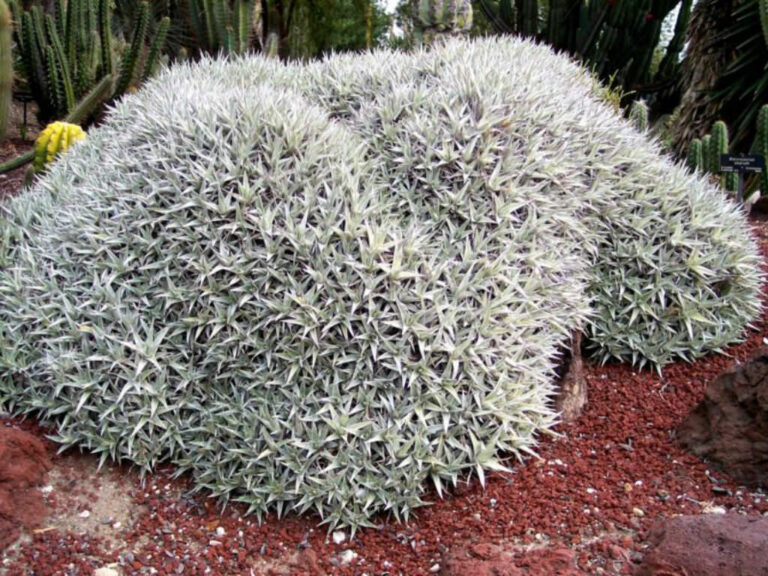
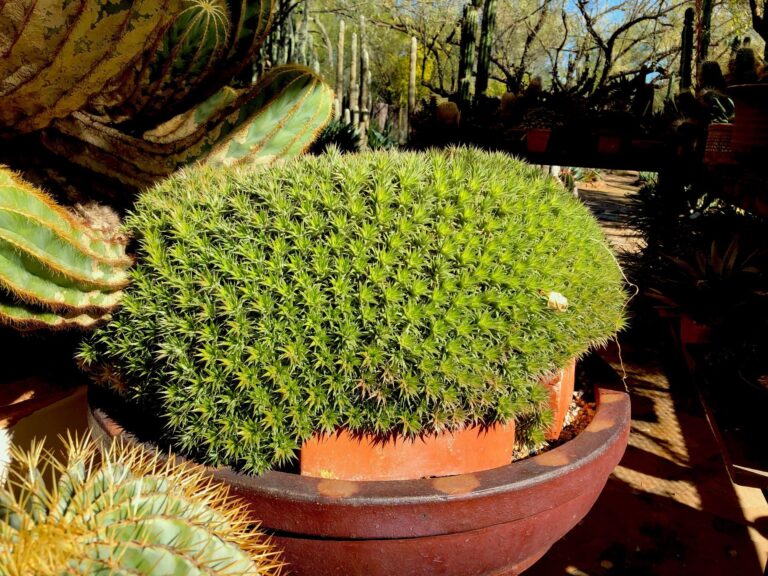
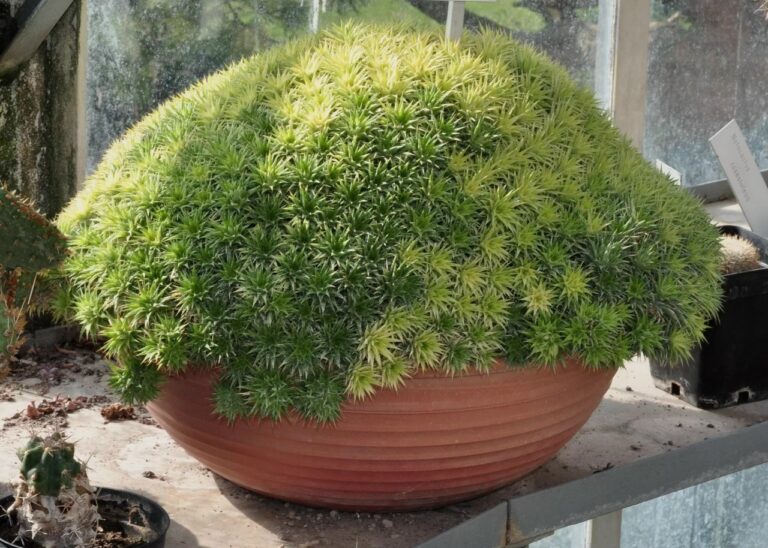
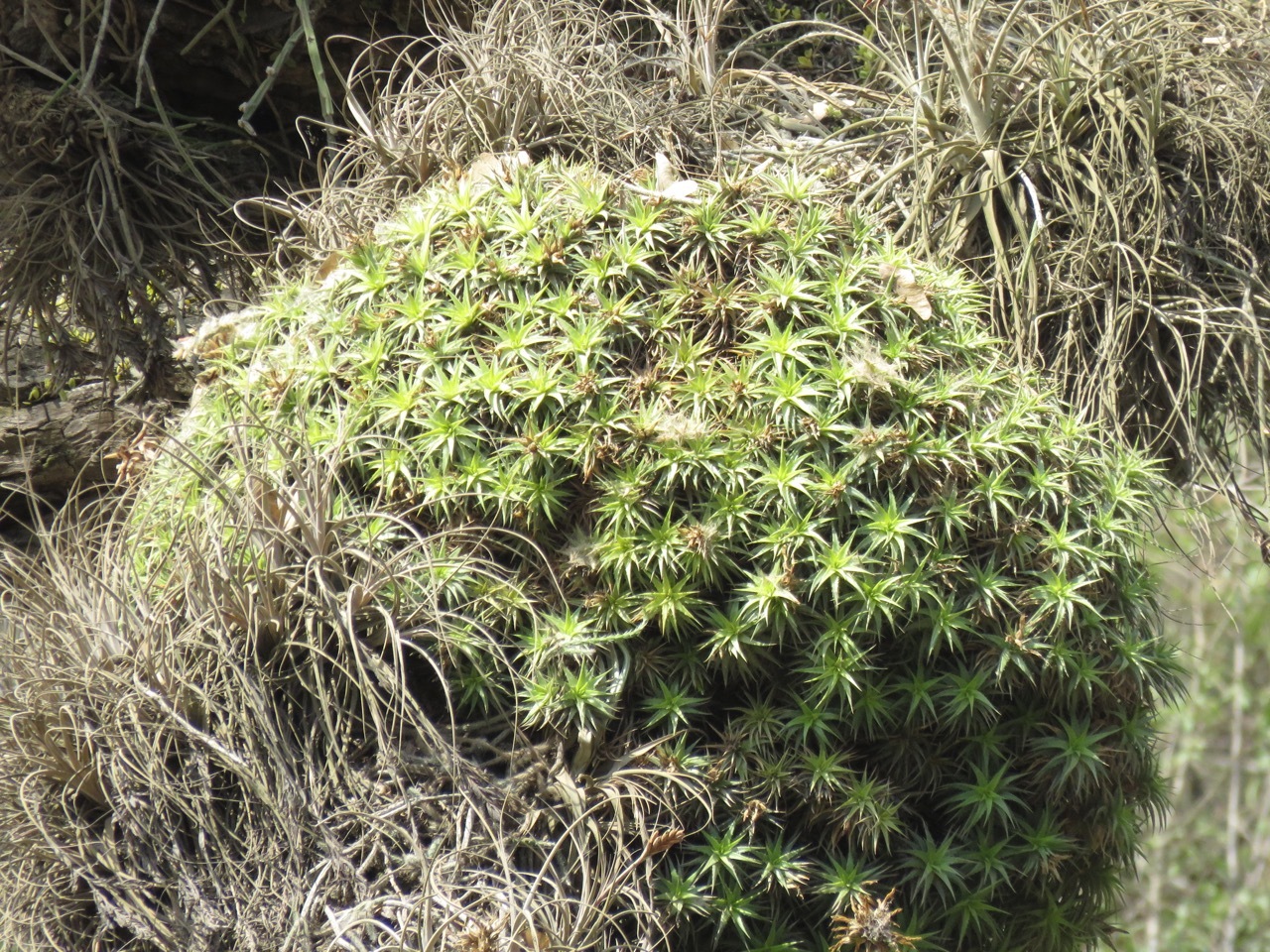
If you are trying to identify this plant by eye, the most immediate clue is its overall habit. Many of the species previously classified as Abromeitiella fuse together into impossibly tight, low-slung cushions, creating a uniform, almost moss-like topography. Deuterocohnia scapigera breaks that mold. While it absolutely forms dense mounds and colonies over time, its architecture is noticeably less compressed and irregular.
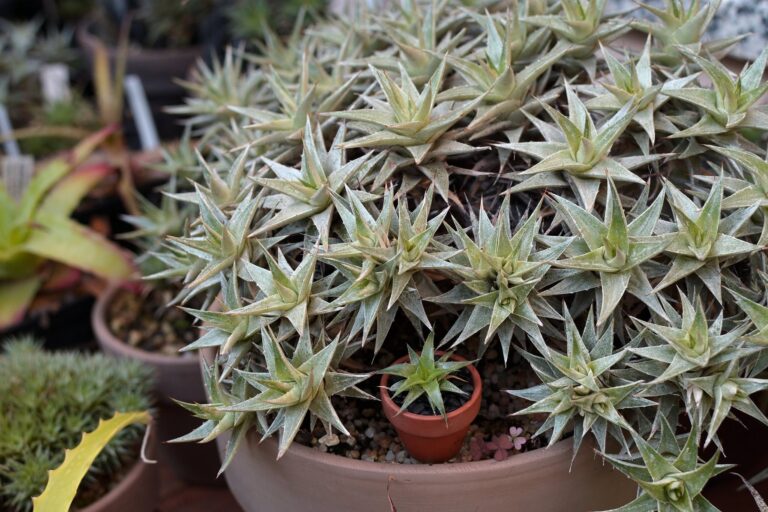
Individual rosettes stand out clearly, giving the entire plant a beautifully unrefined, jagged silhouette. As the plant matures, its lateral branching pushes outward to create an expansive, undulating colony rather than a sterile, uniform dome. This freedom of growth gives the species an unmistakable sense of movement and direction.
In garden design, this structural difference changes everything. Where a super-tight cushion plant reads as a flat, continuous carpet, D. scapigera delivers an intricate tapestry of repeating rosettes. This makes it a phenomenal focal specimen when nestled tightly between large fractures of stone, or an ideal transitional element anchoring the space between low ground-huggers and tall, upright bromeliads.
Foliage
The individual leaves are evergreen, heavily succulent, rigid as steel, and tipped with formidable points. They carry a heavily silvered, dusty grey-green patina—a classic evolutionary coat armor developed by xeromorphic bromeliads to survive the intense, unprotected radiation of the high Andes. Depending on your specific microclimate, light levels, hydration, and regional provenance, the foliage performs a subtle color shift:
- Blue-green or powder-grey when grown under intense, unrestricted sunlight.
- Deep, saturated forest green when given a bit of ambient shade or a generous deep watering.
- Brilliant silver highlights when direct sun catches the tiny, light-reflecting surface scales and trichomes.
- Warm copper or reddish flushing at the very tips and margins when the plant is pushed by environmental stress.
Look closely at the rosettes and you will notice they form tight, starburst clusters of narrow, tapering blades. They have completely abandoned the wide, chalice-like water reservoirs found in common tropical houseplants. Every line of this plant’s anatomy shouts drought resistance: thick moisture-storing tissues, unyielding leaf blades, armed margins, and a compact cluster design that aggressively minimizes surface evaporation. Viewed from directly above, the sharp leaf tips create a dazzling, crystalline geometry. From a distance, a mature colony softens slightly, mimicking a low mound of frost-kissed pine needles.
Surface and Texture
Designing with Deuterocohnia scapigera is an exercise in appreciating texture over loud color. You won’t find the neon variegation or broad, painted stripes of tropical greenhouse bromeliads here. Instead, its dramatic impact comes entirely from the rhythms of its pointed leaves, the stark contrast between the weathered outer blades and the fresh, emerging central growth, and the way hundreds of individual rosettes lock together to form a rich, rugged topography.
To unlock its maximum aesthetic potential, pair it with smooth, contrasting partners. Water-worn river stones, fine mineral gravel, flawless globular cacti, and broad, un-spined succulents instantly accentuate the plant’s fierce geometry. Be cautious when grouping it exclusively with other heavily armed, narrow-leaved plants; without a deliberate variation in height, color, or branching habit, the composition can easily devolve into a visually messy jumble.
Inflorescence and Flowering
A Visible but Restrained Display
Do not expect massive, flamboyant floral spikes from this species. The blossoms are modest, tubular affairs clad in shades of chartreuse and yellow-green. They favor the understated, muted palette shared by the vast majority of Deuterocohnia species. In a private collection or garden display cultivated primarily for its structural foliage, these flowers act as an elegant, quiet seasonal whisper rather than a loud, show-stopping event.
Yet, the inflorescence structure is highly significant for both botanical identification and garden composition. Unlike some cushion-bromeliads whose flowers sit almost completely hidden within the center of the rosette, the flower-bearing stalks of D. scapigera lift themselves noticeably above the foliage. This elevated presentation enhances the plant’s open, texturally complex look and distinguishes it instantly from its tighter lookalikes. The blossoms gather in tight, upright clusters, poking out from behind sharply pointed bracts to create a highly sophisticated, tonal harmony against the grey-green leaves.
Perennial Flowering Architecture
One of the most extraordinary botanical traits of the genus Deuterocohnia is its ability to develop persistent, woody inflorescence axes. While the vast majority of bromeliads produce short-lived flower stalks that wither and die right after blooming, these durable structures remain a permanent fixture of the plant’s anatomy, capable of pushing out brand-new flowers across multiple successive seasons. This is an incredibly rare evolutionary mechanism within the broader Bromeliaceae family, found almost exclusively in highly specialized, arid lineages.
For the cultivator of D. scapigera, this means the old inflorescences should be celebrated as a long-term architectural feature, not snipped away as untidy debris. Long after the actual blossoms fade, the architectural, dried stalks offer superb, rustic structure that remains beautifully proportionate to the living colony below.
Phylogenetic Significance
Former Abromeitiella Group
Horticultural history tells us that four specific species were once split off into the defunct genus Abromeitiella: D. abstrusa, D. brevifolia, D. lotteae, and our subject, D. scapigera. All four share an evolutionary knack for forming dense cushions, short defensive leaves, and producing a restricted number of flowers per rosette—classic adaptations designed to withstand the brutal exposure of high-altitude alpine zones.
However, D. scapigera refuses to be neatly pigeonholed into a generic “compact cushion” stereotype. Recent, cutting-edge phylogenomic research has upended old assumptions. Nuclear DNA profiling demonstrates that its looser growth habit is mirrored by a distinct evolutionary lineage: it actually sits much closer to the larger D. gableana and D. sanctae-crucis on the family tree than it does to its old Abromeitiella bunkmates.
This revelation serves as a fantastic reminder for gardeners that outward physical appearances can be deeply deceiving. Dense, cushion-like growth is not a single shared family heirloom; rather, it is a brilliant example of convergent evolution, sparked independently multiple times within the genus as an extreme survival response to desiccating alpine winds, freezing soils, fierce UV radiation, and hyper-arid conditions.
As a result, the plant holds a dual identity for enthusiasts:
- It captures the coveted, rosette-dense cushion aesthetic popularized by the classic Abromeitiella group.
- It stands out as a highly individual evolutionary maverick, proudly displaying a more relaxed, open architecture and a prominently elevated inflorescence.
A Species Shaped by Elevation
The genus Deuterocohnia spans an incredible ecological gradient, occupying niches from baking, low-elevation scrublands all the way up to dizzying heights approaching 3,900 metres. Across this genus-wide spectrum, an architectural pattern emerges: the higher a species climbs, the shorter, tougher, and more compressed its form becomes to survive the elements. Conversely, species dwelling in middle and lower zones enjoy the freedom to develop expansive rosettes, elongated leaves, and far more substantial floral architectures.
The unique form of D. scapigera perfectly captures this environmental tug-of-war. It retains the dense, water-hoarding, heavily armored visual language of a true high-Andean survivor, yet it stops just short of flattening itself into the absolute compressed carpet seen in its ultra-alpine relatives.
Design Value in the Garden
Rock Gardens and Mineral Compositions
To maximize this plant’s visual impact, treat it first and foremost as a living, sculptural work of art. It shines brightest in the following settings:
- Sharp-angled rock gardens tucked into rocky clefts.
- Deep stone troughs and specialized mineral container displays.
- Impeccably drained alpine-style cold frames or greenhouse benches.
- Striking, minimal desert courtyards and xeric landscapes.
- Elevated succulent berms and sharply sloping beds.
- Dedicated conservatory benches housing rare botanical curiosities.
- Specialist collections focused on terrestrial Pitcairnioideae and xeric bromeliads.
Always position this specimen where it can be appreciated from a top-down angle or up close at eye level. If you plant it behind aggressive, fast-moving groundcovers or beneath towering, floppy companion plants, its intricate rosette geometry will instantly disappear from view.
Your choice of topdressing can completely alter the design mood. Spreading a clean layer of pale limestone or quartz gravel will beautifully illuminate the plant’s cool, smoky grey-green undertones. Conversely, nesting it against fractured black basalt, dark charcoal shale, or pieces of deeply weathered, sandblasted timber creates a dramatic, high-contrast backdrop that makes the pointed leaves look exceptionally sharp. For an authentic, warm desert look that evokes its native Andean home, use rich terracotta gravel or warm, iron-stained sandstone mulch.
Positioning and Scale
While D. scapigera won’t compete in size with massive landscape agaves, it should never be treated as a microscopic novelty that gets swallowed by its neighbors. Its true design power reveals itself as the colony expands. A single young rosette may look unassuming, but a well-established, mature clump evolves into a beautiful, undulating mound packed with repeating sharp points and subtle variations in height.
Consider these strategic placements:
- Right at the front or mid-foreground of an intimate rock garden pathway.
- Perched high on a raised stone ledge where visitors can peer directly down into the rosettes.
- Centred in a wide, low, shallow bowl container that gives the lateral offsets ample room to colonize.
- Acting as a structural bridge between low, flat stone-hugging mats and tall, upright architectural succulents.
- Serving as a dramatic textural contrast directly alongside perfectly smooth, globular cacti or clean, un-toothed agave blades.
Unless you are intentionally aiming for a heavily monochromatic, single-texture look, avoid planting it side-by-side with other species that share an identical fine, grey, spiny silhouette.
| Companion Type | Design Effect |
|---|---|
| Rounded cacti | Creates a beautiful tension by playing spherical volume against jagged, pointed starbursts. |
| Small agaves | Builds a sophisticated layer of armored foliage; ensure you choose species with distinctly wider leaves to break up the pattern. |
| Sedum or low mats | Softens the hard, rigid edges of the stone setting without creeping over or obscuring the rosettes. |
| Silver succulents | Establishes a highly refined, cool-toned, monochromatic color palette. |
| Dark stones / black gravel | Serves as a dramatic backdrop that sharpens and defines the smoky grey-green silhouette. |
| Rust-toned mineral mulch | Injects a lovely, glowing warmth that makes the cool-toned foliage pop. |
| Upright Deuterocohnia | Delivers excellent vertical contrast while keeping the theme unified within a related botanical family. |
| Low-growing grasses | Introduces a gentle element of wind-swept movement, provided they are non-invasive types that won’t choke out the succulent. |
The most breathtaking compositions almost always rely on a simple rule: pair one highly assertive geometric form with a quiet, grounding texture. For example, resting a mature clump of D. scapigera right alongside a perfectly smooth, unblemished globular cactus and a single massive, dark, weather-beaten stone creates three completely distinct visual rhythms that work together beautifully without needing a single flashy flower to steal the show.
Cultivation Notes for Collectors
Deuterocohnia scapigera is a rewarding plant for patient growers who appreciate architectural form, geographic provenance, and slow, meticulous development over instant, fleeting seasonal color. Its master care regimen mirrors the strict cultural disciplines required by all highly specialized, desert-dwelling terrestrial bromeliads: flawless drainage, a sharp limit on stagnant moisture, bright sunlight with gradual acclimatization, and total protection from the lethal combination of prolonged winter wet and freezing cold.
When planning your potting mixes and watering schedules, always consult the Master Growing Guide: Deuterocohnia and Former Abromeitiella rather than falling back on generic, run-of-the-mill houseplant bromeliad tips. Thanks to its high-altitude Andean roots, specialized CAM (Crassulacean Acid Metabolism) pathway, intensely succulent water-storing leaves, and an absolute intolerance for heavy, oxygen-deprived soils, its cultural needs run parallel to those of ultra-specialist desert flora rather than tropical canopy epiphytes.
Furthermore, serious collectors should make every effort to source plants with verified, well-documented collection data. Because the genus Deuterocohnia carries a long, tangled web of historical synonyms, nursery misidentifications, and highly variable growth forms, your plant tags should preserve both its modern accepted name and its historical designation:
Deuterocohnia scapigera (syn. Abromeitiella scapigera)
Maintaining this dual labeling is incredibly valuable for botanical collections, reference gardens, and older herbaria accessions where the plant may have been originally registered under its old Abromeitiella title decades ago.
Identification Summary
You can be highly confident that a specimen is a true match for Deuterocohnia scapigera when it exhibits this precise combination of traits:
- A strictly terrestrial, clumping bromeliad that grows by producing a multiplying community of offsets and rosettes.
- Rigid, thick, sharply pointed leaves clad in a distinct, smoky grey-green or silvered patina.
- An overall colony habit that is visibly looser and more irregular than the hyper-compressed, flat cushions of typical former Abromeitiella species.
- A clear, well-developed inflorescence structure that lifts its flowers visibly above the crown of the foliage.
- Small, understated, tubular blossoms opening in shades of pale yellow-green or chartreuse.
- A thoroughly rugged, desert-adapted, xeromorphic presentation that looks completely unrelated to thin, soft-leaved tropical tank bromeliads.
- A clear collection pedigree or nursery provenance linking back directly to the arid regions of Bolivia.
The lasting impression of a mature Deuterocohnia scapigera is one of pure, unyielding architectural durability, characterized by its subtle blooms and a deeply compelling evolutionary storyline. Its true magic doesn’t lie in flashy, temporary floral displays or explosive growth spurts, but rather in its exquisite combination of silvered, starburst rosettes, repeating geometric patterns, and an open, elevated flowering habit that marks this species as an elite standout among its closest botanical relatives.