The Silver Sensation: Why Deuterocohnia abstrusa Belongs in Your Dry Garden
The Naming Tangle: Identity and Taxonomy
Navigating the botanical history of this plant requires a bit of detective work. Currently, the most accepted botanical name is Deuterocohnia abstrusa (A.Cast.) N.Schütz. However, walk into almost any specialty nursery or flip through an older collection catalogue, and you will likely see it labeled Deuterocohnia lorentziana. To make matters more confusing, you might also run across Abromeitiella abstrusa or Abromeitiella lorentziana, which reflect the plant’s former home in a completely separate genus.
Modern plant taxonomy has absorbed the entire Abromeitiella group into Deuterocohnia. This genus encompasses a fascinating spectrum of terrestrial and lithophytic (rock-dwelling) bromeliads, spanning from tiny, tight cushion plants to sprawling, rosette-forming specimens.
The confusion around the name lorentziana runs deep. When taxonomist Nicole Schütz revised the genus, her research revealed that the plants widely grown in gardens as D. lorentziana are actually D. abstrusa. The true lorentziana type specimen turned out to be an entirely different plant closely linked to D. brevifolia. Despite this botanical clarity, many professional growers stick with “lorentziana” as a handy shorthand, ensuring the old name remains firmly entrenched in the nursery trade.
Anatomy of an Andean Maverick: Appearance and Habit
Stiff, Starburst Foliage Wrapped in Silver
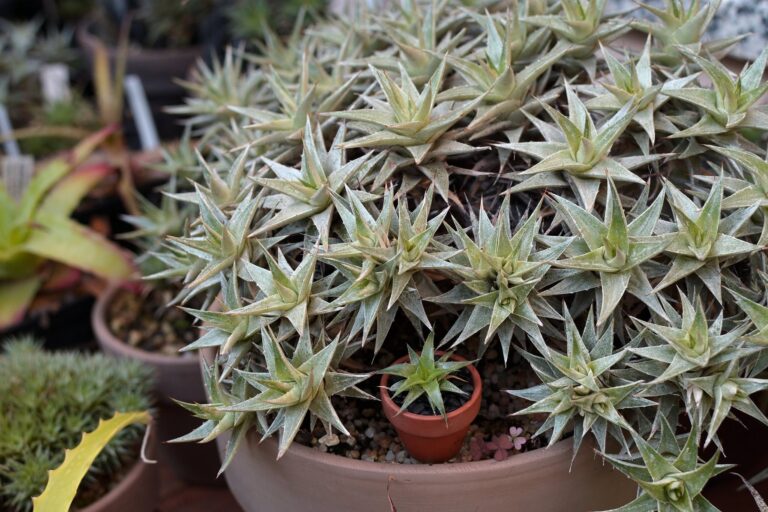
Foliage is the undeniable superstar here. Each leaf is rigid, narrow, triangular, and terminates in a needle-sharp point, all arranged in immaculate rosettes. The mesmerizing silver-grey to frosted-white finish isn’t a powdery, waxy coating that rubs off; it is a dense blanket of fine, reflective surface hairs called an indumentum.
These microscopic hairs do double duty, softening the plant’s fierce geometry while bouncing away harsh sunlight. Under the midday sun, the entire colony looks almost cloaked in frost—an effect that turns absolutely luminous when staged against dark stone, charcoal gravel, or deep green companion plants.
Compared to D. brevifolia, the leaves here are thicker, longer, and far more visually dramatic. The rigid geometry gives each rosette a distinct starburst quality, transforming the colony into a rugged, spiky sculpture rather than a soft mound of greenery.
Rosettes with Room to Breathe
Deuterocohnia abstrusa breaks away from the tight, carpet-like habit of its cousins by forming larger, looser rosettes. Individual rosettes typically expand to about 2.5 cm across, and grand, mature colonies can stand up to 60 cm tall under ideal conditions. Consider these numbers flexible guideposts rather than absolute rules—a plant’s ultimate size and shape are heavily dictated by its age, pot size, light exposure, and specific genetic provenance.
As the years roll by, the plant undergoes a fascinating structural evolution:
- Youthful specimens start out looking like tight, crowded clusters of silver pincushions.
- Established plants expand outward into broad, irregular cushions with a distinct vertical presence.
- Mature colonies begin to lift themselves up, exposing a woody, trunk-like interior as new rosettes stack directly on top of old growth.
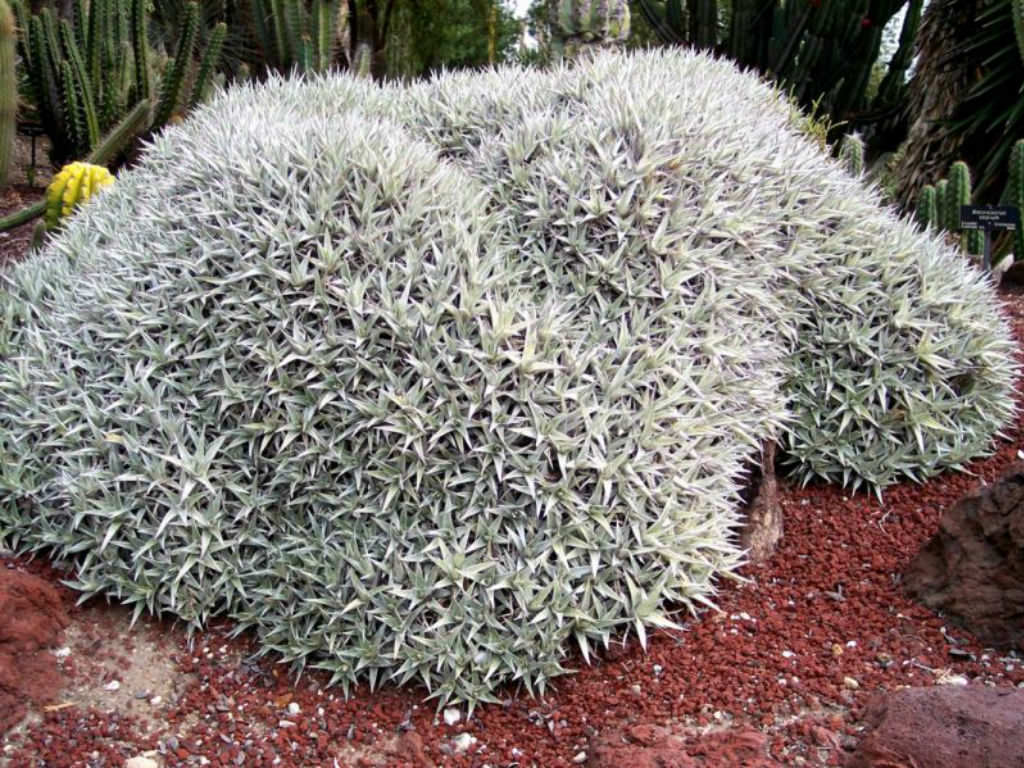
- Ancient specimens ditch all symmetry, morphing into tall, craggy, undulating mounds with immense architectural presence.
This upward growth pattern is a massive selling point. While D. brevifolia excels at creating low, ground-hugging mats, D. abstrusa climbs skyward to become a true focal point.
The Power of Colony Architecture
True to its Abromeitiella roots, D. abstrusa is a prolific cloner, branching freely from the flanks to throw off endless offsets. Instead of growing as isolated individuals, these rosettes fuse into a single, collective living sculpture.
It is a beautiful study in contrast. Viewed from across the garden, you see a solid, undulating mound of pure silver. Step closer, and the macro view gives way to a micro world of hundreds of geometric starbursts locked in a flawless repeating pattern.
As the colony lifts, it holds onto dried interior leaves and organic debris. Far from looking messy, this trapped material bulks out the center, supporting the raised, trunked framework that gives old specimens such an ancient, weathered look.
Restrained, Chartreuse Blossoms
When it comes to flowering, this bromeliad exercises brilliant restraint. Do not expect towering, fiery spikes; the former Abromeitiella species produce short, unassuming inflorescences bearing just a few tubular, yellow-green to chartreuse flowers. They peek out quietly from the rosettes, sometimes sitting flush with the foliage, sometimes rising just a fraction above it.
This subtle bloom cycle perfectly matches the plant’s rugged, alpine persona. Rather than disrupting the monochromatic silver scheme with a loud pop of color, the chartreuse tubes offer quiet sparks of understated contrast that keep the focus squarely on the plant’s dry, mineral aesthetic.
Born of the Andes: Wild Adaptations
To appreciate the toughness of D. abstrusa, you have to look to its homeland. This plant is a native of the harsh, sun-baked, high-altitude regions of Argentina and Bolivia, where it clings to exposed rocky slopes and thin alpine soils.
Every single feature is a survival mechanism honed by millions of years of mountain exposure:
- Thick, succulent leaves store precious moisture against prolonged droughts.
- The dense felt of silver hairs reflects intense ultraviolet light and prevents solar scorching.
- Wicked, needle-sharp leaf tips offer an uncompromising defense against hungry herbivores.
- The tightly knit, communal habit shields the plant’s core from biting mountain winds and rapid desiccation.
- Crassulacean Acid Metabolism (CAM) allows the plant to breathe at night, taking up carbon dioxide when temperatures drop to prevent daytime water loss.
- The packed interior of the mound creates a localized microclimate, trapping old tissue to protect the living outer shell.
Spot the Difference: Abstrusa vs. Brevifolia
Telling these two close relatives apart can be tricky, especially when you are looking at young, unlabelled nursery stock. Use this practical guide favored by taxonomists and professional growers to tell them apart.
| Feature | Deuterocohnia abstrusa | Deuterocohnia brevifolia |
|---|---|---|
| Overall Scale | Large, bold, and visually substantial. | Diminutive, tight, and highly compact. |
| Leaf Colour | Distinctly silver, steel-grey, or frosted white. | Richer green, dull grey-green, or only lightly silvered. |
| Leaf Arrangement | Open, loose, and clearly defined rosettes. | Densely packed, compressed, and uniform. |
| Colony Form | Taller, elevated mounds that can develop trunks. | Low, flat, ground-hugging cushions and mats. |
| Sun Tolerance | Exceptional; thrives in intense, direct sunlight. | Excellent, but appreciates relief in scorching desert zones. |
| Visual Texture | Crisp, spiky, highly reflective, and architectural. | Fine-textured, moss-like, and velvety from afar. |
| Design Role | Dramatic specimen plant, raised container star, border accent. | Exquisite rock-garden crack filler, pathway edger, low groundcover. |
Keep in mind that these traits are most pronounced in mature, open-grown specimens. Young plants frequently exhibit overlapping features, and variables like light levels and watering regimes can shift leaf color and density. Always pair the nursery tag with a close look at the plant’s actual structure.
Masterclass in Garden Design
The Ultimate Silver Focal Point
In dry landscapes, gravel gardens, alpine troughs, or protected succulent collections, D. abstrusa operates as a brilliant sculptural anchor.
Its unique indumentum manipulates light in ways standard grey-foliage succulents simply cannot match. In the soft light of dawn, the mounds cast a cool, pale blue-grey shadow. Under the blistering heat of noon, they flare into a stark, brilliant white. When the sky turns overcast, the leaves transform again, shifting to the deep tone of weathered steel or pewter.
Position this plant where it can be admired up close. The intricate geometry of the rosettes is far too detailed to be pushed to the back of a bed or buried behind sprawling shrubs.
High-Contrast Material Pairings
To unlock the full visual potential of D. abstrusa, contrast its icy, geometric lines against bold textures and rich colors:
- Set it against black volcanic rock or dark basalt to make the silver foliage pop with dramatic intensity.
- Frame it with warm sandstone or classic terracotta to beautifully highlight those subtle chartreuse flowers.
- Contrast the sharp, needle-like leaf tips with smooth, rounded river stones.
- Spread fine gravel around the base to anchor its mineral, high-altitude character.
- Pair it with broad-leaved, deep green companions to make the silver rosettes look impossibly bright.
- Introduce burgundy or bronze-foliaged neighbors for a sophisticated color contrast that doesn’t compete with the bromeliad’s form.
- Plant upright, airy grasses nearby to bring kinetic movement to the deuterocohnia’s static, solid mound.
- Interplant with compact cacti to reinforce the desert vibe while introducing completely different surface textures.
A word of warning: resist the temptation to crowd it with too many other spiky, silver plants. Mixing it indiscriminately with grey agaves, echeverias, and dasylirions can dissolve your garden’s visual hierarchy. Let D. abstrusa be the undisputed star of its zone.
Raised Containers and Troughs
Staging this bromeliad in a raised planter or stone trough is an excellent way to showcase its profile and display its developing, trunk-like architecture. Wide, shallow bowls are perfect for young, expanding colonies, while tall, minimalist pots beautifully complement older specimens that have started to lift off the soil line.
Stick to simple, clean container designs. The plant’s foliage already provides an incredibly complex pattern; pairing it with highly decorated or ornate pottery will only create visual noise.
This species also shines in traditional European crevice gardens. Tucking it into narrow vertical gaps between heavy stones makes it look exactly like a wild specimen clinging to an Andean cliffside.
Massing and Textural Drifts
While it is frequently grown as an individual specimen, planting D. abstrusa in sweeping multiples creates an unforgettable, shimmering silver landscape. For the most natural effect, eschew rigid grids and space the plants at irregular, staggered intervals.
A strategic mass planting can serve several brilliant design functions:
- A shimmering, low-maintenance silver ribbon running alongside a dry gravel path.
- A highly detailed, tactile foreground matrix planted beneath tall, airy, open-crowned trees or shrubs.
- A soft, transitional bridge linking massive boulders with larger rosette-forming succulents like agaves.
- A structured, evergreen groundcover for a rock garden in frost-free regions.
- A high-contrast frame planted around a minimalist stone water basin or a piece of modern outdoor sculpture.
Because mature colonies eventually gain significant height and mass, give them plenty of elbow room. You want them to read as distinct, undulating hillocks rather than forcing them to crowd each other into a flat, formless hedge.
A Crucial Culture Note
Specialist growers generally rate this plant as a sun-worshipper that can handle light shade and tolerate short dips down to around 20°F (approximately -6.7°C), provided the roots are kept bone-dry. Do not treat these numbers as absolute guarantees. The combination of freezing temperatures, wet soil, stagnant air, and winter rain can easily prove fatal even if the thermometer never drops below the official minimum.
Its primary cultural advantage over D. brevifolia is its ability to handle intense, unfiltered sunlight. However, don’t throw a soft, greenhouse-grown nursery specimen straight into the blinding sun. Give it time to acclimate to avoid burning the foliage.
For comprehensive, step-by-step instructions on choosing the right potting medium, dialing in your watering, providing seasonal protection, and applying fertilizer, refer directly to the Deuterocohnia Master Growing Guide.
A Nod to History
The plant’s historical classification under Abromeitiella is the reason why classic gardening books and older specialty collections display such a confusing mix of labels. The genus Abromeitiella was originally created to separate these dense, cushion-forming terrestrial bromeliads from the rest of the family. However, modern genetic testing and clear morphological overlap eventually convinced botanists to fold them back into Deuterocohnia.
While the specific epithet abstrusa is the correct botanical name today, keeping “lorentziana” in your vocabulary is essential for tracking down plants. When shopping, you are highly likely to encounter:
- Deuterocohnia abstrusa
- Deuterocohnia lorentziana
- Abromeitiella abstrusa
- Abromeitiella lorentziana
- Eclectic nursery tags that mash them together as Deuterocohnia abstrusa “lorentziana”
Rest assured, in almost every commercial context, these names all point to the exact same magnificent, silver-toned plant. Just keep your eyes open, as historical naming practices in this corner of the bromeliad world remain notoriously inconsistent.
The Verdict: Why It Deserves a Spot in Your Collection
Deuterocohnia abstrusa is the ultimate solution when a design demands a plant with an uncompromising mix of ruggedness and elegance. It delivers a striking silver palette without the vulnerability of soft-leaved plants, offers powerful geometric form, and brings far more scale and drama to the table than D. brevifolia.
Best of all, its fascinating, colony-forming habit only grows more impressive with age. It bridges the gap between mineral and plant, blending beautifully into gravel, stone, and modern architectural landscapes. Combined with an understated flower display that never detracts from the foliage, it stands out as a highly rewarding choice for collectors eager to explore the world of bromeliads far beyond the standard, tropical tank-forming types.