Acalypha wilkesiana ‘Hoffmannii’: The Sophisticated, Sculptural Side of Copperleaf
At a Glance
Identification: What Makes It Different
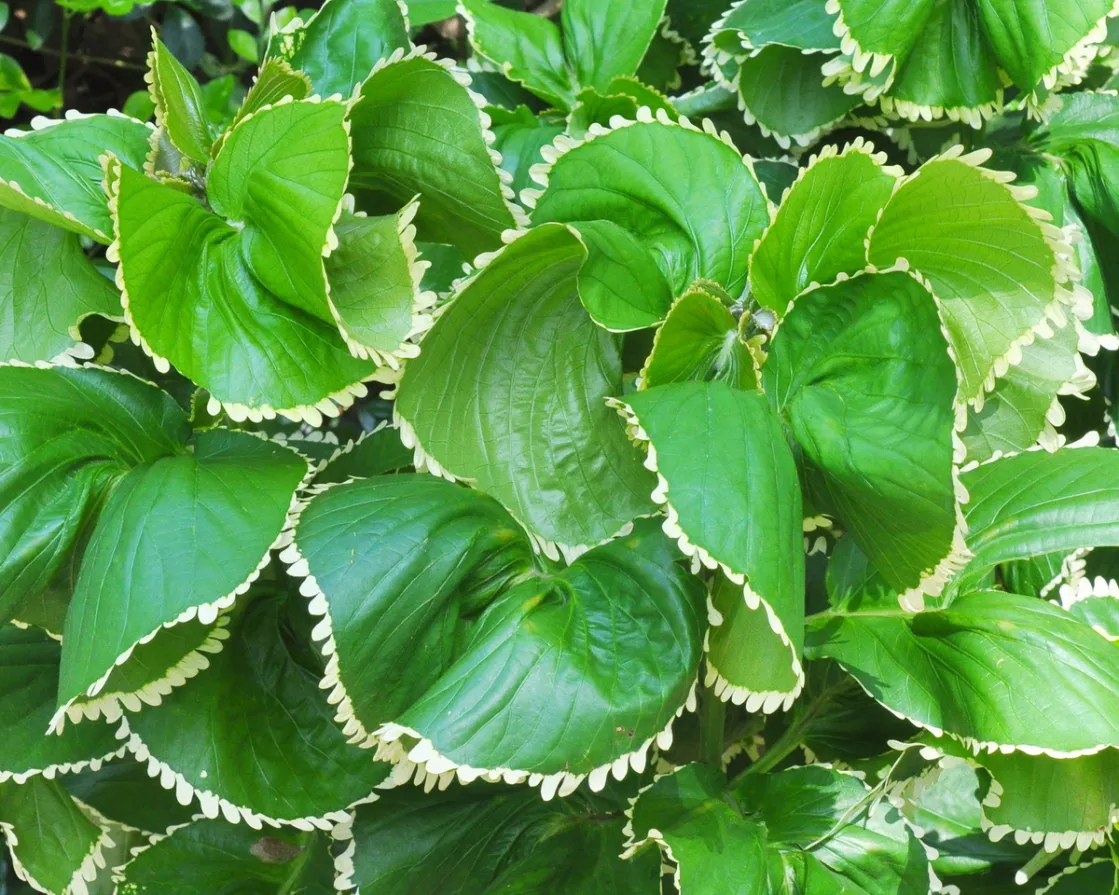
While most gardeners recognize Acalypha wilkesiana by its loud, mottled patchworks of copper, crimson, orange, and pink, ‘Hoffmannii’ makes its mark through deliberate restraint. It swaps the multi-coloured chaos of the traditional “Jacob’s coat” for a high-contrast, two-tone palette. The center of each leaf remains a deep, stable green, framed by a broad, irregular margin of cream or ivory-white.
The architecture of the foliage is what truly elevates this cultivar. The large, broad, ovate leaves feature sharply toothed edges, a rounded-to-heart-shaped base, and an acute tip. Rather than sitting flat, the leaf blades dramatically twist, ripple, and curl. This three-dimensional distortion forces the pale margins to catch light from unexpected angles, giving the entire shrub a uniquely crimped, ribbon-like texture that sets it apart in any nursery lineup.
Foliage Colour Transitions
‘Hoffmannii’ skips the typical autumn color shifts of temperate shrubs, opting instead for a subtle interplay between old and new growth throughout the year:
- Young flush: The newest leaves showcase the sharpest contrast on the plant. Bright green centers are bordered by pristine cream-white edges, occasionally flushed with warm, yellow-gold undertones.
- Mature foliage: As the leaves age, the central green deepens into a rich, dark backdrop. The ivory margins soften slightly into a creamy white or yellow-green, particularly on stems basking in intense sunlight.
- Texture over time: The characteristic twisting and undulation intensify as the foliage expands. This structural development gives mature specimens a remarkably full, architectural presence without relying on a shift in hue.
Viewed from across the garden, the shrub registers as a fresh, luminous green-and-white mass. Step closer, and the intricate choreography of the rumpled, serrated, pale-edged leaves becomes the main attraction.
Habit and Mature Dimensions
This cultivar develops into an upright, densely branched, and naturally bushy shrub. In frost-free tropical landscapes, it leverages its full genetic potential to reach up to 2.5 meters in height with a spread of 1.5 meters. When grown in temperate zones—where it is frequently utilized as a summer bedding accent, a patio showpiece, or an indoor/outdoor container plant—it adopts a more contained profile, typically settling at a manageable 0.9 to 1.2 meters tall and wide.
Design-wise, ‘Hoffmannii’ builds a clean, rounded mass of foliage rather than a leggy, open thicket. This predictable growth habit allows it to anchor a design beautifully, whether you need a standalone focal point, a mid-border transitional element, or a repeating structural anchor in a larger, tropical-inspired garden layout. For guidance on universal care metrics like soil requirements or overwintering schedules, refer to our comprehensive master guide for Acalypha cultivation.
Flowers: Present but Peripheral
Like all members of its genus, ‘Hoffmannii’ is monoecious, meaning it produces separate male and female flowers on a single specimen. The blossoms themselves are tiny, understated, and distinctly greenish, arranged along drooping, catkin-like racemes. Because these flowering structures are largely hidden beneath the large, heavily textured leaves, they play a minor role in the plant’s overall aesthetic. Gardeners select this cultivar entirely for its persistent, structural foliage, treating the delicate summer flower spikes as a subtle, added bonus.
Landscape Positioning
To maximize the visual impact of ‘Hoffmannii’, position it where the brilliant ivory margins can contrast against a darker background. This crisp green-and-white color profile makes the plant exceptionally versatile, allowing it to soften loud tropical combinations, illuminate dim corners, or serve as a sophisticated foliage bridge between competing flowering perennials.
Best Design Roles
- Specimen foliage shrub: Plant a single specimen near walkways or seating areas where the distinctive twist and texture of the leaves can be studied up close.
- Tropical-border anchor: Nestled against broad, dark-green foliage, the ivory borders of ‘Hoffmannii’ appear to glow, breaking up monochromatic green walls.
- Container focal point: The combination of an upright-rounded habit and bold leaf texture makes this plant a superb candidate for a large, decorative pot on a terrace or patio.
- Repeating accent: In large borders or public gardens, planting this cultivar at regular intervals establishes a rhythmic visual cadence without relying on fleeting floral displays.
- Contrast plant for hot colours: The clean, dual-toned foliage works beautifully as a visual buffer, separating intense reds, oranges, and purples so they do not clash.
Planting Combinations
When crafting a design around ‘Hoffmannii’, focus on contrasting leaf shapes and textures rather than trying to mimic its precise variegation:
- Dark backgrounds: Position it in front of the deep, glossy leaves of Fatsia japonica, Alocasia, Colocasia, or large-leaf Philodendron varieties to make the pale margins pop.
- Fine textures: Offset the broad, rumpled leaves of the copperleaf by pairing it with the fine, linear lines of ornamental grasses, Carex, or low-growing Alternanthera.
- Warm accents: Integrate subtle touches of coral, scarlet, or deep purple foliage nearby to inject energy into the vignette, though use a light hand to keep from overwhelming ‘Hoffmannii’s’ refined look.
- Silver and grey partners: Surround the base with dusty miller, Plectranthus argentatus, or grey-leaved salvias to pick up the cool tones of the ivory margins.
Visual Character in the Garden
Compared to its raucous, red-leaved relatives, ‘Hoffmannii’ brings a tailored, almost formal discipline to the garden. Its strict green-and-ivory color scheme responds beautifully to light shearing, yet the organic twist of the foliage ensures it never looks sterile or overly stiff.
Think of it as an exotic alternative to traditional variegated landscape shrubs like Euonymus or Pittosporum. It delivers that same dependable, light-reflecting qualities, but packages it with massive leaves, a dramatic silhouette, and an undeniable tropical flair. In frost-free zones, it is an invaluable tool for building a lush, high-impact landscape without defaulting to a chaotic explosion of color.
History and Naming
The parent species, Acalypha wilkesiana, traces its origins to Fiji and the surrounding islands of the South Pacific. The specific epithet pays homage to Charles Wilkes, the leader of the historic nineteenth-century United States Exploring Expedition, during which this remarkable species was first collected for botanical study.
‘Hoffmannii’ represents a refined chapter in a long history of selecting copperleaf variants for unique leaf patterns. Over the decades, collectors have isolated numerous cultivars based on distinct variegation, charting a line from ‘Hoffmanna’ to well-known forms like ‘Ceylon’, ‘Macafeeana’, ‘Marginata’, ‘Musaica’, and ‘Obovata’. While variations like ‘Hoffmanii’ and ‘Hoffmanna’ frequently crop up in historical archives and nursery catalogs, ‘Hoffmannii’ remains the internationally accepted spelling among major botanical institutions and horticultural references.
Why the RHS Recognition Matters
The Royal Horticultural Society established its Award of Garden Merit to guide gardeners toward plants that exhibit outstanding performance, uniform growth, and excellent reliability under ordinary garden conditions. In 2026, the society updated this prestigious designation to RHS Recommended: Award of Garden Merit. ‘Hoffmannii’ is formally recorded in the RHS herbarium list of taxa, and leading horticultural guides consistently affirm its award-winning status.
For the everyday gardener, this stamp of approval is highly meaningful. Copperleaf cultivars can be notoriously unpredictable when it comes to vigor, leaf drop, and stability of variegation. This recognition confirms that ‘Hoffmannii’ delivers a highly stable, repeatable performance, consistently producing its signature twisted green leaves, ivory edges, and dependable rounded habit.
How to Distinguish It From Lookalikes
Best Garden Uses
Incorporate ‘Hoffmannii’ into your garden plans when you need:
- A bold foliage shrub that offers genuine tropical scale but works within a disciplined green-and-white color palette.
- A high-contrast companion to make dark-leaved or intensely colored neighboring plants stand out.
- A structural, rounded accent tailored for large patio containers, mixed borders, or intimate courtyard gardens.
- A copperleaf variant that delivers dramatic garden impact without relying on red, bronze, or orange tones.
Ultimately, this cultivar shines brightest not as a standard colorful accent, but as a dynamic, light-catching structural foliage plant. The brilliant ivory margins frame each leaf like a crisp highlight, while the heavily contorted blades bring a sense of fluid movement and rich texture to the landscape.