The Unsung Hero of Dark Groundcovers: How to Use Purple Sheep’s Burr
Acaena inermis ‘Purpurea’ is a masterclass in subtlety. This low, evergreen, mat-forming perennial weaves a dense carpet of finely divided foliage that shifts beautifully through tones of plum, bronze-purple, and smoky grey-green. For small-scale garden design, it is easily one of our most versatile dark-foliage groundcovers. It remains neat enough to tuck into narrow paving joints or alpine troughs, yet possesses enough vigor to knit the front of a mixed border into a seamless, velvety rug.
At a Glance
For baseline cultivation—site selection, soil preparation, planting, watering, feeding, pruning and routine pest management—see the Master Growing Guide for Acaena.
A Distinctly Purple Form
‘Purpurea’ represents a highly selected, purple-leaved iteration of the wild Acaena inermis, commonly known as the spineless acaena. While the straight species can be a bit mercurial—fluctuating wildly from basic green to a muddy bronze—this particular cultivar was isolated precisely to bring consistency and ornamental flair to that darker color palette.
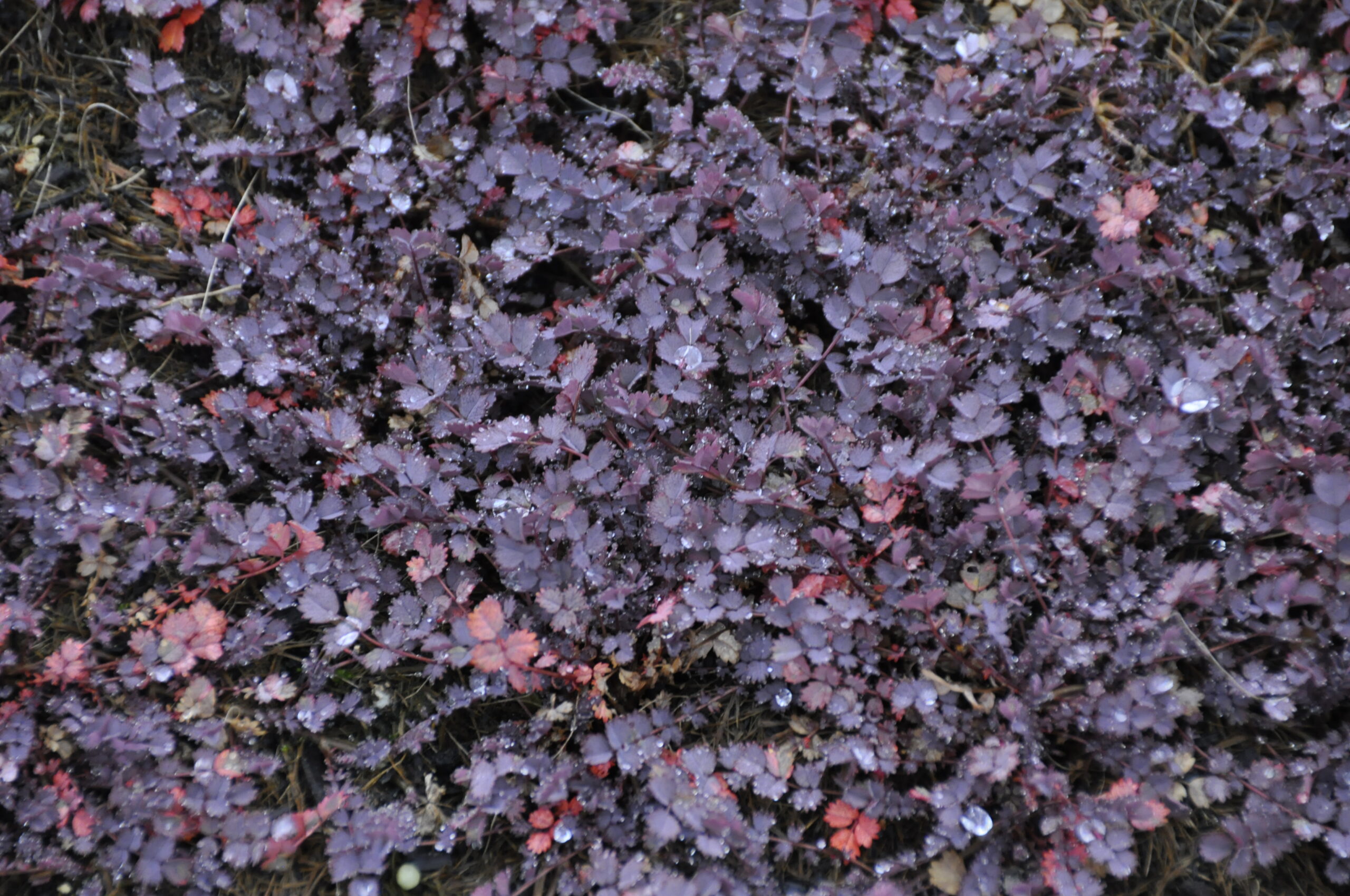
Look closely and you will see tiny, compound, rose-like leaves, each divided into several pairs of rounded, neatly toothed leaflets. The plant reads their environment to dictate their hue. Grown in deep shade, the leaflets settle into a muted grey-green or olive-bronze. Introduce strong, direct sunlight, however, and the plant rewards you by pulling up deep amethyst, rich plum, and intense red-bronze tones from its roots.
Crucially, this color play isn’t a brief autumn finale like you see with deciduous choices. Instead, it is an ongoing, light-driven modulation within an entirely evergreen carpet. The foliage stays cool and smoky in the crisp light of spring, deepens to a rich burgundy under the baking summer sun, and maintains its structural integrity right through the winter months in milder climates.
Flowers and Seedheads
As summer peaks, short stems lift small, rounded pincushions of tiny, creamy-white flowers just above the foliage. While you wouldn’t necessarily plant this acaena for the blossoms alone, they offer a brilliant, pale contrast against the moody mat below.
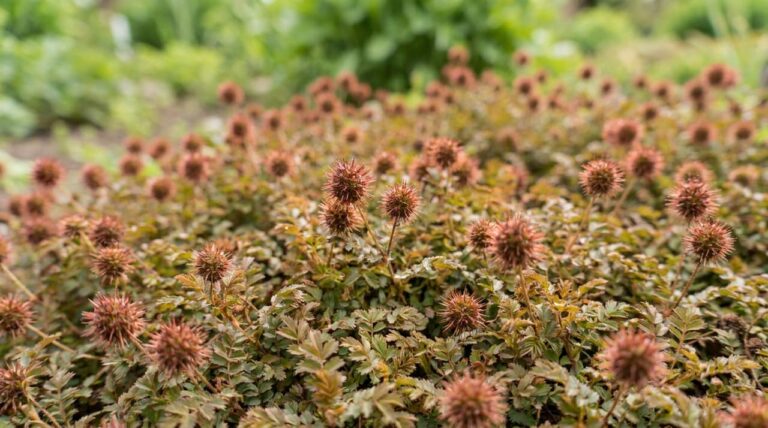
Once the flowers pass, they give way to tiny, globe-like seedheads of a rich red-brown to bronze hue. This is where Acaena inermis truly shines compared to its close relatives. Many common acaenas bear notoriously hooked burrs that latch onto passing socks, pet fur, and wildlife with aggressive persistence. The seedheads of A. inermis, true to their name, are fundamentally spineless and barbless. This single trait makes the cultivar a far more polite choice for flanking high-traffic paths and patio seating areas.
If you prefer a perfectly manicured look, you can easily shear off the spent flower stems before the seedheads fully mature. It is entirely an aesthetic preference, not a requirement for the plant’s health.
Mature Size and Habit
Do not expect an upright clump; ‘Purpurea’ operates entirely in the horizontal plane, creating a completely flat, creeping carpet. It hovers a mere 5 to 10 centimeters off the ground, but will eventually claim a footprint of roughly 0.5 to 1 meter wide, depending on the quality of your soil and site.
The plant covers ground via creeping stems, underground rhizomes, and trailing runners that root firmly wherever they touch down. This makes it an exceptional tool for swallowing up bare gaps, softening raw hardscape edges, and blanketing small pockets of open soil. However, that same creeping enthusiasm means you should think twice before planting it right next to incredibly slow-growing, delicate alpine treasures that could easily be smothered by its advance.
Where It Belongs in the Garden
Dark groundcover
Think of this plant as a beautiful, living alternative to traditional mulch. Its dense, low-slung habit completely blocks out bare earth at the front of the border, swapping out uninspiring soil for a sophisticated color palette rarely found in typical green groundcovers.
It acts as an incredible visual stage. The dark, fine-textured carpet provides the ultimate high-contrast backdrop for showcasing brighter companion plants, whether that means silver foliage, pale flowers, fiery perennials, or architectural grasses.
Paths, paving and edges
Because it shrugs off light foot traffic and refuses to grow tall, ‘Purpurea’ is a premier candidate for planting within the joints of flagstone patios, along gravel walkways, or right at the edge of a bed. Its plum foliage spills lazily over stone or brick, immediately giving new hardscaping a weathered, historic character. Here, the barbless nature of its seedheads becomes a massive functional asset.
Rock gardens and containers
This cultivar is perfectly scaled for the micro-habitats of alpine rockeries, gravel scree beds, and stone wall crevices. It is equally stunning when allowed to cascade over the rim of a container.
When potting it up, pair its dark leaves with pale stone, classic terracotta, weathered zinc, or glazed blue-grey pottery. It also serves beautifully as a rich underplanting for tall, structural focal plants, provided the canopy doesn’t cast so much shade that the acaena loses its trademark purple punch.
Colour Pairing Ideas
To get the most out of ‘Purpurea’, treat it as a moody, intricately detailed base layer. Depending on what you plant alongside it, this plum-bronze carpet can either cool down a design or turn up the heat on warmer tones.
Silver and grey
Juxtapose the dark mat against Stachys byzantina (Lamb’s Ears), Artemisia, Convolvulus cneorum, or silvery sedums. The result is a high-contrast, sun-baked composition with a distinct Mediterranean vibe.
Pale flowers
White alliums, delicate daisies, airy gypsophila-type blossoms, pale cranesbill geraniums, or white spring bulbs take on a sharp, dramatic definition when emerging from this shadowy floor.
Hot accents
Fiery orange geums, intense red salvias, golden-yellow sedums, or arching crocosmia stems look infinitely more saturated and vibrant when they erupt out of a dark purple-bronze base.
Cool blues and violets
Weaving in blue-flowered campanulas, upright veronicas, or deep blue salvias creates a sophisticated, calm, and contemporary palette. Just be careful not to overdo it, or the entire vignette may read as too dark from a distance.
Grasses and structural foliage
Placing low-growing Festuca glauca (Blue Fescue), dwarf Pennisetum, or fine-textured Muhlenbergia species above the static mat introduces wonderful movement, texture, and light play.
One of the smartest design moves you can make is underplanting pale-flowered spring bulbs with ‘Purpurea’. The bulbs will pierce right through the quiet winter mat to bloom brilliantly. Then, just as the bulb foliage begins its messy post-bloom decline, the purple acaena wake up, growing rapidly to hide the dying leaves and reclaim visual control of the space.
Design Character
The real magic of this cultivar comes from the tension between its delicate looks and its underlying toughness. Up close, the glossy leaflets and deep bronze stems reveal a highly architectural, tightly woven mesh. Step back, and that same fine texture blurs into a soft, almost mossy tapestry.
It feels sleek and thoroughly contemporary when used in minimalist gravel gardens or geometric paving patterns. Yet, it looks completely organic in a traditional rock garden, where its dark canvas makes pale stone and tiny flowering alpines look instantly more vivid. Because it holds its leaves all year round without ever creating unwanted bulk, it is a priceless asset for small courtyard gardens where every single plant needs to work double-time.
Origins and Naming
Members of the Acaena genus belong to the broader rose family (Rosaceae), with Acaena inermis recognized as a distinct, valid species by Plants of the World Online. The wild species traces its roots back to the landscapes of Australia and New Zealand; ‘Purpurea’ is the standout, dark-leaved selection that has been preserved and propagated by specialty nurseries for garden use.
The specific epithet inermis translates directly to “unarmed” or “spineless”. It is a direct nod to the plant’s benign fruiting heads, distinguishing it beautifully from the hitchhiking, painfully hooked burrs that give the rest of the genus a bad reputation.
Why Choose ‘Purpurea’?
Turn to Acaena inermis ‘Purpurea’ whenever a design cries out for a genuinely low, evergreen, dark-foliage groundcover that relies on fine texture rather than coarse, bold leaves. This isn’t a plant you buy for show-stopping flowers or architectural height; its true genius lies in its ability to turn the ground itself into a rich piece of the color puzzle.
It is the perfect choice for creating a plum-bronze alternative to monotonous green lawns, softening walkable stone pathways, filling out alpine containers, or acting as the ultimate dark foil for spring bulbs and silver-leaved perennials.