Demystifying White Forsythia: Cultivars, Phantom Taxa, and Korea’s Hidden Selections
Abeliophyllum distichum occupies a precarious, singular niche in the plant kingdom. As the sole species within its genus and a Critically Endangered endemic clinging to survival in central Korea, this deciduous gem—affectionately dubbed “White Forsythia”—is a true collector’s prize. Yet walk into almost any Western nursery, and the entire genus effectively boils down to just two clonal selections: a white-flowered, thrum-eyed cultivar historically designated as ‘Bodnant’, and a pale pink counterpart traded under the collective banner of the ‘Roseum’ Group.
Beyond this familiar duo lies a confusing landscape of botanical nomenclature. Intrigued gardeners will regularly encounter names like ‘Pink Star’, f. albiflorum, f. viridicalycinum, and var. obtusicarpum, alongside recent Korean reports of a seedling boasting uniquely crimped petal margins. Scratch the surface, however, and these anomalies reveal themselves as mere taxonomic synonyms, obscure botanical curiosities, or closely guarded research material with absolutely no footprint in the commercial nursery trade.
This guide untangles these elusive variants, clarifying what each name truly represents, detailing their verified visual nuances, and explaining why they require no deviation from standard cultivation practices. For the technical details on siting, soil chemistry, moisture, pruning regimes, and winter hardiness, simply turn to the Master Abeliophyllum distichum Growing Guide; their fundamental cultural appetites remain identical across the board.
The Duopoly of Western Horticulture: ‘Bodnant’ and ‘Roseum’
‘Bodnant’ – The Definitive White-Flowered Standard
When you encounter a white-flowering Abeliophyllum distichum in a Western landscape, you are almost certainly looking at ‘Bodnant’. This clone is strictly thrum-eyed, meaning its female stigma sits low beneath the pollen-bearing anthers. Without a compatible, long-styled “pin-eyed” partner to share pollen with, it remains stubbornly self-sterile and sets virtually no seed in casual cultivation.
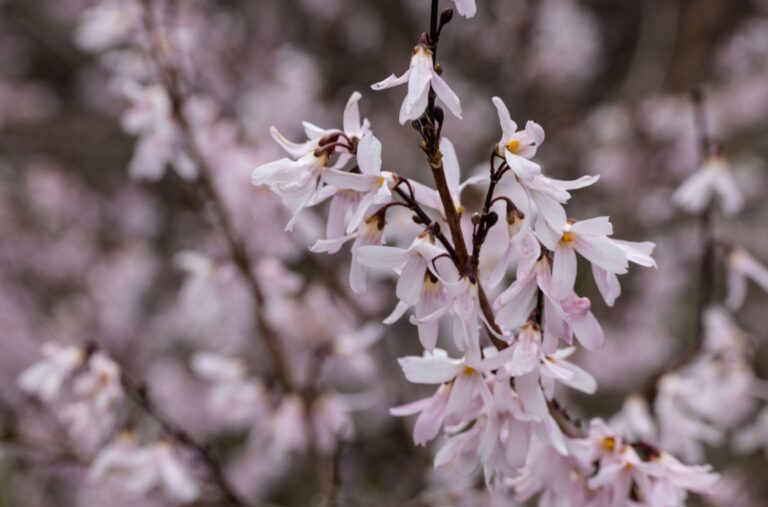
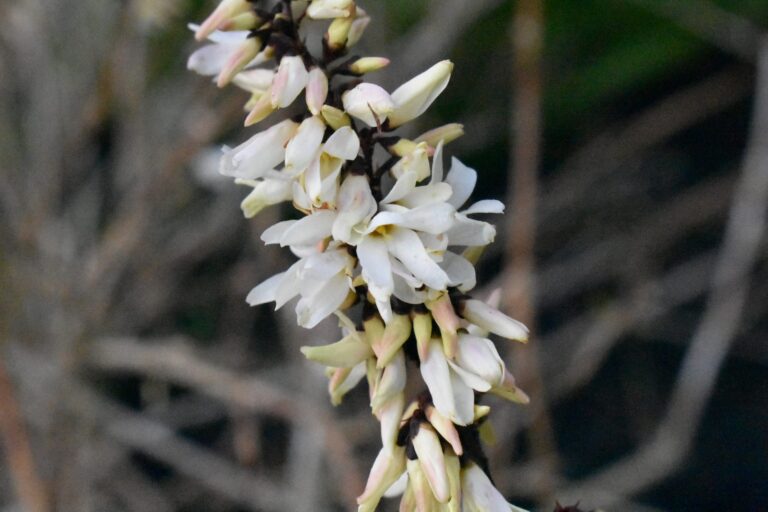
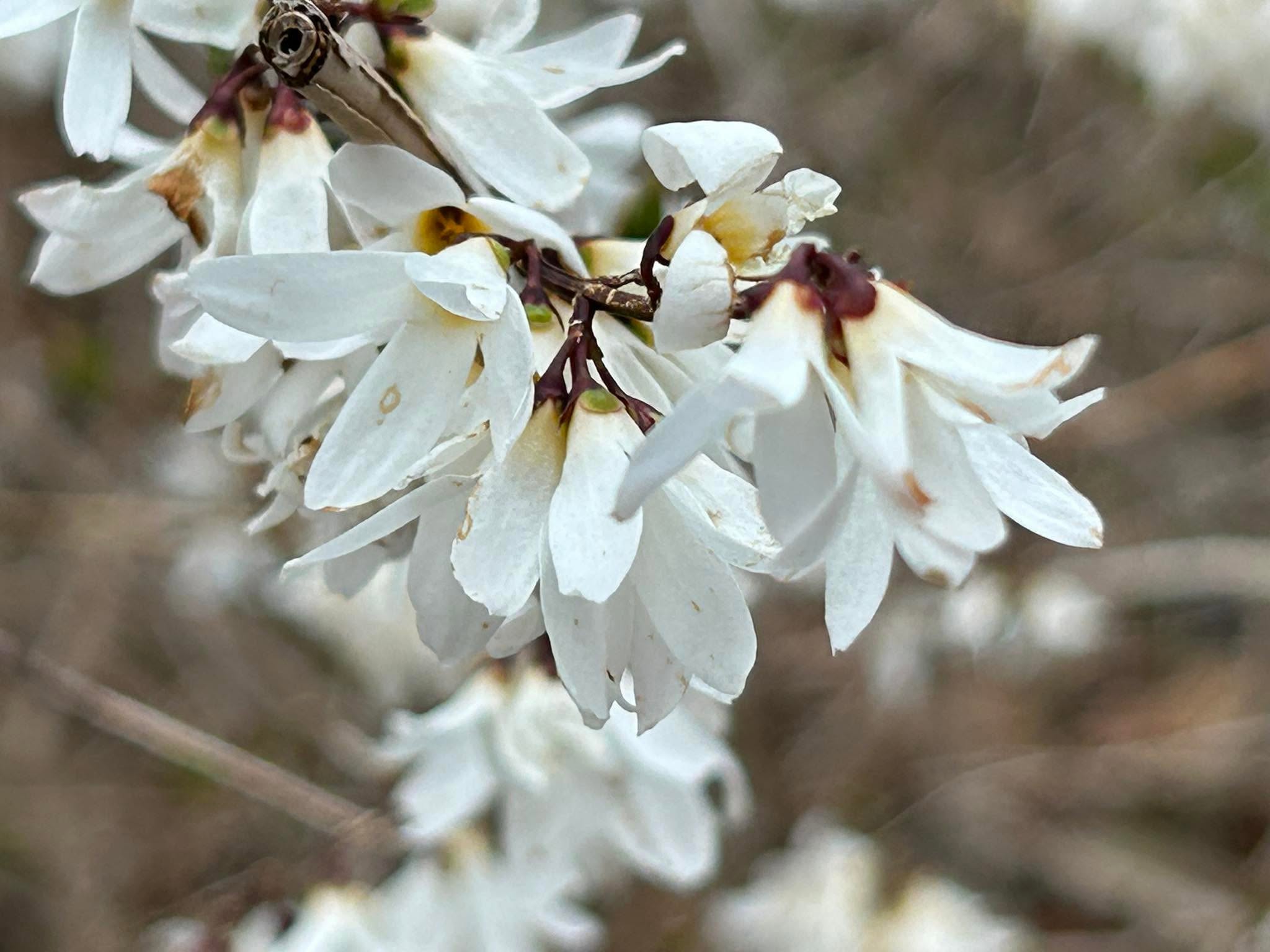
The floral show begins in late winter as deep pink-tinged buds. These gradually unfurl into blossoms that quickly mature to a clean, luminous white, though close inspection often reveals a lingering pink blush on the tips of the outer corolla lobes. Dark purple calyx lobes provide a moody contrast against these pale petals.
[Bud Stage: Deep Pink] ➔ [Opening: Pink-Blushed White] ➔ [Mature: Luminous White + Purple Calyx]
The lineage of this venerable clone is steeped in British gardening history. The trail leads back to the 1930s, when the Arnold Arboretum dispatched material across the Atlantic to Lord Aberconway at his legendary Bodnant estate in Wales. Offshoots of this original introduction eventually made their way to the Royal Botanic Gardens, Kew, where a historic specimen still scrambles against a wall in the Salvia Border. The Royal Horticultural Society recognized its stellar performance early on, granting it an Award of Merit in 1937 followed by a prestigious First Class Certificate in 1944. For nearly a century, it has quietly ruled the European trade as the exclusive white form.
- Flower & Morphology: Pale pink buds open to near-white, occasionally holding onto faint pink tips. Flower stems and calyces are anchored by dark purple pigmentation.
- Sexual Structure: Features a thrum-eyed floral structure with a short style, locking it out of self-fertility.
- Growth Habit: A lax, arching architectural habit that comfortably reaches about 1.5 metres as a free-standing shrub, or stretches well past 2 metres when carefully trained against a sunny wall.
Strangely, despite its ubiquitous presence, ‘Bodnant’ suffers from a lack of consumer branding. You will rarely find it sold under its true cultivar name; nurseries simply market it as the straight species. Horticulturally, it serves as the baseline “type” for the white form, meaning any design advice or care tips written for the species apply directly to this plant.
The ‘Roseum’ Group – The Blush-Pink Alternative
For those seeking a splash of warmth, the pink-flowered variant offers a delicate pastel alternative. Universally traded as ‘Roseum’ or the Roseum Group, its official botanical christening occurred in 1922 when Japanese botanist Takenoshin Nakai named it f. lilacinum. A later attempt by Krüssmann to label it f. roseum created a junior synonym that remains horticulturally redundant. Mirroring the reproductive quirks of ‘Bodnant’, ‘Roseum’ is entirely thrum-eyed, leaving it marooned in genetic isolation within Western gardens.
This pink clone shares roots with the Arnold Arboretum, emerging as a standout seedling among the seeds collected in Korea by E.H. Wilson’s assistant, Torataro Ishidoya, in 1924. A single cutting-grown plant, catalogued as accession 477–59, was eventually distributed by the Arnold Arboretum in 1959, serving as the genetic fountainhead for every pink specimen in the West. Its journey to commercial stardom was a slow burn; it finally cropped up in American specialty catalogues like Heronswood by 1990, and only made its debut in the UK’s RHS Plant Finder by 2024–25, backed by roughly eleven specialist suppliers.
- Flower & Morphology: Soft pink corollas retain their coloration throughout their brief lives, paired with an interior corolla tube that leans a softer yellow than that of ‘Bodnant’. The precise depth of the pink tint fluctuates depending on ambient light, plant age, and microclimate.
- Autumn Value: Distinctive autumn foliage frequently transitions into rich, purply tones—a visual bonus famously highlighted by horticulturist Jim Gardiner in 2011.
- Growth Habit: Shrub dimensions and a sprawling, arching silhouette perfectly mirror ‘Bodnant’, typically maturing at 4 to 5 feet tall. To really make the pale pink blossoms sing, plant it against a dense, dark evergreen backdrop.
Keep an eye out for the name ‘Pink Star’ in the UK trade. Coined by the prominent propagator Brian Humphrey for a plant he sent to the UBC Botanical Garden around 1998, this name carries no unique genetic distinction; it is simply a commercial synonym for ‘Roseum’.
The Forgotten Botany: Phantom Forms Missing from the Trade
Flip through dense taxonomic journals, and you will spot several infraspecific names that hold zero relevance for practical gardeners. These plants exist almost exclusively on paper or in wild herbaria:
- f. albiflorum Nakai: A superfluous botanical name. If we accept white as the default color for the species, this form collapses neatly into the primary species name, f. distichum.
- f. eburneum T. Lee: Described as having rich, creamy-white blossoms, this form has never transitioned into living collections or nursery rows.
- f. viridicalycinum T. Lee: Noted for its complete lack of dark purple pigmentation in the calyx, resulting in a clean green base. It remains completely absent from both commercial trade and public arboreta.
- var. obtusicarpum: A phantom taxonomic variant occasionally mentioned in brief checklists, yet no authoritative gardening literature documents its performance, visual distinctions, or availability.
These names represent hyper-specific botanical distinctions. With no consumer demand and an absolute lack of garden data, they do not warrant independent consideration.
The New Frontier: Research-Stage Korean Selections
The horizon holds some intriguing possibilities, though they remain tantalizingly out of reach. A 2021 abstract from a Korean scientific conference unveiled a newly developed Abeliophyllum distichum selection bred at the Chungcheongbuk-do Forest Environment Research Institute. The data shows significant structural departures from the wild type:
| Plant Part | Standard Dimension | Research Selection Dimension |
| Petal Limbs | 7.20 mm | 9.88 mm (Elongated) |
| Flower Racemes | 12.79 mm | 5.99 mm (Tighter, shorter) |
| Fruit (Samaras) | 31.96 mm wide (Heart-shaped) | 21.77 mm wide (Narrower, obovate) |
| Foliage | 24.38 × 11.26 mm | 36.08 × 18.97 mm (Oversized) |
In addition to these structural shifts, this variant features a delayed spring awakening, bursting into bloom roughly 7 to 10 days later than standard selections. As it stands, this crimped-petal variant remains confined to research plots, with no commercial release, international distribution, or nursery numbers to its name. It belongs firmly in the realm of botanical curiosities, not consumer plant profiles.
Similarly, two other Korean research selections—‘Ok Hwang 1ho’, noted for its unique pale yellow corolla, and ‘Dae Ryun’, prized for its scaled-up blossoms—have had their chloroplast genomes formally mapped. Yet, they too remain protected within academic breeding programs in their homeland.
The Genetic Bottleneck: A Tale of Two Thrums
Western horticulture’s relationship with Abeliophyllum is hamstrung by a massive genetic bottleneck. Because our entire stock consists of just two thrum-eyed clones, normal sexual reproduction has ground to a halt. For these shrubs to successfully set seed, a thrum-eyed blossom must receive pollen from a pin-eyed blossom, which features a long style extending past the anthers.
[Thrum-Eyed Clone] ❌ [Thrum-Eyed Clone] = No Seed Set (Self-Sterile)
[Thrum-Eyed Clone] can cross with [Pin-Eyed Clone] = Successful Seed Pods
True pin-eyed plants are incredibly rare in the West, limited to a few unverified whispers from American seed collectors and a single historical specimen at the Arnold Arboretum. Consequently, seeing the unique winged fruits of this shrub in a Western garden is a rare event.
Fascinatingly, a 2019 observation at the Szarvasi Arboretum in Hungary recorded unexpected fruit production, hinting that both floral morphs might be growing side-by-side there, though the full details have yet to be published. This restricted genetic foundation is worrying for a species facing critical endangerment in the wild. However, there is a glimmer of hope: fresh seed collections brought out of Korea by botanists like Eike Jablonski in 2024 may soon inject much-needed genetic diversity into our gardens.
Sourcing Strategies and Design Wisdom
- Shopping for White: If you buy a plant labeled simply as A. distichum, you are almost certainly purchasing the historic ‘Bodnant’ clone. Anticipate deep purple calyces opening to stark white blossoms that may carry a delicate pink flush in bud.
- Shopping for Pink: Seek out specialists listing ‘Roseum’ or the Roseum Group. Look for soft, consistent pink petals accented by a contrasting yellowish interior tube. Ignore listings for ‘Pink Star’; it is merely a synonym and offers nothing distinct from standard pink plants.
- The Holy Grail of Rarity: Keep your eyes peeled for rare pin-eyed specimens. Tracking one down would unlock the ability to cross-pollinate your shrubs, yielding a beautiful autumn display of winged, elm-like seed pods (samaras). For now, dismiss any rumors of exotic Korean selections like ‘Ok Hwang 1ho’ or the crimped-edge variants; they remain exciting future possibilities rather than current landscape realities.
Regardless of the label on the pot, these shrubs share the exact same cultural preferences. Give them a sheltered spot in full sun to protect the early blossoms from late spring frosts, plant them in rich, well-draining soil packed with organic matter, and prune them immediately after the flowers fade to stimulate the vigorous new wood that will carry next winter’s buds. When performing this essential post-bloom maintenance, it is crucial to consult the Master White Forsythia Pruning Guide to avoid accidentally removing the upcoming season’s latent flower buds.