Abeliophyllum distichum ‘Roseum – Complete Growing Guide
Long before the garden wakes up to the brassy, unmistakable yellows of common spring forsythias, Abeliophyllum distichum ‘Roseum’ (frequently catalogued under ‘Rosea’ or the Roseum Group) steals onto the scene. This rare, deciduous Korean native is a master of early-season drama, garbing its bare winter stems in a dense mantle of pale pink, almond-scented blossoms. For gardeners seeking a sophisticated, fragrant alternative to the standard palette of late winter, this monotypic gem delivers exceptional rewards across USDA hardiness zones 5–8 (RHS H6), demanding very little fuss once its roots take hold.
Botanical Background and Origin
Taxonomy and Nomenclature
Botanically speaking, Abeliophyllum distichum stands alone; it is the sole occupant of its genus, a status designated as monotypic. A member of the olive family (Oleaceae), its name hints at its morphology: the genus reflects a passing resemblance to the leaves of Abelia, while the specific epithet distichum highlights the neat, two-ranked (distichous) arrangement of its foliage along the stems.
In nursery circles and reference collections, this alluring pink variant circulates under a small handful of aliases:
- ‘Roseum’ – The definitive and most prevalent cultivar name in commerce.
- ‘Rosea’ – A lingering alternative spelling occasionally encountered across North American collections.
- Roseum Group – The Royal Horticultural Society’s preferred classification, a cautious nod to the possibility of multiple pink variants (though current evidence indicates a single clone dominates the market).
- f. lilacinum – The formal botanical designation published by Takenoshin Nakai in 1922 to catalog these naturally occurring, pale pink variants.
The lineage of almost every pink-flowered specimen in Western cultivation is remarkably singular. Records trace them back to a single thrum-eyed clone grown from wild seed collected in Korea by T. Ishidoya in 1924 and sent to Harvard University’s Arnold Arboretum. This precious stock eventually trickled down to elite European estates, most notably Lord Aberconway’s Bodnant Garden in Wales, which became the foundational wellspring for European nursery production.
Conservation Status
While it enjoys a secure haven in domestic gardens, Abeliophyllum distichum faces a perilous existence in its native habitats. Classified as Endangered (EN), it clings to survival in just 11 known wild populations tucked into the understory of open, deciduous, and mixed montane woodlands in central South Korea. Though a few of these wild stands are legally protected as Natural Monuments, the species is severely threatened by ongoing habitat loss, isolated gene pools, and a complex heterostylous breeding mechanism that demands both “thrum” and “pin” flower forms for successful cross-pollination. Because virtually all plants in cultivation belong to the self-incompatible thrum-eyed clone, gardeners will find that this shrub rarely, if ever, sets seed.
Description and Seasonal Interest
Size and Habit
Left entirely to its own devices, ‘Roseum’ develops into an open, somewhat wild and lax deciduous shrub with elegantly arching, multi-stemmed branches. It typically settles into a mature frame of 1–1.5 m (3–5 ft) in both height and spread, though it can easily climb higher if carefully trained against a sunny wall.
Growth progresses at a moderate to rapid clip, reaching its ultimate architectural footprint within 10 to 20 years. Young shoots emerge as distinctively four-angled, deep purple stems. Once the spring floral performance concludes, the midsummer foliage is admittedly understated; consequently, it shows to best advantage when integrated into a mixed shrub border or anchored against a wall where its winter display takes centre stage without leaving a dull void in the summer landscape.
Flowers
The crowning glory of ‘Roseum’ is its spectacular, early-season floral display.
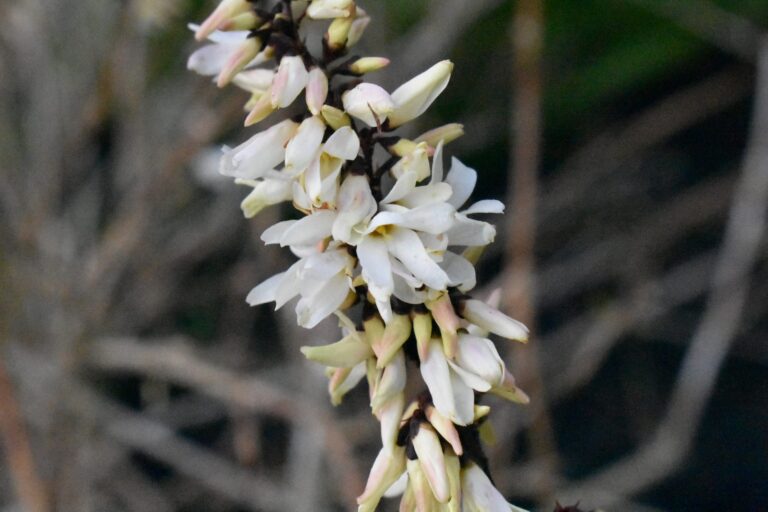
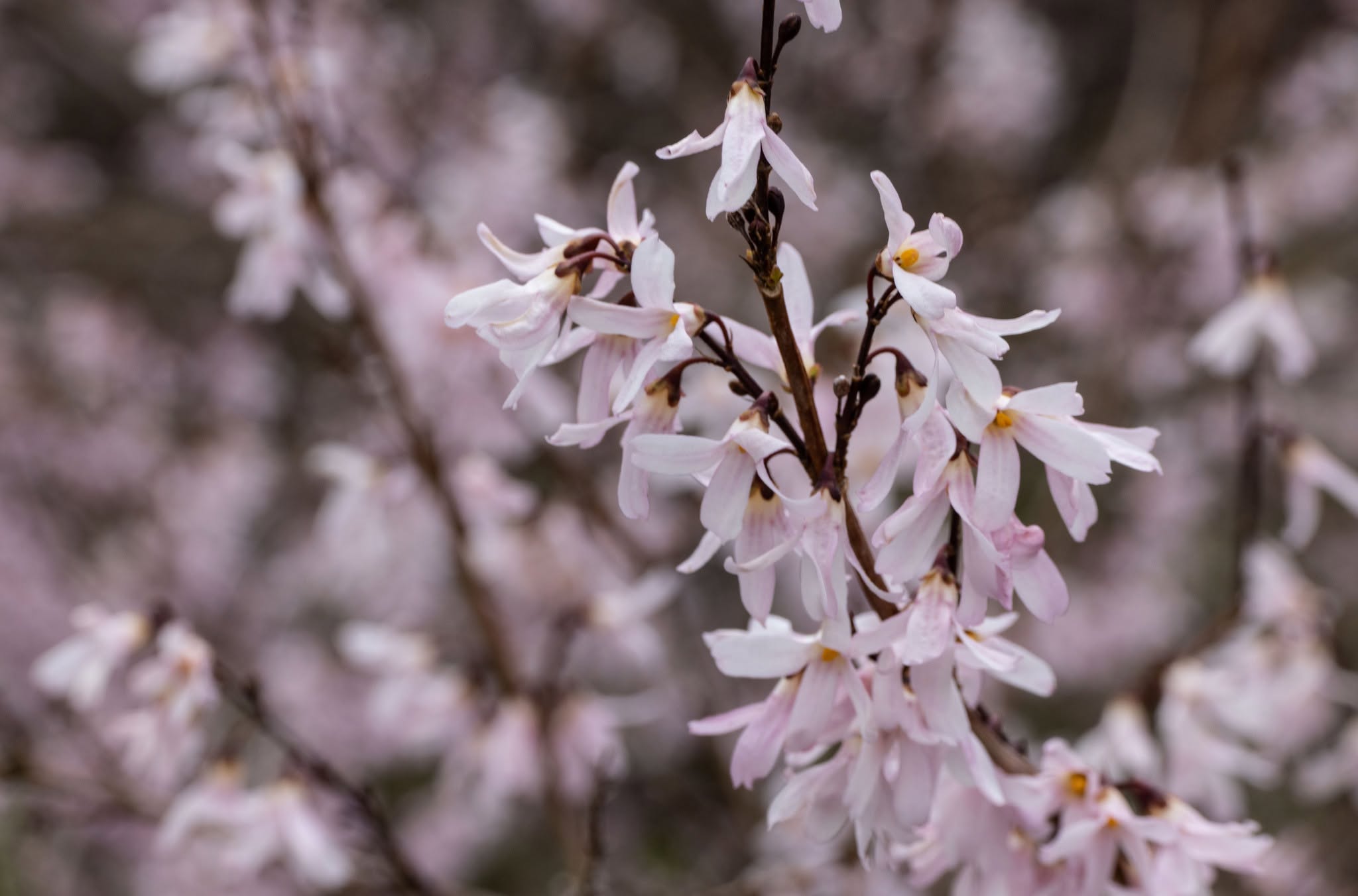
- Flower colour: The four-petalled blossoms emerge from saturated, deep pink buds to reveal a delicate, crystalline pale pink. The precise depth of this pink flush fluctuates based on local climate, available sunlight, and the maturity of the individual blossom.
- Flower size: Each small, delicate lobe measures roughly 6–8 mm in length, supported by a 4 mm corolla tube that flashes a warm, yellow interior.
- Arrangement: The blossoms crowd together in dense, axillary racemes containing anywhere from 3 to 15 flowers, transforming the bare wood of the previous 2 to 3 years’ growth into ribbons of color.
- Fragrance: A rich, almond-blossom perfume wafts from the flowers. This scent becomes intoxicatingly pronounced on still, warm days or when branches are brought into sheltered entryways.
- Bloom time: Depending on winter’s departure, the display ignites between February and April in the northern hemisphere, routinely beating true forsythias to the punch by a fortnight or more.
As a heterostylous, thrum-eyed selection, these flowers are structurally incapable of self-pollination, making garden fruiting an exceedingly rare event.
Foliage and Fruit
- Leaves: The simple, opposite foliage is ovate to lanceolate, stretching 6–10 cm long and coated in soft pubescences on both the upper and lower surfaces. It wears a dependable medium green through the summer months. Autumn colour is generally negligible in mild zones, though crisp continental autumns can coax out subtle washes of yellow, soft orange, or muted purple.
- Fruit: In the rare event of compatible pollination, the plant bears a flat, circular, winged samara measuring 2–3 cm across, closely mimicking the disc-like seed of an elm tree.
Growing Conditions
Hardiness
Abeliophyllum distichum ‘Roseum’ is a tough character, easily navigating the winters of USDA zones 5 through 8. Some growers report success in zone 4 if given a protected microclimate. It carries an RHS rating of H6, indicating total hardiness across the UK and Northern Europe while shrugging off temperatures down to -15 to -20°C. While the dormant flower buds themselves are ironclad, the tender, open petals can be scorched by sudden late-season frosts; planting in a sheltered spot mitigates this gamble.
Light and Position
To get the most out of the spring bloom and maintain a dense, well-branched silhouette, site ‘Roseum’ in full sun, aiming for at least six hours of direct light daily. While it survives in partial or dappled shade, you will sacrifice flower density. Choose an aspect facing south, west, or east, ensuring the site is well insulated from harsh, drying winter winds. This shrub leans heavily on summer heat to bake its wood and set next year’s buds, making it particularly stellar in classic continental climates with hot summers and crisp winters.
Soil Requirements
This adaptable shrub isn’t overly particular about soil chemistry, provided the site boasts impeccable drainage.
- Soil types: It moves happily between loam, sand, and clay. Heavy, sticky clays must be aggressively opened up with organic matter to prevent stagnation.
- pH: Highly versatile, managing anything from quite acidic to distinctly alkaline soils (pH 6.0–7.5).
- Moisture: Prefers a consistently moist but free-draining profile. Mature specimens tolerate reasonable dry spells but will suffer in waterlogged ground.
- Fertility: A modest feeder. Average to rich soils require no supplemental feeding; lean or thin soils will appreciate a light top-dressing of organic compost or a gentle fertilizer.
Planting and Establishment
When to Plant
Container-grown shrubs can go into the ground during the gentle windows of spring or early autumn, when soil moisture is reliable and temperatures are mild. In the rare instance you procure a bare-root specimen, commit it to the earth in late winter or the absolute dawn of spring before the buds begin to swell.
How to Plant
- Site prep: Target a bright, wind-sheltered pocket. If dealing with dense clay or sterile sand, incorporate a generous helping of well-rotted organic matter into the planting zone.
- The pit: Excavate a hole twice the width of the container’s root ball, matching the depth precisely.
- Siting: Center the shrub, ensuring the top of the root ball sits perfectly flush with the surrounding soil grade; avoid planting too deeply. Backfill using native soil, incorporating a touch of compost if your soil needs structural help.
- Hydration: Settle the soil with a thorough, deep watering, and maintain consistent, even moisture throughout its critical first growing season.
- Mulching: Blanket the root zone with a 5–7 cm (2–3 in) layer of shredded bark, leaf mould, or compost to lock in moisture and discourage weeds. Always keep the mulch a few centimetres clear of the base of the stems to avoid bark rot.
Spacing
If massing ‘Roseum’ in a mixed border or establishing an informal hedge, space individuals 1–1.5 m (3–5 ft) apart. To stitch together a tighter, more immediate screen, tighten the spacing to 75–90 cm (2.5–3 ft).
Care and Maintenance
Watering
Once its root system establishes its footprint, ‘Roseum’ shows commendable drought tolerance, requiring minimal human intervention except during prolonged midsummer droughts.
- Establishment phase: Supply regular water during year one, allowing the topsoil to dry out slightly between deep soakings.
- Container specimens: Potted shrubs dry out rapidly; monitor them closely and water deeply whenever the top few centimetres of soil feel dry to the touch.
- Established plants: Restrict supplemental watering to prolonged dry spells; overwatering is a fast track to root rot.
Feeding
In standard garden loam, you can comfortably leave the fertilizer in the shed.
- Hungry soils / Weak blooming: If your soil is notably lean, top-dress with well-rotted compost or a slow-release, balanced organic fertilizer as the ground warms in early spring.
- Potted plants: Apply a yearly top-dressing of compost or a dose of gentle organic fertilizer to replenish lost nutrients.
Steer clear of high-nitrogen fertilizers, which will only trigger an explosion of soft, leafy green growth at the direct expense of next year’s flower buds.
Pruning
Pruning is non-negotiable if you want to avoid an unkempt, tangled mess. Regular intervention keeps the plant compact, rejuvenates flowering wood, and stops it from going bald at the base.
Timing: This is a classic spring-flowering shrub that sets its buds on old wood. Therefore, you must prune immediately after the flowers fade (typically late March to May). Autumn or winter pruning will inadvertently shear off the upcoming floral display.
RHS Pruning Group: Fits squarely into Group 5 (deciduous shrubs flowering on previous year’s growth), or Group 13 if you are training it flat against a wall.
Nurturing Young Shrubs (Years 1–2)
Focus on structural foundation. Lightly trim the outer framework to encourage dense branching, snipping back over-ambitious shoots by one-third and clearing out any dead or crossing twigs.
Maintaining Established Shrubs (Years 3+)
Adopt an annual or biennial maintenance routine:
- The One-Third Rule: Identify the oldest, thickest, most exhausted canes (typically 4–5 years old) and cut them clean to the ground. This forces a flush of vigorous, young basal shoots.
- Thinning: Clear out weak, spindly, or inward-growing stems from the center to maximize light penetration and air movement.
- Heading Back: Shorten the remaining flowered branches by one-quarter to one-third, making your cuts just above a strong, outward-facing bud.
Rejuvenation of Neglected Specimens
If you inherit a leggy, overgrown plant, perform renovation pruning. Immediately after the spring bloom, saw the entire framework down to 15–30 cm (6–12 in) from the soil. The shrub will respond with an explosion of vegetative growth. Note that it will skip flowering the following spring, returning to its full floral glory the second season.
Wall-Trained Maintenance
When exploiting the warmth of a wall (which can coax the shrub past 2 meters in height):
- Secure strong new shoots to your wire framework to fill out the design.
- Post-bloom, spur-prune the flowered side shoots back to 2 to 4 buds from the permanent structural branches.
- Prune away any rogue shoots growing directly toward or away from the wall.
In warmer, eastern zones of the UK, cutting the entire plant back by half every few years keeps wall specimens impeccably tailored.
Mulching and Soil Care
Every spring, right after pruning, top-dress the root zone with a 5–7 cm (2–3 in) blanket of rich organic matter—think dark compost, leaf mould, or well-aged manure. This maintains soil structure, suppresses weeds, and preserves moisture through the heat of summer. Again, keep the mulch from directly resting against the wood of the base.
Pests and Diseases
From a health perspective, ‘Roseum’ is exceptionally clean, navigating the gardening year virtually pest-free.
- Pests: No insect pests of any significance trouble this plant.
- Diseases: Exceptionally clean, though like many woody plants, it can fall prey to honey fungus (Armillaria spp.) if that specific soil pathogen is already established in your garden.
- Cultural Mishaps: If your shrub refuses to bloom, look to three cultural culprits: a lack of direct sun, an ill-timed autumn pruning that removed the buds, or a brutal late-spring freeze that nipped the opening flowers.
Maintaining an open, airy branch structure via regular pruning is your best defense against opportunistic fungal blights in high-humidity regions.
Propagation
To increase your stock of ‘Roseum’, you must rely on vegetative propagation. Because it is a sterile clone in most gardens, seed is out of the question, and seedlings would not come true to the pink form anyway.
Softwood or Semi-Ripe Cuttings
- Timing: Snip soft wood in late spring to early summer; opt for semi-ripe wood as it begins to firm up in mid-to-late summer.
- Method: Harvest clean 7–10 cm (3–4 in) cuttings from non-flowering shoots. Strip the lower foliage, dip the base in rooting hormone if desired, and insert them into a sharply draining propagation medium like equal parts perlite and peat-free compost.
- Aftercare: Enclose the cuttings in a humid propagator or under a clear plastic tent, providing a steady bottom heat of 18–21°C (65–70°F).
- Potting On: Roots should take hold within 6 to 10 weeks. Once established, pot them on individually and overwinter the young plants in a cold frame or a deeply sheltered garden nook.
Layering
- Timing: Initiate in early spring.
- Method: Choose a low-slung, pliable branch and bend it to the earth. Lightly nick or wound the underside of the stem where it contacts the soil, apply a touch of rooting hormone, peg it securely into the ground, and bury that section under 10–15 cm (4–6 in) of soil, weighting it with a stone.
- Severing: This genus layers readily. By autumn or the following spring, the branch should boast its own root system, allowing you to snip it away from the parent and transplant it.
Landscape Uses and Design Ideas
Best Uses in the Garden
- The Mixed Shrub Border: Group them where their early pastel pinks can shatter winter’s monotony; they look particularly striking juxtaposed against the standard yellow forsythias.
- The Fragrance Garden: Position ‘Roseum’ near a well-traveled garden path, an outdoor seating area, or a courtyard entryway where its almond perfume can be fully appreciated.
- Wall Training: Utilize a south- or west-facing wall. The reflected heat shields vulnerable early blooms from frost and coaxes the plant into a taller, more dramatic architectural form.
- Woodland Margins: Mass them under a high canopy of deciduous trees. They will thrive on the abundant spring sunlight before the overhead trees leaf out.
- Urban Courtyards: Its well-behaved proportions and willingness to be trained flat make it an asset for space-starved city gardens.
Companion Plants
To design a dynamic, multi-layered spring awakening, interweave ‘Roseum’ with these early-season heavy hitters:
- Spring Bulbs: Blanket the ground below with a carpet of vivid blue Scilla sibirica (Siberian squill), Muscari (grape hyacinth), early species crocus, or Chionodoxa (glory-of-the-snow).
- Woody Companions: Mix with classic yellow forsythias (Forsythia × intermedia), winter-blooming Viburnum selections, or the colorful twigs of Cornus (dogwoods).
- Early Perennials: Frame the base with shade-loving stalwarts like Pulmonaria (lungwort), Helleborus (Lenten rose), or Erythronium (trout lily).
Forcing Indoors
You can easily cheat the season by bringing the show inside. Cut several bud-heavy steps in late winter, plunge the stems into lukewarm water, and set them in a bright, cool room. Within 2 to 3 weeks, the buds will unfurl indoors, filling your home with a delicate almond fragrance.
Common Problems and Troubleshooting
| Problem | Likely Cause | Solution |
| Shy or non-existent blooming | Insufficient sun exposure; mis-timed pruning; late frost zapping the buds. | Relocate to full sun; restrict pruning to the immediate post-bloom window; choose a sheltered microclimate. |
| Leggy, messy, or open habit | Neglecting the pruning shears; an accumulation of old, exhausted canes. | Commit to annual thinning and a post-bloom heading back; cut old specimens hard to the ground to renovate. |
| Browned, crispy, or ruined blossoms | Sudden late-season frost striking open petals. | Accept as an environmental hazard; shield future blooms by planting against a protective south- or west-facing structure. |
| Stunted growth and poor vigor | Soggy, waterlogged roots; heavy shade; completely spent, sterile soil. | Sharpen the drainage; move the plant to a brighter location; fold in plenty of organic compost. |
| Complete lack of berries/fruit | The absence of a genetically distinct, pin-eyed partner for pollination. | Standard behavior for this cultivar; simply enjoy the plant for its purely floral merits. |
Cultivar Comparisons: ‘Roseum’ vs. The Species
While the classic white-flowered species (often sold plain or under the selection ‘Bodnant’) shares identical cultivation needs with ‘Roseum’, they part ways on a few key ornamental notes:
| Feature | Species (White Form / ‘Bodnant’) | ‘Roseum’ (Roseum Group) |
| Flower colour | Alabaster white opening from pink-tinted buds; faint pink can linger on the exterior. | Clear pale pink throughout, opening from deep pink buds. |
| Corolla tube colour | Rich, bright yellow. | A much softer, paler yellow. |
| Nursery availability | Reasonably easy to track down across Europe and North America. | Scarce; listed by roughly 11 specialist nurseries in the 2024–25 RHS Plant Finder. |
| Genetic diversity | Exclusively a single thrum-eyed clone within European cultivation. | Believed to be a single, identical thrum-eyed clone throughout the trade. |
| Landscape impact | Offers a crisp, clean white contrast against dark, wintry stems. | Offers a highly unusual, sought-after pastel pink at a time when little else is in flower. |
Availability and Sourcing
Though ‘Roseum’ takes a bit more hunting than the white species, determined collectors can track it down via a few specific avenues:
- Specialist Nurseries: Direct your search toward nurseries specializing in rare, woody, or unusual shrubs (such as Burncoose Nurseries in the UK, or White Flower Farm and Quacking Grass Nursery in North America).
- The RHS Plant Finder: A crucial tool for UK gardeners, listing approximately 11 specialist stockists as of the 2024–25 edition.
- Botanical Institutions: Major public gardens—such as the Chicago Botanic Garden or the Arnold Arboretum—maintain older specimens and occasionally distribute rooted cuttings through plant heritage sales.
Always confirm the label reads Abeliophyllum distichum ‘Roseum’, ‘Rosea’, or Roseum Group to make sure you aren’t accidentally buying the standard white species.
Summary: Key Facts at a Glance
- Botanical name: Abeliophyllum distichum ‘Roseum’ (Syn: Roseum Group, f. lilacinum)
- Common names: Pink White Forsythia, Pink Forsythia, Pink Korean Abelialeaf
- Family: Oleaceae
- Type: Deciduous woody shrub
- Height × spread: 1–1.5 m × 1–1.5 m (3–5 ft × 3–5 ft); can grow taller if trained vertically
- Flowers: Pale pink, delicately four-petalled, almond-scented; blooming late winter to early spring
- Foliage: Medium green, ovate-lanceolate, soft texture; negligible fall color
- Hardiness: USDA Zones 5–8; RHS H6 (hardy down to -15 to -20°C)
- Light requirement: Full sun yields the best floral show, though it tolerates light shade
- Soil preferences: Highly adaptable to pH; requires superb, uncompromised drainage
- Pruning protocol: Prune immediately post-bloom; falls into RHS Pruning Group 5 (or Group 13 on walls)
- Pests & diseases: Virtually trouble-free; keep an eye out for honey fungus if present in the area
- Propagation: Best achieved via softwood/semi-ripe cuttings in summer, or simple layering in spring
- Landscape roles: Brilliant for fragrant borders, wall training, urban courtyards, and forcing indoors